The International Trade and Customs Law Consulting Market: Size, Scope, and Career Trajectories
 Import Export
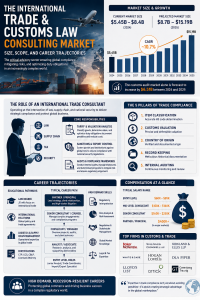
The international trade and customs law consulting market is currently valued between $5.45 billion and $8.4 billion, reflecting the absolute need for global compliance. Projections indicate a massive surge to over $15 billion by 2035, driven entirely by shifting tariffs, stringent sanctions, and complex supply chain restructurings. For businesses navigating cross-border commerce, engaging specialized regulatory experts is no longer optional; it is a strict requirement for mitigating audit risks and optimizing duty obligations. Understanding the sheer scale of this advisory sector reveals exactly how heavily modern global trade relies on precise, strategic legal intervention to maintain profitability across heavily regulated borders.
International Trade Consultant
Understanding the International Trade Consultant Ecosystem
The sheer complexity of moving physical goods across sovereign borders demands a highly specialized class of regulatory professionals who understand both domestic law and international treaties. Many enterprise leaders eventually ask exactly what an international trade consultant does when reviewing their ballooning logistics budgets and facing unexpected border delays. These experts operate at the exact intersection of supply chain management, federal tax law, and national border security. They systematically review complex tariff classifications, verify country of origin declarations, and construct intricate duty drawback optimization strategies designed to legally minimize financial obligations. By actively acting as a preemptive, intellectual shield against aggressive federal enforcement, an International Trade Consultant ensures that a company’s vast global shipping network remains entirely aligned with current government expectations. Their daily operational involvement permanently replaces guesswork with rigorous, data-driven legal certainty.
The modern regulatory environment absolutely mandates the use of Specialist Consultancy Services to avoid catastrophic border disruptions that can instantly halt manufacturing lines. Corporate executives frequently underestimate the massive financial penalties associated with simple, seemingly benign misclassifications on standard customs forms. Consequently, the overall demand for highly specialized consultant jobs has surged significantly over the past decade. Multinational corporations desperately seek experienced professionals capable of interpreting dense statutory updates published weekly by international governing bodies. These dedicated advisors actively conduct rigorous internal corporate audits, strategically structure voluntary disclosures to mitigate penalties, and completely redesign internal compliance frameworks before government agencies ever decide to initiate a formal, hostile investigation.
Navigating these distinct compliance requirements demands a highly structured, almost architectural approach to global corporate risk management. Enterprise directors quickly realize that you cannot effectively scale global operations without four types of highly specific advisory interventions: exhaustive tariff evaluation, real-time sanctions screening, rigorous export control management, and meticulous free trade agreement qualification. These foundational elements act collectively to protect the massive enterprise from severe legal exposure and potentially devastating financial penalties resulting from simple administrative oversight. Relying strictly on these formalized pillars of compliance guarantees that international shipments cross foreign borders smoothly, securely, and without attracting unwanted regulatory scrutiny.
- Tariff and Valuation Analysis: Senior consultants rigorously examine complex product specifications down to the molecular or engineering level to assign the exact correct Harmonized System (HS) codes and determine accurate customs valuation. This highly technical forensic process directly influences the final international tax burden and permanently prevents retroactive penalties during intense post-entry audits by regional customs authorities.
- Sanctions and Export Control Management: Dedicated regulatory specialists continuously cross-reference massive international shipping destinations against frequently updated global denied-party lists to ensure absolute, unquestionable compliance with strict national security directives. Failing to maintain this strict digital oversight can instantly trigger severe, unmitigable financial sanctions and lead to the immediate, permanent loss of critical international importing privileges.
Market Valuation and Regulatory Drivers
The massive financial footprint of this specialized legal and advisory sector provides a perfectly clear indicator of its absolute necessity in modern, hyper-connected commerce. Industry analysts formally value the global international trade and customs law consulting market at approximately $5.45 billion to $8.4 billion, depending heavily on how researchers explicitly categorize specific auxiliary legal services within the broader global trade ecosystem. Future overall economic projections aggressively estimate that this vital sector will rapidly expand to between $8.7 billion and $15.19 billion by 2035. Looking closely at specific, highly lucrative niches, the customs audit market alone is officially forecast to increase by an astonishing $6.51 billion between 2024 and 2029. This massive influx of corporate capital directly reflects a global industry aggressively shielding its fragile supply chains from sudden geopolitical shocks, unexpected trade wars, and the rapid, unpredictable realignment of international manufacturing hubs.
Establishing a perfectly compliant cross-border operation requires far more effort than merely filing the appropriate digital import paperwork at a local maritime port. Global logistics teams must systematically build the 5 bases for comprehensive trade management: accurate item classification, precise fiscal valuation, verified geographical origin, strict historical record-keeping, and continuous proactive internal auditing. Relying heavily on advanced consulting compliance software alongside seasoned human expertise, aggressive businesses actively restructure their global shipping routes to deliberately secure highly lucrative duty mitigation opportunities. This proactive, legally sound realignment fundamentally protects slim corporate profit margins from sudden, devastating tariff spikes while simultaneously ensuring that commercial goods cross physical borders without triggering intensive, highly costly regulatory inspections.
The international legal frameworks governing these massive financial transactions are notoriously fragmented, exceptionally dense, and constantly shifting beneath the feet of global operators. The ancient, historical concept of what is lex mercatoria—the traditional, unwritten body of commercial principles utilized by early merchants—has completely evolved into a highly rigid, heavily codified system of international treaties and strict national enforcement policies. Modern shipping firms must successfully navigate this complex, overlapping web of sovereign regulations by securing expert legal counsel truly capable of interpreting subtle, nuanced changes in multilateral free trade agreements. By structurally integrating specialized trade attorneys directly into their broader corporate risk management strategy, multinational corporations successfully avoid the utterly devastating financial consequences of prolonged government audits and sudden physical supply chain seizures.
Career Trajectories: Degrees, Demand, and Salaries
The formal educational pathway leading directly into this highly lucrative advisory sector remains surprisingly diverse, actively drawing ambitious professionals from various academic and technical backgrounds. Prospective university students frequently wonder what exact roles they can get with degree credentials concentrated heavily in international relations, logistics, or specialized corporate law. Top-tier university graduates frequently secure highly coveted, entry-level positions as junior trade analysts, corporate compliance managers, and dedicated import-export specialists at massive multinational manufacturing firms. The daily, intensive responsibilities specialist practitioners handle require a profound analytical capacity to perfectly interpret dense, archaic legal texts and successfully apply those nuanced findings directly to physical, fast-moving supply chain operations.
Transitioning directly from a general corporate compliance role into acting as specialized, formal legal counsel requires successfully navigating a notoriously rigorous, multi-year credentialing process. Many highly ambitious law students frequently ask if it is hard to become a lawyer specializing explicitly in cross-border trade, and the brutal reality involves grueling academic requirements followed immediately by passing a highly competitive state bar examination. However, those dedicated individuals who successfully secure these prestigious legal credentials quickly find themselves positioned inside an incredibly resilient, high-growth job market that remains completely insulated from standard macroeconomic downturns. Massive global corporations view these elite legal experts as absolutely indispensable corporate assets, remaining entirely willing to pay massive premium salaries to permanently protect their fragile global revenue streams from sudden regulatory interference.
The broader international legal industry frequently experiences massive, unpredictable shifts in specific practice area demands based largely on external global market forces. For instance, ambitious students deeply analyzing future trends often ask whether IP high-demand fields compare directly to physical trade compliance, and the underlying data reveals that both vital sectors are currently experiencing unprecedented, explosive parallel growth. The inevitable convergence of these two distinct legal specialties instantly creates an incredibly robust, highly competitive job market specifically for candidates possessing highly sought-after dual expertise. Understanding this intersection completely redefines how modern legal professionals intentionally construct their long-term career trajectories.
- Intellectual Property and Trade Synthesis: As massive corporations consistently manufacture advanced technological hardware overseas, they urgently require seasoned legal experts capable of defending both their physical shipping containers and their proprietary intellectual property at the sovereign border. This strict dual requirement practically forces disparate legal teams to actively collaborate, directly ensuring that cheap counterfeit goods are intercepted and destroyed immediately by vigilant customs officials.
- Rapid Career Advancement Tracks: Junior quantitative analysts who fully master complex tariff engineering strategies frequently experience massively accelerated promotional timelines when compared directly to standard corporate finance employees. By directly saving their grateful employers tens of millions of dollars through clever, legally sound duty drawback programs, these dedicated professionals practically guarantee their continuous upward mobility within the rigid corporate hierarchy.
Compensation Structures Across Leading Advisory Firms
The immense, undeniable financial risks associated directly with international trade disputes massively inflate the standard compensation packages aggressively offered to specialized legal practitioners. The general public frequently asks whether lawyers make a lot of money working inside this specific, highly technical niche, and the empirical industry data confirms a massively lucrative, unparalleled compensation structure for top-tier talent. A newly minted associate entering the competitive field will typically see a highly paid starting base salary well above standard corporate legal averages. This generous baseline compensation is then heavily supplemented by incredibly aggressive, metric-driven performance bonuses. As these dedicated professionals accumulate distinct operational experience, their total earning potential rapidly scales to perfectly match the massive corporate financial liabilities they successfully mitigate on a daily basis.
Pinpointing exactly how much pay a senior practitioner ultimately commands requires closely examining the specific operational size and geographic location of the aggressive hiring firm. A capable mid-level consultant independently managing a regional corporate compliance desk easily makes $100,000 a year, while senior equity partners operating at globally recognized legal institutions command significantly larger, highly publicized figures. In major coastal logistics hubs, it is not entirely uncommon to find that a highly specialized, partner-level job pays $400,000 or substantially more when that specific individual directly manages multinational litigation and highly complex government defense strategies. These massive premium salaries perfectly reflect the exact, quantifiable financial value these experts directly return to their corporate clients by systematically dismantling devastating government penalty assessments.
Securing these highly lucrative, career-defining positions usually requires gaining initial employment within the most prestigious, internationally recognized legal institutions. Competitive law students aggressively network to quickly discover who the top 10 law firms handling massive customs and trade disputes globally are, desperately aiming to secure prestigious summer internships that virtually guarantee future generational wealth. These elite organizations operate at the absolute pinnacle of the legal industry, fiercely representing massive pharmaceutical companies, global automotive manufacturers, and sprawling international technology conglomerates. Ultimately, the dedicated professionals who successfully secure roles in the highest salary brackets possess a truly rare, highly developed ability to seamlessly translate incredibly dense international tax law into highly aggressive, perfectly executable corporate supply chain strategies.

One thought on “The International Trade and Customs Law Consulting Market: Size, Scope, and Career Trajectories”