What "Shipment Will Be Cleared and Delivered by Broker" Means for DHL, FedEx, and UPS
 Import Export
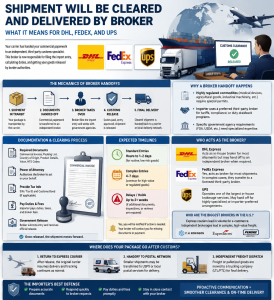
When tracking an international package, seeing the status "shipment will be cleared and delivered by broker" indicates that your standard carrier has legally handed over your commercial paperwork to an independent, third-party customs specialist. This external agent, chosen by either the importer or shipper, is now entirely responsible for filing the official import entry, calculating applicable tariffs, and negotiating the cargo's release with border authorities. You must immediately contact this designated broker to provide any missing tax identification, pay required import duties, and coordinate the final domestic delivery of your goods.
What Happens During a DHL Customs Clearance Event and How Long Does It Take?
A customs clearance event means border officials are actively reviewing your shipment's documentation and calculating applicable taxes. This standard procedure typically wraps up within 24 hours, provided your paperwork is flawless.
Once your package reaches the port of entry, agents immediately assess the commercial invoice. They verify the contents, check the harmonized system codes, and ensure nothing restricted is sneaking across the border. If everything aligns perfectly, the shipment sails through the DHL customs clearance process without a hitch. But red tape exists for a reason. Sometimes agents require a non-routine entry for high-value items, forcing a deeper manual review. Do not panic. Stalled tracking here is just standard operating procedure for international logistics.
What Happens After Your Package Clears Customs and When Will It Arrive?
After customs releases your shipment, it moves to a regional sorting hub before being dispatched for last-mile delivery. You can generally expect the package at your doorstep within one to three business days.
The hardest part is over. Border officials hand the cargo back over to the courier network. Next, the package boards a truck headed for a local distribution center. Depending on your specific route, a dedicated third-party broker might take the reins to finish the journey. Keep a close eye on your tracking status. Once you see the update confirming clearance, the logistics machine accelerates rapidly. Your goods are finally back on the road! Just make sure someone is available to sign for the delivery if the sender requires a signature.
Why Is Customs Taking So Long to Clear My Package?
Packages usually get stuck in customs due to missing commercial invoices, undervalued goods, or restricted items triggering physical inspections. Yes, it is completely normal for a package to remain held for four days or longer under these circumstances.
Border security operates strictly by the book. If your sender vaguely described the contents or skipped a mandatory tax ID field, agents will slam the brakes on your shipment immediately. Missing data forces them to pause the conveyor belt. They have to verify everything manually. Complex customs clearance protocols and strict guidelines from agencies like U.S. Customs and Border Protection mandate absolute precision. If officials suspect a wildly low price tag intended to dodge taxes, they will detain the box pending proof of payment. Fix these issues fast. Provide the requested paperwork so agents can finally green-light your cargo.
Will You Be Notified if Your Package Fails to Clear Customs?
Yes, you will receive an automatic notification via the carrier's tracking portal or a direct email if your shipment encounters a clearance failure. The tracking feed will clearly display a Shipment on Hold or "Clearance Exception" alert.
Couriers do not leave you guessing in the dark. The moment border agents flag an issue, the digital system triggers an alert. You might get a text message demanding additional details. Check your inbox. Sometimes, a third-party broker reaches out requesting a specific safety data sheet or import license required by local law. Authorities governing global commerce, such as the International Trade Administration, strictly enforce these documentation standards. Ignoring these warnings is a terrible idea. If you fail to respond promptly, authorities will either return the package to the sender at their expense or outright destroy the goods. Always monitor your alerts closely.
Which Carrier Delivers DHL Packages, and Is It Faster Than FedEx?
DHL handles most international deliveries through its own yellow fleet, but it frequently contracts USPS or independent couriers for final-mile delivery in rural areas. DHL Express generally matches or beats FedEx on international routes, though domestic speeds vary.
Speed depends heavily on the specific service tier you purchased. DHL built its entire reputation on aggressive, rapid international transit. They completely dominate certain European and Asian shipping corridors. However, stateside deliveries can be a different story entirely. If you live far outside a major metropolitan hub, DHL might just drop your package at the local post office for that final stretch. This handoff definitely adds a day or two to the timeline. FedEx and UPS boast much denser domestic networks inside the United States, giving them an edge locally. Choose your carrier based strictly on the destination map.
The Mechanics of Broker Handoffs in Global Shipping
Most routine international packages pass effortlessly through automated border checkpoints because global couriers utilize their own massive internal brokerage divisions. However, highly specific situations trigger a mandatory handover to an external entity. If you are importing highly regulated commodities like medical devices, agricultural goods, or heavy industrial machinery, the government often requires specialized permits that standard express couriers simply do not have on file. The Food and Drug Administration (FDA) or the Department of Agriculture enforces extremely strict admissibility standards that require deep, specialized product knowledge. In these specific instances, the primary carrier explicitly transfers the commercial invoice and physical custody of the goods to a designated non-FedEx clearance broker who possesses the exact licenses required to clear that specific commodity. This third-party expert legally steps in to satisfy the stringent requirements of federal agencies, ensuring that dangerous or non-compliant goods never reach the domestic market.
Many massive corporate importers intentionally configure their logistics profiles to bypass carrier-default brokers entirely. They establish permanent, high-volume contracts with specialized brokerage firms to maintain strict control over their product classification codes and duty drawback programs. For example, a heavy equipment manufacturer might explicitly instruct their suppliers to use routing options that force a third-party handover. By doing so, the importer ensures their preferred external agency handles the complex tariff math, completely overriding the default carrier process. In this scenario, the dreaded Amazon on-hold exception might momentarily flash on a retail tracking screen, simply signifying that the automated retail network is pausing to wait for the independent agency to physically assume control of the customs filing.
Understanding the specific DHL meaning behind this tracking update requires recognizing the strict legal separation between international transportation and government compliance. DHL Express transports the physical box across the ocean, but they will not illegally force a shipment through border control if the importer of record explicitly demands a third-party agent. Once the documents are legally transferred, the express courier loses all direct control over the speed of the regulatory review. The external agent must now interface directly with border agents, carefully validating the harmonized tariff codes and proving the cargo matches the declared commercial value.
Documentation Requirements and Clearing the Next Step
To successfully navigate border control, the independent agency requires an incredibly specific set of commercial data as outlined in the FedEx international customs clearance guidelines. You cannot simply hope the box slides through undetected. The broker needs a hyper-detailed commercial invoice that explicitly lists the country of origin, the precise material composition of every single item, and the accurate transaction value in the purchasing currency. Providing vague product descriptions like "machinery parts" or "apparel" guarantees an immediate regulatory hold. The information for shipping must be microscopically accurate, matching the financial wire transfers down to the exact decimal point to legally prove to government auditors that you are not attempting to evade lawful import taxes.
Proactive communication dictates exactly how to speed up customs clearance when utilizing an independent agent. You must legally grant the firm a signed Power of Attorney, which explicitly authorizes them to conduct customs business on your behalf. Without this legally binding document, the agent cannot even begin typing your tax identification number into the government's digital portal. The very moment you see the broker handover status appear on your tracking screen, you must proactively call the agency to confirm they have your employer identification number (EIN) and a valid customs bond on file. Sitting back and waiting for them to hunt you down only adds unnecessary days to the transit timeline.
Once the paperwork is verified and the tariffs are calculated, you are responsible for immediately funding the duty payment. The government will not release commercial freight on credit. Clearing the next step requires wiring the exact tariff amount, plus the broker's service fee, directly to the agency so they can electronically submit the final entry to Border Patrol. Only after paying duties and receiving the official release message from the government will the physical box be legally authorized to move. For further details on how taxes and duties are assessed by third-party agents, importers should review the DHL customs clearance and declaration FAQ to understand their exact financial liabilities. At this exact point, a DHL shipment or heavy freight pallet is officially cleared for domestic transit and handed over to the final-mile trucking network.
Expected Timelines: How Long Does It Take to Receive a Package?
Importers constantly stare at their screens, frantically wondering, "Why is FedEx customs taking so long?" The reality of global trade is that government border agents operate entirely on their own schedule, heavily influenced by seasonal port congestion, randomized security sweeps, and localized staffing shortages. While a standard electronic entry for basic consumer goods might be processed in a matter of hours, formal commercial entries for high-value merchandise require intense manual scrutiny by human officers. Yes, it is completely normal for a package to be in customs for 4 days when dealing with complex tariff structures, anti-dumping investigations, or FDA holds.
If a shipment lacks a proper commercial invoice or gets flagged for an intensive x-ray examination, the timeline stretches exponentially. Importers frequently panic when their inventory gets stuck in customs for 2 weeks, assuming the cargo has been lost or destroyed. In these severe cases, the holding facility securely locks the freight inside a bonded warehouse while border officials demand supplemental documentation from the manufacturer. Will I be notified if my package doesn't move? Absolutely. Your designated agent will actively contact you via phone or email to demand the specific commercial records, material safety data sheets, or manufacturer affidavits the government is legally requiring before releasing the hold.
So, exactly how long does it take to receive a package after it clears customs? Once the government issues the official release notice, the timeline shrinks dramatically. Once the status officially updates to indicate customs clearance is complete, the bonded facility immediately releases the freight to the dispatch yard. Depending on the pre-arranged logistics contract, the cargo is either tendered back to the original express courier or loaded onto an independent domestic trucking line. Generally, you can expect the freight to arrive at your loading dock within 24 to 48 hours. The tracking system will rapidly update to indicate the cargo has departed from a facility, confirming it is currently rolling down the highway toward your final destination.
Roles of Major Carriers: Who Acts as the Broker?
New importers frequently ask, "Does FedEx act as a broker for standard international shipments?" The answer is a definitive yes. For the vast majority of routine, low-value consumer imports, massive global couriers operate entirely as in-house, default brokers. They leverage massive electronic data interchange networks to seamlessly transmit cargo manifests to border agencies while their airplanes are still physically crossing the ocean. This aggressive, in-flight pre-clearance strategy allows them to process millions of small parcels daily without missing a beat. Similarly, when retail buyers ask, "Is UPS a customs broker?", they are often surprised to learn that UPS operates one of the absolute largest and most heavily integrated customs brokerage divisions on the entire planet.
Determining exactly who the biggest broker is in the US markets involves analyzing sheer transaction volume. The major express couriers handle an incomprehensible amount of daily digital entries, heavily dominating the sheer volume of low-value e-commerce clearance. However, independent giants like C.H. Robinson, Expeditors, and specialized corporate compliance firms command the massively complex, high-value commercial freight sector. These specialized firms handle the brutal, highly technical commodity classifications that the automated courier systems are simply not designed to process. When a massive aerospace manufacturer imports millions of dollars in titanium turbine blades, they absolutely refuse to rely on automated retail courier algorithms, opting instead for dedicated, highly specialized human compliance officers.
The logistical handover following a successful government release requires absolute precision to prevent warehouse bottlenecks. Where does your package go after customs? The final routing depends heavily on the specific contractual terms established between the shipper, the importer, and the underlying freight forwarders long before the cargo ever left the origin factory. Depending on the size, weight, and chosen service tier of the imported goods, the destination facility will execute one of three highly specific final-mile delivery protocols to get the freight to your loading dock.
- Return to the Express Courier: In many standardized broker-select programs, the independent agent strictly handles the digital paperwork while leaving the physical box in the courier's physical possession. Once the digital release is secured from federal authorities, the original carrier resumes control and the tracking board updates to show normal domestic transit toward your address.
- Handover to Domestic Postal Networks: For lighter, economy-tier shipments originating overseas, the cargo might be injected directly into local postal streams to reduce delivery costs. In these highly common instances, an independent customs agent handles the legal federal entry at the port of arrival, and then directly hands the legally cleared parcel to USPS for cheap residential distribution.
- Independent Freight Dispatch: For heavy, palletized commercial goods, the third-party agent will physically extract the cargo from the port and load it onto a dedicated flatbed or LTL (less-than-truckload) carrier. This action completely removes the shipment from the original courier's automated network, requiring you to track the final delivery through a completely different regional trucking portal to monitor its arrival.
Ultimately, navigating international supply chains requires a firm understanding of exactly who is legally responsible for your goods at every stage of the journey. Whether you rely on an automated carrier network or aggressively utilize an independent compliance expert, proactive communication remains your absolute best defense against border delays. By preparing pristine commercial documentation, promptly paying assessed tariffs, and maintaining direct contact with your assigned agent, you guarantee that your global shipments arrive smoothly, legally, and entirely on schedule.
Related Post: How Irish Beef Exports to the UK Are Shaping Industry Quality and Trade Statistics

One thought on “What "Shipment Will Be Cleared and Delivered by Broker" Means for DHL, FedEx, and UPS”