Global Screw Compressor Market Analysis: Regional Demands and Top Manufacturers
 Import Export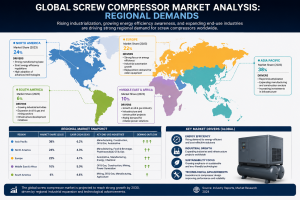
Global Screw Compressor Market Analysis
The global screw compressor market is currently valued at approximately $13.97 billion and is projected to experience robust growth fueled by heavy industrial automation and strict energy-efficiency regulations. Asia-Pacific stands as the undisputed geographical leader, capturing over 41% of global revenue due to immense manufacturing expansion in China and India. Upgrading from legacy systems to advanced variable-speed drive (VSD) and oil-free architectures remains the most actionable strategy for factory managers seeking to slash massive electricity overheads and comply with tightening carbon mandates. By aggressively adopting these modernized rotary systems, manufacturers immediately secure reliable compressed air while avoiding catastrophic production downtime.
When analysts review a comprehensive screw compressor market by countries and regions graph, the profound dominance of the Asia-Pacific region becomes instantly apparent. China aggressively drives regional volume consumption through vast factory networks, while India? acts as a rapidly growing hub for automotive and electronics manufacturing. Similarly, heavy mining operations in Australia? Require ruggedized, high-capacity machines capable of withstanding brutal environmental conditions. These distinct regional demands have pushed global production volumes well past the previous benchmarks set during the industrial screw 2020 production cycles, forcing equipment builders to rapidly scale their supply chains across all five major continental markets.
North America and Europe also maintain tremendously powerful positions, though their growth is characterized by upgrading existing infrastructure rather than greenfield construction. In the United States, strict environmental compliance and advanced petrochemical operations demand highly engineered, oil-free systems. European nations, led by Germany's heavy engineering sector, prioritize extreme carbon-reduction frameworks, legally mandating the removal of inefficient legacy hardware. This aggressive push toward sustainability ensures that Western markets remain highly lucrative for vendors selling premium-tier, energy-efficient rotary technologies, despite the massive volumetric output of Chinese and other Asian industrial centers.
Technical Architectures and Operational Realities
Industrial facility operators frequently ask about the three different types. Of the screw compressors available on the commercial market, dknp xsu typically categorizes them into oil-injected, oil-free, and water-injected configurations. Oil-injected models dominate general manufacturing due to their exceptional cooling properties and lower initial capital costs, while oil-free systems are strictly required in pharmaceuticals, food processing, and semiconductor fabrication where even microscopic hydrocarbon contamination causes disastrous product spoilage. Water-injected designs serve as a highly specialized middle ground, utilizing water for cooling and sealing to deliver pure air without the extreme thermal challenges associated with dry-running oil-free blocks.
A common operational question regarding rotary technology is: Do they run constantly? Unlike traditional piston compressors that require frequent rest periods to dissipate extreme heat, a properly sized rotary screw machine is specifically engineered for a 100% duty cycle, meaning it can operate continuously 24 hours a day without catastrophic failure. However, buyers must understand the inherent disadvantages compressors face when severely oversized for a specific application. If a massive system is forced to run at a mere fraction of its intended capacity, it will constantly cycle on and off, wasting tremendous amounts of electrical energy, accumulating internal condensation, and violently wearing down internal mechanical bearings long before their scheduled maintenance intervals.
When assessing equipment longevity, maintenance managers naturally wonder which lasts longest. Among the various compressed air technologies. A heavily built industrial rotary screw, provided it receives rigorous preventative maintenance, regular oil sampling, and timely filtration replacements, will easily exceed 60,000 to 80,000 running hours before requiring a major airend rebuild. Buyers sizing a mid-range 20 hp system for a moderately busy fabrication shop can expect a decade or more of flawless performance, answering the persistent question of exactly how long it will last. Under normal, clean factory conditions. Proper ventilation and aggressive moisture control remain the absolute most effective methods for extending the mechanical lifespan of any rotary system.
Evaluating the Titans: Global Manufacturers and Brand Ownership
The highly consolidated nature of the heavy machinery sector leads procurement teams to constantly ask, who is the largest manufacturer in the world? The answer is undeniably the Swedish conglomerate Atlas Copco, which commands a massive footprint across all major global territories. Financial analysts and competitors alike respect the sheer scale of the organization, prompting many to research exactly who the owner of Atlas Copco is. As a publicly traded entity on the Nasdaq Stockholm exchange, it operates entirely independently, acquiring numerous smaller regional brands over the decades to thoroughly saturate different pricing tiers and demographic markets. The parent company strictly controls its manufacturing quality, ensuring that its flagship products maintain their premium status globally.
This aggressive acquisition strategy often confuses retail buyers attempting to navigate the top 10 manufacturers in the industry. For example, some buyers wonder who owns the Copco brand in China. operations, assuming a separate entity controls the Asian manufacturing wing. In reality, the Swedish parent company directly owns and heavily manages its Chinese facilities, ensuring that the domestic products built in Shanghai meet rigorous corporate tolerances. The landscape is crowded with famous company brands commonly used across heavy industry, including massive conglomerates like Ingersoll Rand, Kaeser, and Hitachi Global Air Power, all battling fiercely for dominance in the lucrative heavy manufacturing and energy extraction sectors.
Ultimately, who makes the best compressor? is a highly subjective exercise heavily dependent on the specific industrial application, regional service availability, and capital budget. A massive offshore oil platform requires vastly different engineering tolerances than a small, climate-controlled automotive paint booth. While certain legacy brands carry immense historical prestige, modern engineering standards have drastically narrowed the performance gap between top-tier competitors. The smartest purchasing decision almost always hinges on the quality and responsiveness of the local distributor's service network, as even the most brilliantly engineered air conditioner becomes a massive liability if the factory technician takes three weeks to arrive with replacement parts.
Manufacturing Origins: From American Iron to Global Sourcing
Nostalgic plant managers frequently search for domestic equipment, persistently asking Are there American builders left, and which specific models are genuinely made in the USA? While companies like Quincy and Sullair still maintain substantial assembly operations and engineering headquarters within the United States, the brutal reality of modern globalized manufacturing means that very few industrial machines are forged entirely from domestic components. Often, heavy cast-iron air ends are machined in specialized German or Italian foundries, electronics are sourced from advanced Asian tech hubs, and the final assembly, testing, and painting occur in Alabama or Indiana to legally satisfy domestic sourcing requirements.
The consumer and light-industrial markets rely even more heavily on international supply chains, prompting DIY enthusiasts to ask where Mastercraft compressors are made. Alongside other heavily marketed retail brands. Buyers often ask if the cheaper imported alternatives are any good. The vast majority of these entry-level units are rapidly mass-produced in massive Chinese factories, built to satisfy specific price points rather than decades of continuous industrial abuse. Similarly, buyers investigating the legacy of Campbell Hausfeld discover a brand that transitioned from a heavy American agricultural manufacturer into a highly recognizable consumer label, relying heavily on globalized components to compete in the extremely aggressive big-box retail environment.
Europe continues to heavily influence global rotary design, and engineers often seek out some popular Italian brands. Like Mattei, which famously produces exceptionally durable rotary vane alternatives to the traditional twin-screw design. Whether an importer is evaluating specialized European hardware or massive shipments of Chinese equipment, verifying the underlying engineering pedigree is strictly necessary. Plant engineers must look past the superficial paint color and aggressively investigate the actual origin of the internal rotary block and electrical contactors, as these specific components dictate the true reliability and long-term viability of the entire compressed air system.
Cost Dynamics and Strategic Procurement Methods
To accurately determine what the current price of an air compressor installation entails, financial planners must look far beyond the initial capital invoice. A 100-horsepower rotary screw might cost anywhere from $20,000 to $45,000 upfront, but the electricity required to run that machine continuously will easily exceed its purchase price within the very first year of operation. Consequently, when executives ask Which is the most expensive brand? On the market, they are often asking the wrong financial question. A premium European VSD system might demand a staggering initial premium, but its ability to precisely match electrical draw to fluctuating factory air demand saves hundreds of thousands of dollars over its operational lifespan.
Budget-conscious buyers frequently ask, is Ingersoll Rand cheap compared to premium European alternatives? The answer requires a deep understanding of their incredibly broad product portfolio, which ranges from highly affordable, mass-market reciprocating units to incredibly complex, heavily engineered centrifugal systems designed for massive petrochemical refineries. Determining whether a specific type? For a machine to be reliable all around requires evaluating the exact tier of equipment being quoted. The same manufacturer can produce a heavily cost-optimized unit for light manufacturing alongside an absolutely indestructible powerhouse engineered for brutal, continuous mining operations.
Finally, when a frustrated plant manager asks where to buy an industrial system quickly, the answer lies strictly with authorized regional distribution networks rather than internet retailers. Buyers must prioritize local service contracts, readily available spare parts, and guaranteed response times to ensure their factory remains operational. Purchasing a heavily discounted, unknown brand online often results in total catastrophe when a proprietary sensor fails, and the manufacturer offers zero local support. Industrial operators must demand absolute quality and verifiable local service infrastructure to select the specific hardware that will quietly and efficiently power their facility for the next twenty years.