How to Declare Medication at U.S. Customs: What to Declare and Carry
 Import Export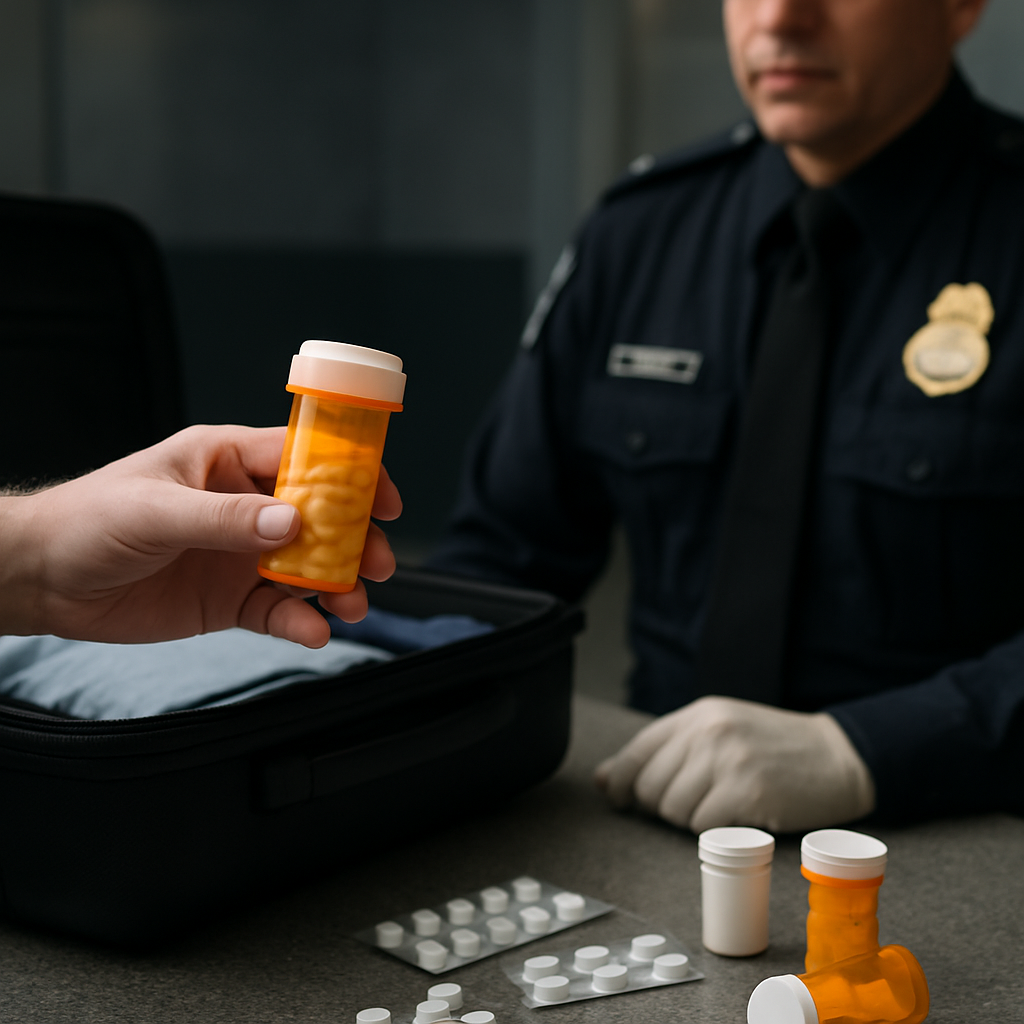
When entering the United States, declare all drugs, medicinal products and similar substances to the appropriate U.S. Customs and Border Protection (CBP) official. CBP also advises travellers to carry these items in their original containers. Declaring a medicine does not guarantee that it is admissible: disclosure to CBP and whether a drug may be imported are separate questions.
How to declare medication at U.S. customs
Tell the CBP official that you are carrying medication and disclose the relevant products. Keep them in their original containers, as CBP advises, and follow any instructions the official gives you. The [CBP guidance for travellers entering the United States with medication](https://www.help.cbp.gov/s/article/Article-1444?language=en_US) is the source for these instructions.
The supplied CBP guidance does not specify a particular declaration form, lane or scripted procedure for medication. Do not assume you need to use a particular form or make a specific statement: disclose the medication to the appropriate official and follow their directions.
Original packaging is practical preparation, not permission to bring a medicine into the country. It does not prove that a product is legal to import or ensure that it will be admitted. Requirements can depend on the particular medicine and circumstances, so check the applicable rules with the relevant U.S. authorities before travelling if you are unsure.
What does it mean to declare medication?
In this context, to declare medication means to tell the appropriate customs official that you are carrying it. You disclose that you are carrying drugs, medicinal products or similar substances rather than leaving that information unstated.
Declaration is not the same as approval. Telling CBP about a medicine does not itself establish that the medicine can be brought into the United States. Customs processing and the rules governing whether a drug may be imported are distinct matters; the [FDA’s personal-importation guidance](https://www.fda.gov/industry/import-basics/personal-importation) explains the FDA’s role and the limits that can apply to imported drugs.
Medication you carry versus medication sent by mail or courier
Medication in your luggage when you travel is different from medication sent to you as an international mail or courier shipment. The CBP advice to declare medication and carry it in original containers concerns travellers entering the United States; it should not be treated as a complete clearance procedure for a parcel.
For medication sent by mail or courier, the FDA suggests including documentation showing that the medicine is for your own use while visiting the United States. The agency gives examples such as documentation from a physician. This is a suggestion about supporting documentation, not a guarantee that a shipment will clear customs or that the medicine is admissible.
The FDA also states that foreign nationals visiting the United States for purposes such as vacation, study or work may bring or ship a 90-day supply of drug products. If a foreign national’s stay is longer than 90 days, the FDA says additional medication may be sent to them. This statement is limited to the foreign-national visitor context described by the FDA; it should not be read as a universal allowance for every traveller, medicine or situation.
Check the rules for your particular medicine before travelling
Rules may vary by medication. The information here does not set out detailed requirements for controlled substances, medical cannabis or other specific categories. Check the current requirements with the relevant U.S. authorities for the exact medicine you plan to carry or receive, and do so before travelling or arranging a shipment.
Airport security screening is separate from customs inspection. Advice about how to present medication to the Transportation Security Administration (TSA) at a security checkpoint is not, by itself, a CBP customs declaration rule. Follow the relevant agency’s instructions for the process you are going through.