
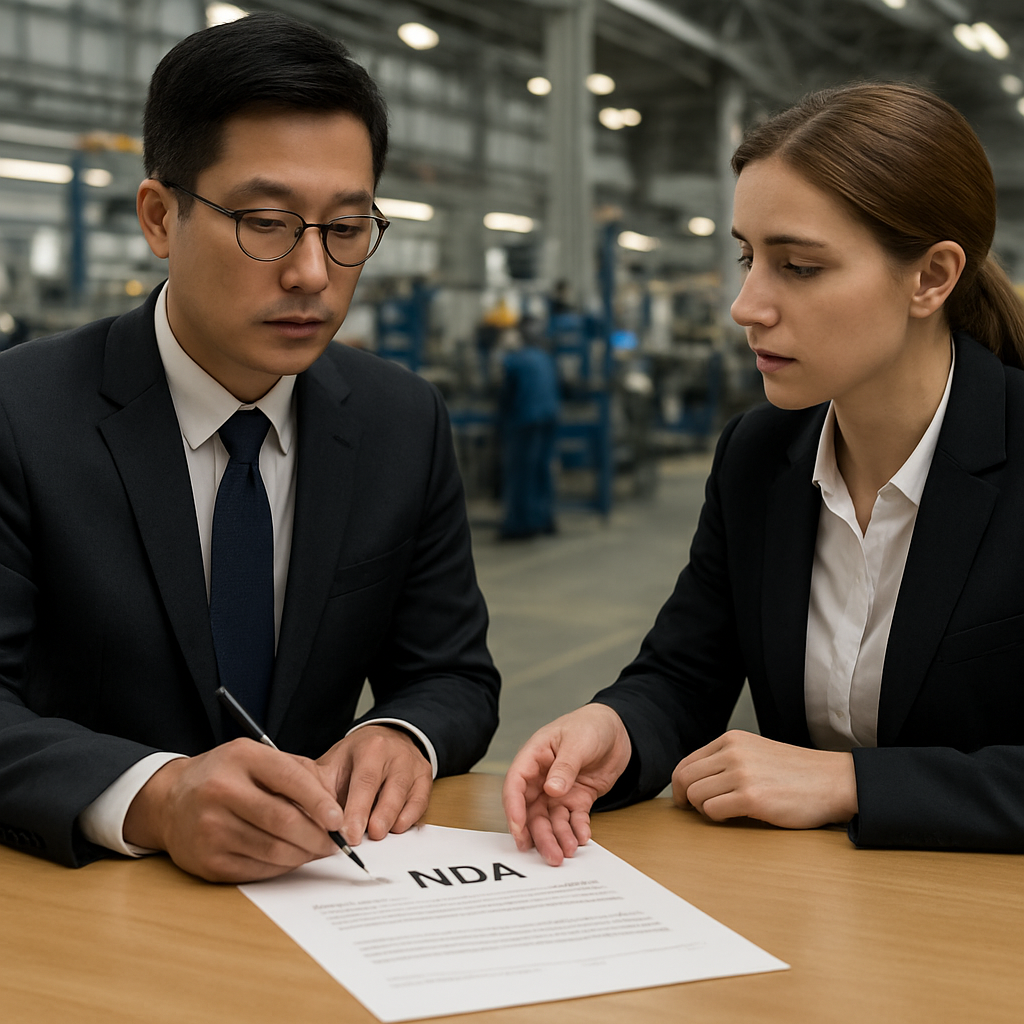
If you are visiting a Chinese factory and plan to share product details, drawings, pricing assumptions, supplier requirements, or a new design idea, an NDA can be a sensible first step — but it is not always the best or strongest protection on its own. For many China sourcing situations, the real question is whether you need a simple confidentiality agreement, or a China-oriented agreement that also restricts use and circumvention. Before you hand over anything sensitive, make sure the document is actually enforceable in China, and do not rely on a generic U.S.-style form without checking it first.
Should You Use an NDA for a China Supplier Factory Tour?
Yes, if the factory tour will involve any confidential exchange. An NDA is meant to protect information you disclose during the visit or in the lead-up to the visit, such as product information, pricing assumptions, technical drawings, supplier requirements, or a product concept you have not launched yet. If the tour is just a walk-through with no sensitive discussion, an NDA may not be necessary. But once you start showing prototypes, drawings, specifications, or commercial terms, you should decide in advance what information must stay confidential and who is allowed to see it.
The key practical question is not whether you are “touring” a factory. It is whether the meeting is only observation, or whether it includes confidential discussions and document sharing. That scope decision should drive the agreement you use. A narrow disclosure-only promise may be enough for a limited exchange, while a deeper product-development conversation usually calls for stronger protection.
For buyers who need help finding and vetting the right contact before the visit, it is worth first reading our guide on how to get in touch with a Chinese manufacturer. If you are not sure whether the company is a real factory or a broker, that step matters before you decide how much to disclose.
NDA vs NNN for China: Which Document Is Better for Factory Visits?
For China factory visits, the label alone does not decide the outcome. The practical difference is what the agreement actually restricts. An NDA is usually aimed at non-disclosure: it says the other side should not reveal your confidential information. An NNN agreement goes further by adding non-use and non-circumvention, which can matter when you are discussing a new design, technical drawing, or product idea with a factory.
That is why many buyers make the mistake of assuming a standard NDA is enough for China. In some situations, it may be sufficient for a limited confidential exchange. In others, especially where you are sharing development information or trying to keep a factory from using your concept elsewhere, broader protection may be more appropriate. A China-specific approach is often preferred because the practical risk is not just leaking information — it is also use of the information and bypassing your business relationship.
The best rule of thumb is simple: if the factory visit is only a brief screening meeting, an NDA may be adequate. If the visit is part of a real product development or sourcing relationship, and you are showing detailed materials, drawings, or a new product concept, consider whether you need something stronger than a basic confidentiality form.
What Makes a Manufacturing NDA Enforceable in China?
The first thing to understand is that a U.S.-style NDA does not automatically hold up under Chinese law. That is the central legal caution repeated by practitioners working on China sourcing matters. Before you rely on any document, confirm that it is actually binding in China and drafted for the jurisdiction where you may need to enforce it.
That does not mean an NDA is useless. It means the document must be prepared with China in mind rather than copied from a domestic template and translated. In practice, that means focusing on:
- the governing law and forum structure;
- clear definitions of confidential information;
- practical restrictions that match the actual relationship;
- and wording that can support enforcement rather than just signalling intent.
Legal guidance on manufacturing NDAs in China consistently stresses that buyers should check enforceability first, rather than assuming a standard Western form is enough. In other words, the legal design of the document matters as much as the signature on it. A useful starting point is the discussion in 3 key steps before signing a manufacturing NDA in China, which highlights the need to confirm that the agreement is legally binding in China before relying on it.
If your situation involves a new concept, technical data, or any material that would be hard to recover once disclosed, it is worth assuming that a generic form is not enough. The safe approach is to review the agreement for China-specific enforceability before the tour.
What Information Should You Protect Before Visiting a Chinese Factory?
The evidence around China sourcing is quite clear about the categories buyers usually need to protect. Before a factory visit, think carefully about whether you may be sharing any of the following:
- product information;
- pricing assumptions;
- technical drawings;
- supplier requirements;
- new designs;
- product ideas.
These are the exact kinds of information that often come up before or during a visit, especially when a buyer is screening suppliers, requesting quotations, or discussing how a product could be made. The more technical and commercially sensitive the information, the more important it becomes to limit access and use.
The practical distinction is this: if you are only discussing a narrow, low-risk set of details, a standard confidentiality promise may be enough. If you are opening up design files, specifications, or a product concept that gives a factory real commercial leverage, you should treat the disclosure as a higher-risk event and use stronger protection. For many importers, the factory visit is not just a tour; it is the point at which the commercial relationship becomes real.
Where the supplier relationship is still unclear, it is wise to verify the business first. You can use our guide on how to verify a Chinese factory so you know whether you are dealing with an actual producer or a middleman before sharing confidential material.
How Factory Tours Fit Into China Sourcing Trips and Trade Fairs
A factory tour is usually one part of a wider sourcing trip, not a standalone event. Buyers often combine supplier meetings, factory visits, and product discovery at trade fairs or industry exhibitions. That broader flow matters because it affects when and why you share information.
At a trade fair, a buyer may shortlist potential suppliers, compare capabilities, and arrange follow-up factory visits. At the factory, the buyer may then discuss specifications, pricing assumptions, or development details. So the tour is often the point where a promising contact becomes a serious sourcing opportunity.
This is why trade-fair planning and factory-visit planning belong together. If you meet suppliers at an exhibition floor and later visit their facilities, you should think ahead about what information each stage requires. In the first meeting, you may only need a broad outline. On the factory floor, you may need more detailed confidential discussion — which is exactly when an NDA or stronger agreement becomes more important.
If you are building your sourcing process from the ground up, the article on getting a sourcing agent in China may also help, especially if you want local support arranging meetings and factory visits.
Where trade fairs fit into the process
Trade fairs are useful for discovering suppliers, comparing product ranges, and setting up in-person meetings. They can shorten the search stage, but they do not replace verification or due diligence. A buyer may meet several potential factories at one event and then choose only a few for on-site visits. That is where document control becomes important: the more serious the candidate, the more carefully you should decide what to disclose.
How to Find the Right Chinese Supplier Before a Factory Tour
Finding a Chinese supplier is not the same as finding the actual factory. That distinction is one of the most important practical lessons in sourcing. China has many capable manufacturers, but the market also contains trading companies, brokers, and agents who can present themselves as factories while standing between you and the real producer.
That means the first step is not only “who can make this product?” It is also “who am I actually speaking to?” If the contact is a middleman, your trust, pricing expectations, and confidentiality risk all change. You may not be dealing with the party that will manufacture the product at all, which makes your NDA decision and your disclosure strategy more complicated.
Live sourcing guidance notes that finding the real factory that makes your product to the right standard at an honest price is often the hard part. The market is full of intermediaries, and the buyer can lose money by assuming the first contact is the manufacturer. Before you schedule a tour, check the company’s legal identity, factory location, and production capability. That is also why a proper supplier verification step should come before any meaningful document sharing.
If you need a practical verification workflow, see how to verify a Chinese factory and use that information to decide whether an NDA is even the right next step.
Can You Negotiate Price With Chinese Manufacturers?
Yes, price negotiation is often part of the sourcing process, but it should be handled as part of a broader cost comparison rather than a simple haggling exercise. The right question is not only whether you can push for a lower unit price. It is whether the factory’s quote makes sense once you compare it with alternatives and calculate the full sourcing cost.
That broader approach matters because a low quoted price can be misleading. A supplier may offer a low unit cost, but the real cost picture includes duties, freight, customs clearance, inland delivery, tooling, engineering changes, inspection, defect risk, and warranty exposure. If you only focus on the unit quote, you may miss the true landed cost.
So yes, negotiation is normal. But the best negotiation strategy is usually based on clarity: compare apples with apples, ask for a complete quote, and understand what is included. If you are visiting a factory, use the visit to test the supplier’s capability, responsiveness, and willingness to clarify costs — not just to chase the lowest number.
Why Is China Manufacturing Still So Cost-Competitive?
China is no longer cheap for the same reasons it once was. Rising wages and tariffs have reduced the old “cheap labour only” story. What still makes China competitive for many products is something deeper: ecosystem density, supply-chain depth, tooling availability, and the breadth of factory capability in one place.
That ecosystem matters because a buyer can often find multiple capabilities in the same region or even the same city — from manual low-cost workshops to highly automated export-oriented factories. For many products, that means faster tooling, easier access to parts and vendors, and more flexibility when a design needs to change.
This is why China can still be cost-competitive even when the headline labour-cost story no longer explains everything. For mature products, the supply base may already be there. For complex products, the ecosystem can support the combination of components, assembly, finishing, and scale that other markets struggle to match.
It also helps to compare total landed cost rather than only the factory quote. One illustrative comparison in live research shows how duties, freight, clearance, inland delivery, inventory, engineering changes, defects, and warranty exposure can change the final result. In some cases, China remains competitive even after these costs; in others, the total picture may favour another market. The right answer depends on the product, route, and risk profile, not on the factory price alone.
For a broader view of the current sourcing environment, see the China sourcing ultimate guide. It explains why the country’s manufacturing strength is tied to ecosystem depth and why the hard part is often finding the actual factory rather than just a contact.
What Costs and Cost Drivers Matter in a China Supplier Visit?
There is no verified standard price for a China supplier factory tour in the research supplied here, and there is no verified standard fee for an NDA in this context. So the real cost question is not “What does the tour cost?” as much as “What is the full cost of sourcing this product from China?”
The major cost drivers to watch are:
- the factory quotation itself;
- duties and tariffs;
- international freight;
- insurance;
- customs and port charges;
- domestic delivery;
- tooling;
- engineering changes;
- inspection;
- defects;
- warranty exposure;
- inventory carrying cost.
That is the right context for evaluating a visit. A tour may be useful, but it is not the main cost driver. The real cost of a sourcing decision sits in the product economics and the risk of getting the wrong supplier, the wrong specification, or the wrong legal protection. A cheap visit can still lead to expensive mistakes if you disclose too much to the wrong party or fail to verify the factory first.
If you are comparing manufacturing locations more broadly, a useful reminder from current sourcing analysis is that lower unit prices do not automatically mean lower total cost. Freight, duties, lead times, and defect risk can change the answer quickly. In other words, the cheapest quote is not always the cheapest outcome.
Practical Checklist Before You Sign Anything
- Confirm whether the meeting is just a tour or a confidential product discussion.
- Verify that the company is a real factory, not only a broker or trading company.
- Decide exactly what information you will share: product data, pricing assumptions, drawings, requirements, or design concepts.
- Choose the right document type: a simple NDA for limited disclosure, or stronger China-oriented protection where use and circumvention matter.
- Check that the agreement is legally useful in China before relying on it.
- Keep the sourcing decision focused on total landed cost, not just the tour or NDA itself.
If you are still early in the process, a useful next step is to review what Trade Assurance covers. It can help you understand what online platform protections do and do not solve before you move into in-person meetings and factory visits.
In short: use an NDA when the factory tour involves confidential information, but do not stop there. For China sourcing, the stronger question is whether the agreement is the right one for the kind of information you are sharing and whether you are dealing with the actual factory. That is what protects both your IP and your sourcing budget.