
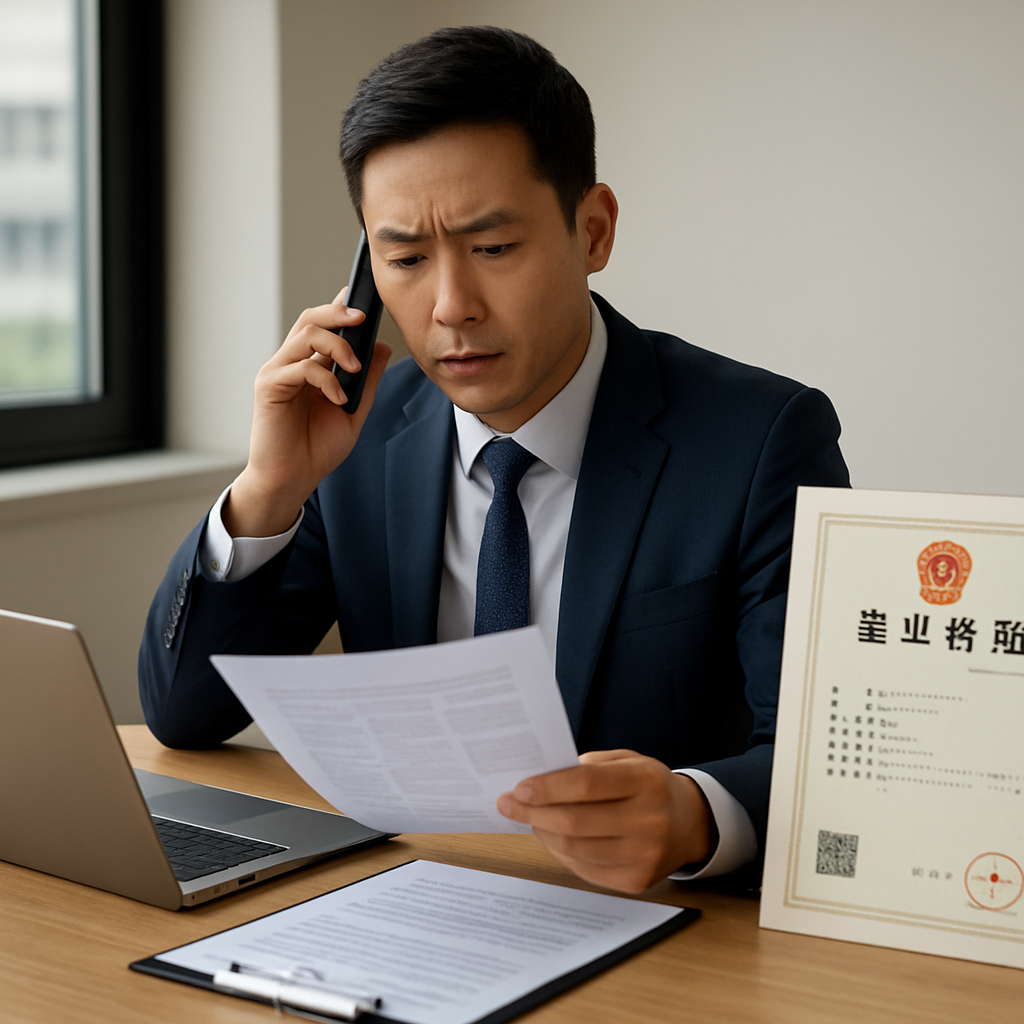
If you are trying to verify a Chinese factory by phone number, the short answer is this: a phone number alone cannot prove legitimacy. Use the call as your starting point, then confirm the company’s Chinese legal name or USCC, request the business licence, and match every detail against the official registry in GSXT / NECIPS before you pay.
The goal is not just to prove that a company exists. It is to confirm that the entity you are speaking to on the phone is the same entity shown in the official record, and then decide whether it is a genuine manufacturer, a trading company, or simply not a supplier you should trust.
How to verify a Chinese factory using its phone number
A phone call is useful because it lets you test whether the contact details, company name, and paperwork all line up. But the call itself does not establish legitimacy. A real business can have a weak website or a generic email address, and a scammer can also answer a phone call. That is why the number should be treated as the first checkpoint, not the final proof.
Use the call to ask for four things straight away: the company’s Chinese legal name, the 18-character Unified Social Credit Code (USCC), a full copy of the business licence, and the registered address. If the person only gives you an English trading name, evasive answers, or partial details, slow down. The Chinese legal name or USCC is much more reliable than an English name for verification, because that is what the official registry uses.
What to ask for on the call
- The company’s exact Chinese legal name
- The 18-character USCC, if available
- A colour copy of the latest business licence
- The registered address and legal representative
- A fixed-line number and professional email address
Then compare the phone response with the licence and registry record. If the name, address, legal representative, or other core details do not match, treat that as a stop sign. A legitimate company should be willing to provide enough information for you to reconcile the documents against the official record.
How to check a Chinese company in GSXT or NECIPS
The official public route for Chinese company verification is the National Enterprise Credit Information Publicity System, usually referred to as NECIPS or GSXT. A practical overview of the search process is covered in our guide to checking a Chinese business licence online. The reason this matters is simple: the registry is the best place to confirm whether the company behind the phone number actually exists and whether the licence details are real.
Use the exact Simplified Chinese legal name or, better still, the USCC. The USCC is the fastest route when you have it, because it reduces the risk of searching the wrong entity. An English name is often not enough for reliable searching, and in many cases it will not be precise enough to find the right record.
In the official record, you should expect to see at least the registered legal name, status, legal representative, registered capital, address, and other registration details. Some buyers refer to this as a “free company search” because the official registry is the starting point, not a paid private database. English navigation tools can help you reach the site, but the underlying record still needs to be reconciled to the Chinese entity and USCC.
How to use the registry search correctly
- Ask the supplier for the Chinese legal name or USCC.
- Search the exact Chinese name or code in GSXT / NECIPS.
- Open the official record and compare the data with the business licence copy.
- Check whether the legal representative, address, and status match.
- Save screenshots or PDFs for your due diligence file.
If the supplier documents mention a tax identifier or invoice number, you can also use those as supporting identifiers to reconcile the entity. But do not treat a tax-related search as a substitute for GSXT / NECIPS. The official registration record should remain the main reference point.
How to read a Chinese business licence and spot red flags
A Chinese business licence is useful evidence, but it is not proof of a genuine factory by itself. You need to read the document and compare it to the official registry record. For a detailed breakdown of fake-document risks and registry matching, see how to verify a Chinese business licence online.
The key fields to check are the legal name, USCC, registered address, legal representative, business scope, and establishment date. Those fields help you see whether the document matches the company you contacted and whether the business description fits the supplier type you expected.
| Licence field | Why it matters |
|---|---|
| Legal name | Must match the official GSXT / NECIPS record exactly. |
| USCC | The most reliable identifier for reconciliation. |
| Registered address | Should align with the registry and the contact details. |
| Legal representative | Useful for confirming you are dealing with the same entity. |
| Business scope | Helps indicate whether the company is a manufacturer, trader, or both. |
| Establishment date | Provides context on how long the entity has existed. |
Do not overread any single field. A new company can still be legitimate, and an older company can still be risky. The point is to build a consistent picture. If the licence image is low quality, cropped, inconsistent, or clearly altered, that is a warning sign. If the supplier refuses to share the full licence or keeps changing details, stop and investigate further.
Also watch for contact details that do not fit a real business. A legitimate supplier should normally have a fixed-line number and a professional email address. If the only contact is a mobile number or a generic mailbox, that does not automatically mean the company is fake, but it does mean you should scrutinise everything more carefully.
How to tell whether the supplier is a factory or a trading company
Many buyers want to know how to order straight from a Chinese manufacturer, not from an intermediary. The licence and registry can help, but they do not always give a simple yes-or-no answer. A company can be legally registered and still not be the type of supplier you expected.
Look at the business scope for clues. Terms linked to manufacturing, processing, or production can suggest a factory. Words such as wholesale or import-export may point more towards a trading entity. However, this is not absolute proof either way. Many real manufacturers also trade or source from other plants, so the business scope should be treated as a clue rather than a final verdict.
That means you should never assume the phone contact is the actual factory owner or the entity making your goods. The person answering the call may be a salesperson, a trader, an export office, or a separate branch. Your real job is to verify both the legal entity and the operational reality.
If you want help distinguishing a manufacturing entity from a trading company, it is worth comparing the official record with a broader sourcing check. Our article on how to source a manufacturer in China covers the wider workflow from vetting to sampling and payment.
What the business scope can and cannot tell you
- Can suggest: whether the company is authorised to manufacture, process, sell, or export.
- Cannot prove: that the company actually produces the goods in-house.
- Can help with: deciding whether the supplier looks like a factory or a trader.
- Cannot replace: a real-world check of production capability.
What a Chinese factory phone number can and cannot tell you
The number is useful because it gives you a way to make first contact and test consistency. But it only tells you so much. A genuine factory should usually be able to answer clearly, provide the Chinese legal name, and send the business licence without hesitation. A weak or inconsistent response is often more informative than the number itself.
Be cautious if the supplier only gives you a mobile number, avoids sharing a fixed-line number, or uses a free email address that looks disconnected from the company name. Those are not final proof of fraud, but they are red flags that deserve more scrutiny. When the contact details are consistent with the licence and registry data, confidence rises. When they are not, your confidence should drop quickly.
The phone call is also the moment to ask for verification details, not just product details. You are not only checking whether someone answers. You are checking whether their identity, paperwork, and registration can all be reconciled.
How to use Alibaba and other platform signals without overtrusting them
Alibaba and similar platforms can be useful starting points, but they do not replace official company verification. A platform badge, verification label, or paid membership can be a helpful signal, yet it is not proof of genuine factory status on its own. You still need to cross-check the company against the official Chinese registration record.
This matters because a platform profile can look polished even when the underlying entity is not what you expect. If you found the supplier on Alibaba, use the platform identity as one input only. Then verify the Chinese legal name or USCC in GSXT / NECIPS, reconcile the business licence, and confirm the contact details.
If you need to understand the limits of platform protection, see our guide on Alibaba refund coverage and Trade Assurance. It explains what protection can and cannot do after a dispute or scam risk appears.
You can also compare the platform identity with our article on how to check if an Alibaba supplier is real for a more complete platform-verification workflow.
What else to check before paying a Chinese supplier
Even after the registry check passes, you should keep going. Legitimacy does not automatically mean the company is the right supplier, the right factory, or the right commercial fit. Strong due diligence goes beyond the phone number and registry.
Check the website quality, look for certifications, search the company name plus words like scam, fraud, or reviews, and ask for references. A professional website is not proof by itself, but a poor or inconsistent one can be another warning sign. If the supplier has no clear product information, broken pages, mismatched branding, or reused stock photos, treat that as a signal to dig deeper.
You should also request a live video call or live factory walk-through when possible. This is not perfect evidence, but it can help you confirm that the site is active and that the person you are speaking with can show the relevant production area, equipment, or stock. If the supplier cannot provide this, or if the video feels staged, you may need a third-party inspection.
For a broader view of supplier risk controls, you can also read how to hire a sourcing agent in China if you need local help with verification and communication.
Useful checks beyond GSXT and the phone call
- Search the company name together with scam, fraud, or complaints
- Review the website for consistency and professionalism
- Ask for product certifications that match the product
- Request references from existing buyers
- Ask for live video or a video walk-through of the site
- Order samples before committing to volume
- Use a third-party inspection when the order is meaningful or risky
What to do next after you verify a Chinese supplier
Once the company identity checks out, move from identity verification to transaction protection. That means requesting samples, confirming certifications, checking production capability, and deciding whether you need a factory audit or third-party inspection before placing a serious order.
If you are planning to order directly from a Chinese manufacturer, verification should be the gatekeeper, not the finish line. A verified entity can still have quality problems, weak capacity, or unsuitable commercial terms. Samples help you judge quality before committing. An inspection helps you confirm the factory is operational and that the goods match what you ordered.
If the order value or risk is high, it often makes sense to involve a specialist inspector. Our guide to third-party inspection in China explains how to choose the right inspection support before payment or shipment.
At this stage, use safer payment methods and keep a proper paper trail. Save the registry record, the licence copy, screenshots of the phone and email details, sample approvals, and any inspection reports. If anything changes before payment or shipment, re-check the official record. Changes in legal representative, address, or status can matter.
For readers who want the full sourcing sequence after verification, our guide to sourcing a manufacturer in China walks through platforms, vetting, samples, and payments in one workflow.
Practical checklist before you send money
- Call the supplier and ask for the Chinese legal name and USCC
- Request a full business licence copy
- Search GSXT / NECIPS using the exact Chinese name or USCC
- Match the licence against the registry record
- Check whether the business scope fits a factory or trading company
- Confirm the address, legal representative, and contact details
- Ask for samples, references, and certifications
- Use a live video call or third-party inspection if needed
- Only then consider payment
The key rule is simple: a phone number helps you start the verification process, but it never finishes it. The real proof comes from reconciling the phone contact with the Chinese legal name, USCC, business licence, and official GSXT / NECIPS record. If those pieces line up, you can move forward with more confidence. If they do not, stop.