
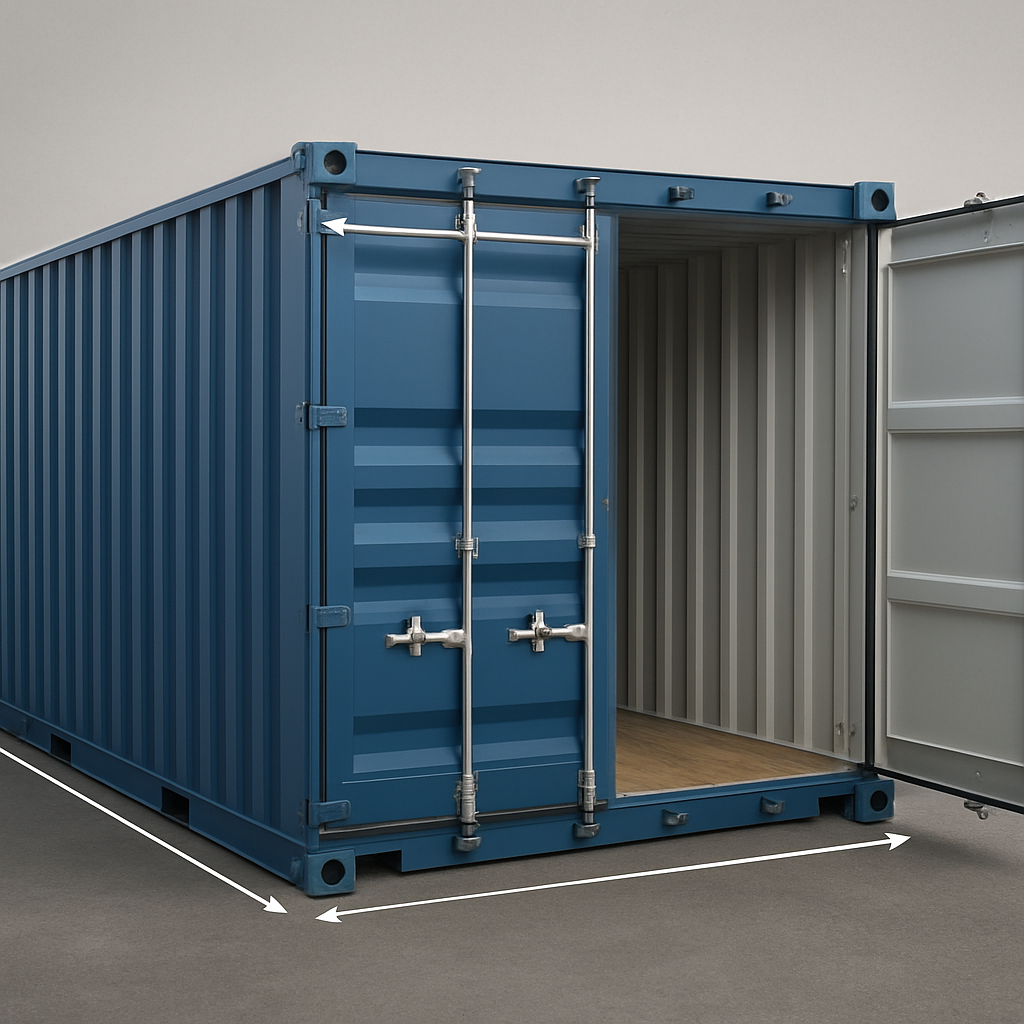
The standard external dimensions of a 20-foot shipping container are 20 ft long, 8 ft wide, and 8 ft 6 in high on the outside. In metric terms, that is commonly given as about 6.06 m long, 2.44 m wide, and 2.59 m high. Keep in mind that the label “20-foot container” is nominal: some references give the outside length as closer to 19 ft 10 in, depending on how the container is measured and reported. In this article, we are referring to a standard dry 20-foot shipping container.
20-Foot Container Dimensions in Feet
If you need the quick answer in feet, here it is:
| Measurement | External size | Approx. metric equivalent |
|---|---|---|
| Length | 20 ft | 6.06 m |
| Width | 8 ft | 2.44 m |
| Height | 8 ft 6 in | 2.59 m |
That is the standard exterior size most people mean when they ask for a 20-foot container’s dimensions. Some dimensional references also show a slightly more exact outside length of around 19 ft 10 in, while still rounding the container type to “20-foot”. The important point is that the nominal size and the actual measured outside length are not always identical.
For container planning, that distinction matters. A container’s advertised size is a category label, while the actual measurements depend on the container type, manufacturer tolerance, and whether you are looking at outside or inside dimensions.
Internal Dimensions and Usable Space
External dimensions are only part of the story. If you are trying to load cargo, you need the internal dimensions and the usable space, which are smaller than the outside measurements because of wall thickness, flooring, roof structure, and the door frame.
Interior dimensions of a 20 ft shipping container
A standard 20-foot dry container is commonly reported at roughly 19 ft 4 in long inside, 7 ft 8 in to 7 ft 9 in wide inside, and about 7 ft 10 in high inside. These figures are approximate and may vary slightly by source and rounding.
| Measurement | Approx. internal size | Notes |
|---|---|---|
| Internal length | 19 ft 4 in | Common standard figure; some sources round slightly differently |
| Internal width | 7 ft 8 in to 7 ft 9 in | Useful for loading pallets, cartons, and vehicles |
| Internal height | 7 ft 10 in | Lower than the exterior height because of the container structure |
This is why the usable space is slightly less than the nominal interior measurements suggest. If you are packing freight, you should always work from the internal dimensions rather than the outside label.
What is the interior width of a 20 ft shipping container?
The interior width of a standard 20-foot shipping container is usually around 7 ft 8 in to 7 ft 9 in. That makes the container narrower inside than the outside 8 ft width might suggest, and it is one of the most important measurements for loading pallets, machinery, and vehicles.
Practical width planning matters because even small differences can affect whether cargo fits side by side, whether a forklift can manoeuvre safely, and how much clearance is left once dunnage or packing materials are added.
How Much Fits in a 20-Foot Container?
Usable space is not the same as the headline dimensions, so the amount that fits inside depends on the shape of the cargo, the packing pattern, and the clearance you need for doors, bracing, and handling equipment. A 20-foot container is often used for cartons, palletised cargo, furniture, machinery, and other dense shipments because it offers a compact but practical loading space.
If you want a deeper explanation of volume, see our guide on cubic feet in a 20-foot shipping container. That article goes into capacity and CBM in more detail.
Can two cars fit in a 20ft container?
Sometimes, but not universally. Whether two cars fit in a 20-foot container depends on the size of the cars, how they are loaded, and whether the arrangement allows enough clearance for entry, positioning, and safe securing.
In practice, two compact vehicles may be possible in some loading scenarios, but standard passenger cars often require very careful planning. The container’s internal length of roughly 19 ft 4 in and internal width of around 7 ft 8 in to 7 ft 9 in leave limited room once mirrors, bumpers, ramps, tie-downs, and door clearance are included.
So the safest answer is: two cars may fit in some cases, but you should never assume that they will fit without checking the exact vehicle dimensions and the loading method. If the cargo is vehicles, the real question is not just container size, but whether the loading plan is physically workable.
Door Opening and Loading Clearance
When people ask about container dimensions, they often focus on length, width, and height, but the door opening is just as important. A container may have enough internal volume on paper, yet still be difficult to load if the cargo does not clear the door frame or if the handling equipment needs extra space to operate.
That is why shipping container dimensions should be read together with loading clearance. Door opening height and width determine what can actually be moved inside, especially for palletised cargo, equipment, and wheeled items. If your shipment is close to the container’s internal height or width, the door opening can become the limiting factor even before the interior space does.
For that reason, practical container planning is about more than the listed dimensions. You should compare:
- the external dimensions,
- the internal dimensions,
- the door opening, and
- the cargo’s actual packed size.
20-Foot vs 40-Foot Container Dimensions
A 40-foot container is the next common size up, and it is typically about twice the length of a 20-foot container. That makes the 20-foot unit a useful benchmark when comparing shipping container sizes in metres or feet.
| Container type | External length | External width | External height |
|---|---|---|---|
| 20-foot container | 20 ft | 8 ft | 8 ft 6 in |
| 40-foot container | 40 ft | 8 ft | 8 ft 6 in |
The key difference is length. Width and height are generally the same for standard dry containers, but the 40-foot unit gives you much more internal space along the floor line. If your cargo is long, bulky, or needs separation between items, the 40-foot size may be more practical. If your shipment is compact, the 20-foot container is often the better fit and can be easier to plan around.
How Much Cubic Space Does a 20-Foot Container Have?
A 20-foot dry container is commonly described as offering roughly 1,170 to 1,172 cubic feet of usable space, based on standard internal dimensions. That figure is useful for rough planning, but it is still an approximation. Real-world loading space can be lower once you account for pallet patterns, irregular cargo, dunnage, bracing, or items that cannot be stacked efficiently.
If you want a broader volume-focused explanation, you can also read our guide on how many cubic feet are in a 20-foot shipping container.
For importers and exporters, the practical takeaway is simple: cubic space helps you estimate capacity, but it does not replace a proper load plan. The shape of the cargo matters as much as the total volume.
Practical Takeaway
If you are asking, “What are the dimensions of a 20-foot container in feet?”, the standard external answer is 20 ft long, 8 ft wide, and 8 ft 6 in high. For loading purposes, the more useful figures are the internal measurements: roughly 19 ft 4 in long, 7 ft 8 in to 7 ft 9 in wide, and 7 ft 10 in high.
That difference between nominal size, outside dimensions, and usable interior space is what usually matters in shipping. If you are comparing shipping options or working out whether your cargo will fit, always measure the cargo first, then compare it with the internal dimensions and door opening, not just the container label.
If you are moving from dimensions into freight planning, you may also find it useful to read about shipping a 20-foot container.