
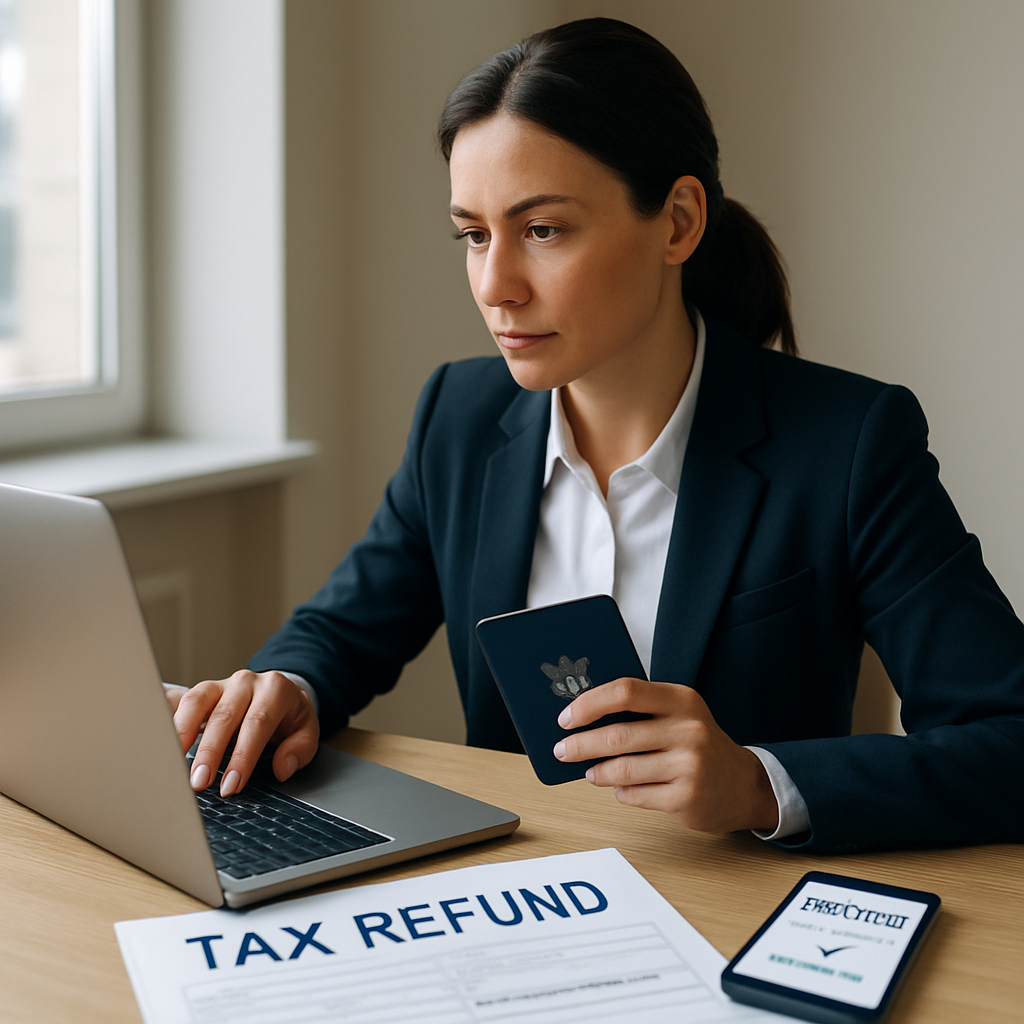
If you are a non-EU tourist, the way to get a tax refund in Spain online is through the tourist VAT refund process: buy eligible goods, ask for the tax-free form in the shop, get the form validated when you leave the EU, and then submit or track the claim through the refund operator’s online system, if that operator offers one. This is a VAT refund on goods bought in Spain, not a general income-tax refund or a business VAT return.
The key point is that the “online” part usually comes after purchase and customs validation. In other words, you do not normally complete the whole refund purely on a website without the store paperwork and departure validation. The Spanish Tax Agency explains the traveller refund route on its official page for VAT refunds for travellers, and Madrid’s DIVA guide shows how the electronic validation step works at departure through the customs system.
How the Spain Tourist VAT Refund Process Works Online
The standard flow is straightforward once you know the sequence. First, you buy eligible goods in Spain. At the time of purchase, you ask the retailer for the tax-free form, often handled through the DIVA system or a refund operator’s form. Then, when you leave the EU, customs or a DIVA terminal validates the purchase so the refund can be processed. After that, you send the validated form to the operator or retailer, and you can usually check the claim status online if the operator provides a portal.
That distinction matters because many travellers assume “online” means they can skip the airport step. For tourist VAT refunds, the departure validation is not just an administrative extra; it is the point that confirms the goods are leaving the EU with you. The DIVA guide states that once validation is confirmed, the refund can be obtained from the tax-free operator or, in some cases, from the shop where the purchase was made.
The basic sequence
- Buy eligible goods in Spain.
- Ask for the tax-free form at the shop.
- Show your passport if requested.
- Validate the form at departure using DIVA or customs.
- Submit the validated form to the operator or shop.
- Track the refund online if the operator offers status checking.
If you want a broader overview of how refunds, customs, and payment tracking work together, our guide on how to pay customs duty online is a useful parallel read, even though the process is different from Spain’s traveller VAT refund.
Who Can Claim a Spain VAT Refund as a Tourist
The refund is generally for non-EU residents, including tourists who are permanently resident outside the EU. Shops and refund operators may ask for a passport as proof of eligibility. The taxpayer’s residence status matters more than nationality alone, and different operators may ask for slightly different supporting documents.
Spain’s traveller refund rules are also designed for personal-use purchases, not goods bought in bulk for resale or commercial use. If customs suspects that you are buying for trade rather than personal use, the claim can be denied.
In practical terms, you should be ready to show identification when buying the goods and again when validating the form at departure. The official guidance from the Spanish Tax Agency and the DIVA materials both reinforce that the process is tied to traveller eligibility and export validation, not just the receipt.
What proof may be needed
- Passport or other identity document requested by the retailer or operator
- Proof that you are resident outside the EU
- Purchase invoice or receipt
- Validated tax-free form or DIVA confirmation
If you are wondering whether you can shop tax-free on a specific programme such as Global Blue, the answer is that the operator depends on the store. Some retailers work with one refund provider, some with another, and not every Spanish shop uses the same system.
Spain VAT Refund Minimum Spend, Tax Rate, and Expected Refund
The amount you can recover depends on the VAT treatment of the goods, the operator’s fees, and the price you actually paid. Spain’s standard VAT rate on most goods is 21%, but that does not mean you will receive a flat 21% back in every case. Refund operators may deduct fees, and some product categories carry different VAT rates.
There is also some conflicting public guidance on minimum spend. One live operator source indicates that Spain has no minimum spend threshold for tax-free shopping, while other guidance and snippets you may see online mention a threshold of around €90.16 in a single store. Because the evidence is not fully consistent across sources and operator regimes, it is safest not to assume one universal threshold. Check the current rules shown on the store’s tax-free form or the operator’s current guidance before you buy.
So, if you are looking for a Spain tax refund tourist calculator, the honest answer is that there is no universal calculator that will be correct for every purchase. The refund estimate normally depends on:
- the purchase price
- the VAT rate applied to the item
- the refund operator’s service fee
- any handling or processing deduction
- the final eligibility of the transaction
As a result, any amount you see before validation is usually an estimate rather than a guaranteed payout. If the store or operator provides a calculator, use it as a guide only.
What affects the final refund amount
| Factor | Why it matters |
|---|---|
| VAT rate on the item | Higher VAT generally creates a larger refund base. |
| Operator fees | The operator may deduct processing charges. |
| Store eligibility | Only eligible goods and transactions qualify. |
| Validation status | Without departure validation, the refund may fail or be delayed. |
| Documentation | Missing invoices or forms can reduce or block the claim. |
For general context on tax-free shopping in Spain and current refund mechanics, see the operator and guide references from Planet Tax Free’s Spain page and the Spain VAT refund guide from Privé.
What to Ask for at the Store: DIVA and Tax-Free Forms in Spain
The most important step happens at the time of purchase. Ask the shop for the tax-free form and show your passport if requested. In Spain, the DIVA system is the electronic mechanism used for validating traveller tax-free forms, so you should think of DIVA as part of the customs and refund workflow rather than a separate shopping app.
In many cases, the retailer does not pay the refund directly. Instead, the shop issues or links the transaction to a refund operator, and that operator handles validation, payment, and tracking. That is why the same process can look slightly different from one store to another even within Spain.
If you are specifically trying to understand Global Blue, the safe answer is that it is one possible operator, not a universal Spanish standard. The store decides which tax-free partner it works with. If the retailer uses another operator, you must follow that operator’s instructions and forms.
What you should do in the store
- Tell the cashier you need a tax-free or VAT refund form.
- Have your passport ready if asked for identification.
- Check that the invoice matches your passport name and purchase details.
- Keep the form, receipt, and any operator reference number together.
- Confirm which refund operator is being used.
If you want a deeper explanation of the DIVA workflow, the Barcelona municipal guide on how the DIVA form works is one of the clearest publicly available references.
How to Check Your Spain VAT Refund Status Online
Once the form has been validated and submitted, you can usually check the processing status online if your operator offers a portal. This is the follow-up step, not the refund itself. The Spanish refund process may be partly digital, but the tracking system is still operator-specific.
The practical way to check the status is to log in to the relevant online portal and look for your claim or file number. Some systems use a “my files” area or a similar personal dashboard. To do that, you will usually need the details from your refund form, invoice, or operator reference.
Keep these details for tracking
- Tax-free form reference or file number
- Purchase invoice or receipt
- Passport details used for the claim
- Date of purchase
- Date of validation or submission
If the refund seems delayed, the right next step is to check the operator portal and then contact the operator or retailer with your reference details. Do not assume that a delay means the claim has failed; sometimes it simply means the operator is still processing it.
What to Do If You Forgot to Ask for the Tax Refund Form in Spain
If you already bought the item and forgot to request the form, act quickly while you are still in Spain. The safest move is to contact the retailer or refund operator immediately and ask whether the form can be reissued or whether there is a store-specific remedy. Do not assume you can fix the problem later with only a receipt.
This matters because the standard traveller refund route depends on the form being linked to the transaction and then validated at departure. If you have not completed that chain, the refund becomes much harder to recover and may depend entirely on the operator’s rules.
Ask the retailer or operator these questions
- Can the tax-free form be reissued?
- Can the claim still be linked to my receipt?
- Do I need to return to the store in person?
- Is there a duplicate document or replacement procedure?
- Will my refund still be possible without standard validation?
For travellers who forget paperwork, the key lesson is simple: the earlier you act, the better. Once you leave Spain and lose the chance to validate the form properly, the odds of success usually drop sharply. The DIVA process is built around validation before departure, not after the trip is over.
Spain VAT Refund Deadlines: When You Must Validate and Submit
Deadlines matter at two different stages, and they should not be confused. First, the DIVA and traveller guidance indicate that customs validation must happen within three months of purchase. Second, one operator source states that refunds may be claimed within four years from the date of purchase. Those are not the same deadline: one relates to export validation, and the other relates to the operator’s refund claim window.
In practice, the critical deadline is the departure validation. You must leave the EU with the goods and get the form validated as required. If you miss that step, the refund can be jeopardised even if the purchase itself was eligible.
The rules also assume that you are returning to your country of habitual residence with the goods within the required timeframe. Airport procedures, security layouts, and whether customs staff or DIVA terminals are available can all affect whether you are able to complete the validation before departure.
Practical timing tips
- Do not leave validation until the last minute.
- Allow time for customs or DIVA checks at the airport.
- Check whether your airport has staffed customs validation or an electronic terminal.
- Keep the goods with you until validation is complete if the procedure requires inspection.
- Follow the operator’s filing deadline after departure.
The DIVA guide from Madrid makes clear that if the form cannot be validated electronically, you should go to the customs services office. That is why departure logistics are part of the refund process, not an afterthought.
How Spain VAT Refunds Are Paid: Cash, Card, or Operator Processing
Refund payment methods depend on the operator. Some refund points pay in cash, while others pay by credit card or process the amount back through a card-based channel. The operator source for Spain notes that refunds can be paid in cash at refund points or by credit card, and that you may have up to four years from the purchase date to obtain the refund through that operator’s system.
That does not mean every refund is instant. In many cases, the validated form still has to be submitted to the operator or retailer before payment is released. The online portal is usually there to track progress rather than to issue money immediately.
So if you are asking, “Can I get the refund online?” the realistic answer is: you can often track it online, and in some systems you can complete parts of the claim digitally, but the actual payout method still depends on the operator’s process.
Can You Get a Spain VAT Refund for Online Purchases?
For normal tourist refunds, the system is designed around goods that are physically taken out of the EU. That means ordinary online shopping often does not fit the standard tourist VAT refund path, especially if the item is shipped directly to your home address.
There is some limited room for online or remote purchases if the seller can verify your identity and the transaction fits the export/refund rules. But that is not a blanket rule for all e-commerce in Spain. In other words, do not assume that every website purchase qualifies just because you are a non-EU resident.
The practical implication is simple: if the item is being delivered to a home address rather than carried out of the EU with you, it usually falls outside the usual tourist refund route. If you are considering a remote purchase, ask the seller or refund operator before you buy rather than after.
Brand and Operator Differences: Why Loewe and Other Retailers May Be Different
A brand-specific search such as Loewe Spain tax refund is usually really a question about the retailer’s operator or refund partner. The policy is not necessarily brand-wide in the abstract; it depends on the specific store, the tax-free partner it uses, and the paperwork issued at the time of sale.
That is why it is better to ask a simple operational question at the point of purchase: which refund operator is being used, and what exactly do I need to do to claim the VAT back? If you are shopping in a luxury store or a multi-brand department store, the answer may differ from counter to counter.
What to Remember Before You Leave Spain
- The refund is for traveller VAT, not a general tax refund.
- You usually need to be a non-EU resident.
- You should ask for the tax-free form at purchase.
- You generally need DIVA or customs validation before departure.
- The refund amount depends on VAT, fees, and operator rules.
- Online tracking is useful, but it is not a substitute for validation.
- If you forgot the form, contact the retailer or operator immediately.
If you want to understand the wider refund and customs context, you may also find our guide to customs refund rules for returned items helpful, especially if you often deal with returns, refunds, and cross-border documentation. For a broader VAT perspective, see also VAT on goods from the EU. If you are comparing timing issues in other cross-border claims, our article on international purchase refund time limits may also be useful.