
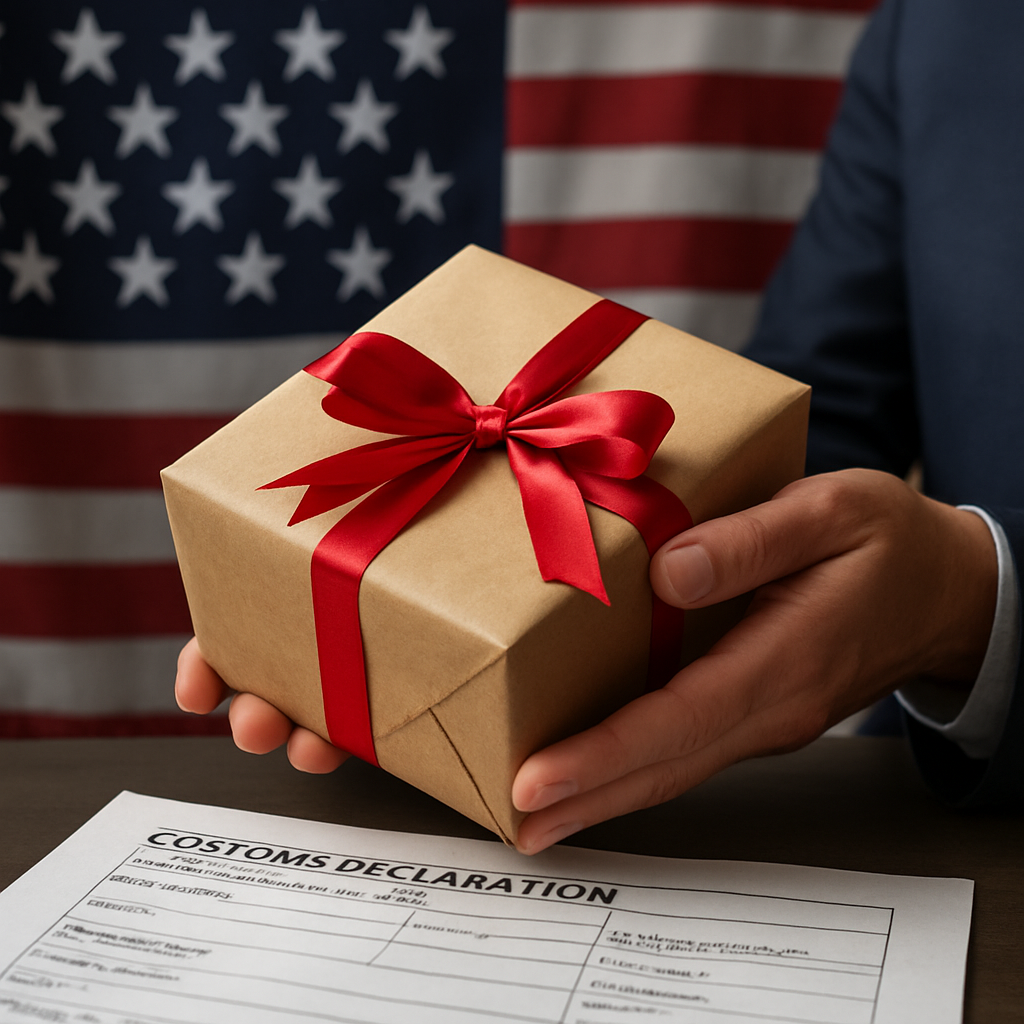
Yes, you can sometimes send a gift to the US without tariffs or duty, but it is not automatic. The parcel has to qualify as a bona fide gift, be declared correctly, and fit the applicable customs allowance and shipping rules. If the gift is over the allowance, or if it does not meet the gift conditions, the recipient may be charged duty, customs processing fees, or other handling costs.
The important distinction is this: a gift can be duty-free in some cases, but “gift” does not mean “no customs paperwork”, and it does not override prohibited-item rules. It also does not mean every low-value parcel enters the US duty-free under the same rule set, because the broader low-value treatment for many shipments has changed over time.
If you are sending a present to family, friends, or a customer in the United States, the safest approach is to treat the shipment as a customs-controlled parcel first and a gift second: describe it accurately, check the item is allowed, and then confirm whether it still qualifies for the gift allowance.
Can You Send a Gift to the US Without Tariffs?
In many cases, yes — but only if the shipment qualifies for the US gift exemption and the customs requirements are met. U.S. Customs and Border Protection explains that international mail is still processed by CBP, and the paperwork must be completed accurately even when the shipment is a gift. CBP’s guidance on internet purchases and mailed imports also makes clear that mailed items may be assessed duty if they are dutiable, then released for delivery.
That means the answer depends on several factors:
- the declared value of the gift;
- whether it is a true personal gift rather than a purchase disguised as one;
- the shipping method used;
- the customs rules in force at the time of shipment;
- and whether the item itself is allowed into the country.
In plain terms: a genuine gift may travel duty-free, but only if it qualifies under the relevant US customs rules.
What Is the US Gift Limit for Duty-Free Entry?
The supplied research consistently points to a gift allowance around US$100 for bona fide gifts sent into the United States by mail in the contexts covered by the sources. Third-party carrier guidance, including DHL and FedEx, describes a gift allowance of up to US$100 for certain gift shipments, and the customs discussion in the research package repeatedly treats that threshold as the key gift-specific limit.
However, this limit should be read carefully. It is not the same thing as the older broad low-value de minimis concept that once applied to many shipments worth up to US$800. Those are related ideas, but they are not identical, and the research shows that recent US tariff and de minimis changes mean readers should not assume the older low-value treatment still applies in the same way for every shipment.
So the practical takeaway is:
- US$100 gift allowance: a gift-specific threshold described in the supplied sources for bona fide gift shipments;
- US$800 de minimis concept: the older broad low-value treatment that applied to many shipments, but which has been altered for some postal flows under recent changes;
- not every item under US$100 is automatically exempt: the parcel still has to meet the gift conditions and the shipping route matters.
If the value exceeds the gift allowance, or the customs officer decides the parcel does not qualify as a bona fide gift, duty and other charges can apply.
How to Declare a Gift to the US Customs Authority
Even when a parcel qualifies as a gift, it still has to be declared. A truthful customs declaration is not optional. CBP notes that international packages must have customs paperwork with a full and accurate description of the contents, and the declaration should be securely attached to the shipment. You should not write vague wording or misdescribe the contents in an attempt to avoid charges.
The practical customs flow for mailed items is straightforward:
- The parcel is sent with the correct customs declaration form.
- CBP or the relevant mail-processing channel reviews the shipment.
- If the parcel is admissible and duty-free, it is released.
- If duty is assessed, the recipient may have to pay it before delivery.
FedEx’s gift guidance also stresses that gift treatment depends on the customs definition of a bona fide gift. In other words, customs care about the legal nature of the parcel, not just the sender’s intention.
For a useful explanation of the customs-value language that often appears on paperwork, see our guide on value for customs purposes. If you are unsure how the item should be classified, our article on HS tariff classification explains how customs codes are used.
What Changed With US Tariffs and the De Minimis Rule?
This is the part that causes the most confusion. For years, many low-value shipments could enter the United States without duty under the de minimis framework. The supplied sources show that this broader treatment has been changed for some postal shipments, and recent coverage states that international postal shipments, including personal gifts, may be subject to duties and customs processing under the updated rules.
That does not mean every gift is now charged. It means the old assumption — “it is low value, so it will definitely go through duty-free” — is no longer safe.
Two points matter most:
- The gift allowance and the de minimis rule are not the same thing. A small personal gift may still qualify under the gift rules even though the broader low-value parcel treatment has changed.
- The shipping channel matters. Postal shipments and courier or express shipments may be handled differently depending on the applicable rule framework and the date of shipment.
That is why the safest approach is not to rely on old advice from before the rule changes. Instead, check the current carrier guidance and confirm how the parcel will be treated at the time you send it.
For background on the policy change affecting low-value shipments, the research package includes the discussion of the end of the de minimis exemption for online shoppers and a government resource on import tariffs and fees. For postal-specific treatment, see postal tariff guidance for the United States.
What Conditions Must a Gift Meet to Qualify?
A parcel is not treated as a duty-free gift simply because the sender calls it a gift. To qualify, it needs to meet the customs conditions. The research package and carrier guidance point to several common requirements.
| Condition | Why it matters |
|---|---|
| Sent by an individual donor | A bona fide gift is a personal transfer, not a commercial sale disguised as one. |
| Properly declared | Customs paperwork must be truthful and complete. |
| Within the gift allowance | The value must fit the applicable gift threshold to qualify for duty-free treatment. |
| Sent to the right type of recipient/address | Carrier guidance notes that residential delivery can matter for gift treatment in some cases. |
| Not prohibited or restricted | A gift is still subject to the rules for banned or controlled goods. |
This is also where Amazon or other retailer fulfilment can cause confusion. Just because something was ordered online and sent to a friend does not automatically make it a customs gift. The customs facts still matter. If the item was purchased like a normal retail order, customs may treat it differently from an actual gift transfer.
If you want a broader explanation of where customs draws the line between personal and commercial shipments, our article on what counts as commercial goods is useful background, even though it focuses on the Canadian customs context.
Can a Gift Still Trigger Charges or Fees?
Yes. A parcel can still trigger charges even if it was sent as a gift. The most obvious case is when the item does not qualify for the gift exemption or its value is too high. In that situation, duty can be assessed and the recipient may also be asked to cover postage or handling charges linked to customs processing.
CBP explains that mailed imports may be assessed duty and released for delivery once the proper paperwork and payment are in place. FedEx’s 2024 gift guidance also warns that duty or tax may be assessed if a shipment is not properly declared or does not qualify under gift provisions.
For recipients, the practical implication is simple: do not assume the sender has already “covered everything” just because the parcel was marked as a gift. If customs charges apply, the recipient may still be the one who has to pay them before delivery.
As a separate issue, people sometimes ask about taxes on money gifts — for example, whether they can gift a son £50,000 in the UK or what tax applies to a $100,000 gift. Those are personal tax and wealth-transfer questions, not the same thing as customs duty on a physical parcel. This article is about sending goods, not monetary gift tax rules.
If you want a deeper explanation of duty calculation itself, see our guide on how customs duty is calculated.
How to Avoid Problems When Sending a Gift to the US
The easiest way to avoid customs trouble is to prepare the shipment as if it will be checked — because it may be. That means checking the item, the paperwork, and the carrier instructions before you send it.
- Confirm the item is allowed. A gift does not override prohibited or restricted-item rules.
- Describe the contents accurately. Do not hide the real item behind vague wording.
- State the correct value. Undervaluation can create customs problems.
- Use the proper gift designation only if it is truly a gift. A purchase is not automatically a gift.
- Check the carrier’s guidance. Royal Mail, DHL, FedEx, and other carriers may have their own label and customs-process instructions.
This is especially important if you are sending from Canada, using Royal Mail, or buying through a platform such as Amazon. Those are different shipping scenarios, but the underlying rule is the same: customs treatment depends on the facts of the shipment and the paperwork, not just on how the parcel was purchased or which carrier handles it.
For practical shipping context, our guide to couriering to the USA can help if you are choosing between postal and courier options. If you are sending by mail, our USPS international shipping rules guide is also useful.
What If You Send a Prohibited or Restricted Item as a Gift?
Gift status does not make a banned item acceptable. If the item is prohibited or restricted, it can still be stopped, delayed, returned, or seized, depending on the circumstances. That is true whether the parcel contains a birthday present, a holiday gift, or a personal keepsake.
This matters because a lot of gift senders focus only on value and forget about contents. Customs does not. Certain goods may require permits, special declarations, or may simply be barred from entry. If you are unsure, check the current prohibited-item list before you ship anything.
For a fuller overview of items that cannot be shipped internationally, our article on prohibited items and restrictions explains the main risk areas.
Quick Checklist Before You Post a Gift to the US
- Is it a genuine personal gift, not a disguised sale?
- Is the declared value within the applicable gift allowance?
- Have you filled out the customs form truthfully?
- Is the item allowed to enter the US?
- Are you clear on whether the route is postal or courier?
- Do you understand that the recipient may still pay duty or fees if the parcel does not qualify?
If you can answer yes to the first four and you understand the last two, you are in a much better position to send the parcel without unpleasant surprises. The main mistake people make is assuming that “gift” alone guarantees duty-free treatment. It does not. Customs looks at value, paperwork, item type, and shipment context.
So, can I send a gift to the US without tariffs? Yes, sometimes — but only when the gift qualifies under the relevant customs rules, is declared properly, and is shipped in a way that still fits the current policy framework. If you stay within the gift allowance, provide honest paperwork, and avoid restricted items, you reduce the chance that the recipient will face duty or extra charges.