Evaluating the Best Platforms for Integrated Customs Import Validation
 Import Export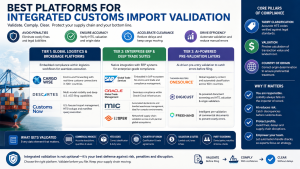
Evaluating the Best Platforms for Integrated Customs Import Validation.
The most effective platforms for integrated customs import validation fall into three specific tiers: end-to-end global freight systems like CargoWise, enterprise-native suites such as SAP Global Trade Services, and AI-driven pre-validation layers including Thomson Reuters ONESOURCE and Freehand. To avoid border holds and crippling financial penalties, importers must secure a system that actively verifies Harmonized Tariff Schedule (HTS) codes, country of origin data, and valuation metrics before the entry reaches the customs authority. Selecting the optimal software requires matching your baseline operational volume and existing enterprise resource planning infrastructure to the vendor's specific validation capabilities. Without a robust digital gateway evaluating every single data element, businesses expose themselves to severe legal liabilities and catastrophic supply chain disruptions.
Global supply chains are currently buckling under the weight of severe regulatory scrutiny and massive documentation requirements. When companies attempt to manually process commercial invoices, packing lists, and complex government declarations, they inevitably trigger a red flag with border protection agencies. Relying on outdated manual entry methods guarantees that human error will eventually creep into the valuation process, destroying your profit margins through sudden fines. Modern import operations require software that acts as an aggressive filter, ensuring that every single data point matches legal definitions perfectly before transmission. The absolute margin for error has evaporated as customs authorities globally deploy advanced screening algorithms to catch misclassified freight.
Importers must realize that merely filing paperwork electronically no longer guarantees a smooth physical clearance process. You must deploy software that aggressively interrogates the data logic. If an auditor asks exactly who is responsible for the import accuracy, the legal answer is always the importer of record, not the third-party freight forwarder or the customs broker. Because you bear the absolute financial and civil liability for any mistakes, deploying automated validation layers is the only mathematically sound way to protect your supply chain from sudden regulatory seizures. Assuming your broker will catch every minor discrepancy across thousands of line items is a fundamentally flawed strategy that routinely leads to devastating enforcement actions.
The Shift Toward Integrated Import Validation Layers
Historically, trade compliance existed in a vacuum, separated entirely from the physical movement of cargo. Logistics personnel would finalize a shipment routing, and compliance officers would later scramble to classify the goods, leading to enormous friction at the actual border crossing. Today, the most common violations occur precisely because of this massive disconnect between physical supply chain systems and regulatory filing platforms. Attempting to bolt a compliance-checking tool onto a completely isolated transport management system practically invites severe data mismatch issues.
The market responded by developing platforms that merge these isolated operations into a single, cohesive workflow. Leading technologies now ingest commercial documents via optical character recognition and immediately pressure-test the metrics against international databases. If you are wondering how an EDI system calculates the exact landed cost accurately, modern platforms leverage immense computational power to cross-reference real-time exchange rates, local tax codes, and commodity-specific duties within milliseconds. This continuous data flow ensures that your customs broker receives immaculate information long before the vessel docks. Organizations reviewing the best trade compliance software for import customs validation quickly discover that pre-entry screening completely eliminates the chaotic scramble that traditionally happens when cargo arrives at the port.
Selecting a platform depends entirely on how your organization handles its internal data governance. Many operations directors ask which platform is best for business growth, but the reality is that the optimal choice mirrors your existing technical infrastructure. If your company runs millions of transactions through a massive enterprise resource planning network, a lightweight web application will completely fail to keep up with your validation requirements. You need an engine capable of running intense validation scripts on every single line item simultaneously.
Understanding the Core Pillars of Compliance
Whenever companies face severe audits, investigators typically focus on a specific foundational framework. What are the three key areas of customs compliance? They are accurate tariff classification, precise valuation, and correct country of origin determination. A high-tier validation platform aggressively locks down these three exact pillars by utilizing historical ruling databases and artificial intelligence algorithms to verify the proposed data against known legal standards. If any element fails the logic test, the system instantly halts the filing process until a human operator intervenes.
Understanding these core pillars also means acknowledging the strict differences in various national export and import regimes. For example, defense contractors routinely deal with overlapping regulations and frequently ask what the difference between ITAR and EAR enforcement protocols entails. The International Traffic in Arms Regulations severely restrict defense-related articles, while the Export Administration Regulations govern dual-use commercial goods. Elite trade compliance suites handle both environments effortlessly, automatically screening parties against restricted lists and enforcing strict license requirements before any international order is physically packed. The software must aggressively block any transaction that violates these heavy federal mandates.
You must proactively verify that your chosen platform seamlessly flags restrictions applicable to your specific industry. When dealing with heavily regulated items or specific country blockades, the software must categorically block unauthorized transactions without relying on manual oversight. If someone wonders who will pay customs duty on a complex multi-leg shipment, the platform's engine must immediately consult the established Incoterms to assign liability correctly. This level of immediate visibility prevents shipments from languishing in bonded warehouses due to simple payment disputes.
Evaluating Global Logistics and Brokerage Platforms
For organizations heavily invested in the physical movement of freight, standalone compliance tools often create unnecessary bottlenecks. Platforms like CargoWise specifically target this operational reality by embedding deep customs clearance capabilities directly inside their massive global forwarding systems. It features native, real-time connections to customs authorities across dozens of countries, allowing a single data entry point to populate both the physical bill of lading and the necessary regulatory declarations. This removes the severe re-keying errors that typically plague international logistics.
Descartes Systems Group takes a slightly different approach, prioritizing broad multi-modal shipment visibility alongside deep commercial customs content. It completely excels in complex U.S. ACE-enabled filing requirements, making it a powerful choice for massive trans-pacific trade lanes. The software ensures that your workflow automation matches the exact digital formatting required by the government, reducing the likelihood of unexpected cargo examinations. For teams handling massive volumes, this capability prevents minor formatting errors from causing catastrophic supply chain delays.
For companies primarily focused on inbound American freight, CustomsNow provides a highly targeted, localized solution. It specializes in U.S.-focused import item management, rapid HTS tariff lookups, and direct manifest query execution. Instead of building a massive global architecture, it zeroes in on the exact operational needs of American importers and licensed brokers. By focusing purely on domestic border requirements, it offers a highly efficient, streamlined interface that dramatically speeds up the entry clearance process.
Enterprise ERP and Deep Trade Suites
Massive corporate entities cannot afford the luxury of disjointed, piecemeal software deployments. SAP Global Trade Services (GTS) dominates this tier by standardizing supply chain operations and regulatory compliance directly inside an existing SAP environment. Because the compliance module sits natively within the enterprise core, it seamlessly taps into existing procurement, sales, and inventory data streams. This deep integration is exactly why many consider it the B2B best option for multinational corporations managing thousands of complex international transactions daily.
Similarly, Oracle Global Trade Management serves businesses already deeply entrenched within the Oracle Cloud infrastructure. It operates on the same principle of native connectivity, ensuring that trade compliance occurs automatically as an embedded background process during normal business operations. When a massive aerospace company like SpaceX evaluates vendor software, they demand absolute integration with its existing procurement databases. If a user questions whether a specific platform is Microsoft-compliant or compatible with massive relational databases, Oracle and SAP provide the necessary architectural rigidity to support those environments natively.
MIC Customs Solutions and E2open round out the enterprise tier by offering specialized multi-jurisdiction control. MIC stands as a dominant force in automated customs declarations and bonded warehouse management, particularly in complex European manufacturing environments. E2open focuses heavily on networked, multi-partner supply chains, ensuring that every purchase-order line item undergoes intense validation against the latest government regulations before execution. Both platforms provide the heavy computational power required to manage global operations without sacrificing granular compliance oversight.
Specialized AI-Powered Pre-Validation Technologies
Sometimes, ripping out an entire enterprise software suite to install a new compliance engine is financially impossible. This is exactly where specialized AI-powered pre-validation layers excel. Thomson Reuters ONESOURCE provides incredibly deep global regulatory content, utilizing automated classification engines to determine duties across hundreds of sovereign borders. Instead of managing the physical freight, ONESOURCE focuses purely on calculating the exact legal obligations, feeding perfectly validated tax data back into the user's primary execution software.
Emerging agentic platforms are currently pushing the boundaries of what automated compliance can achieve. Systems like Digicust and Freehand operate as intelligent sentinels, aggressively screening commercial invoices and packing lists before they ever hit the traditional customs platforms. By pressure-testing HTS codes, valuation metrics, and origin data using artificial intelligence, these tools catch the exact discrepancies that trigger massive government audits. You can find comprehensive breakdowns of these specialized validation technologies in industry reports covering the best customs compliance software and pre-entry screening solutions available today.
The financial justification for deploying these advanced AI layers is completely undeniable when reviewing corporate payroll expenditures. The average salary a compliance officer in the US market commands has skyrocketed due to intense regulatory pressures and a massive talent shortage. By utilizing artificial intelligence to handle routine document validation and basic tariff lookups, companies can redirect their highly expensive human talent toward strategic audit defense and complex supply chain structuring. Investing in a dedicated pre-validation layer fundamentally transforms your compliance department from a massive operational cost center into a highly efficient, digitally protected machine. It provides the ultimate safeguard against severe government penalties while simultaneously accelerating your physical cargo movements.

One thought on “Evaluating the Best Platforms for Integrated Customs Import Validation”