
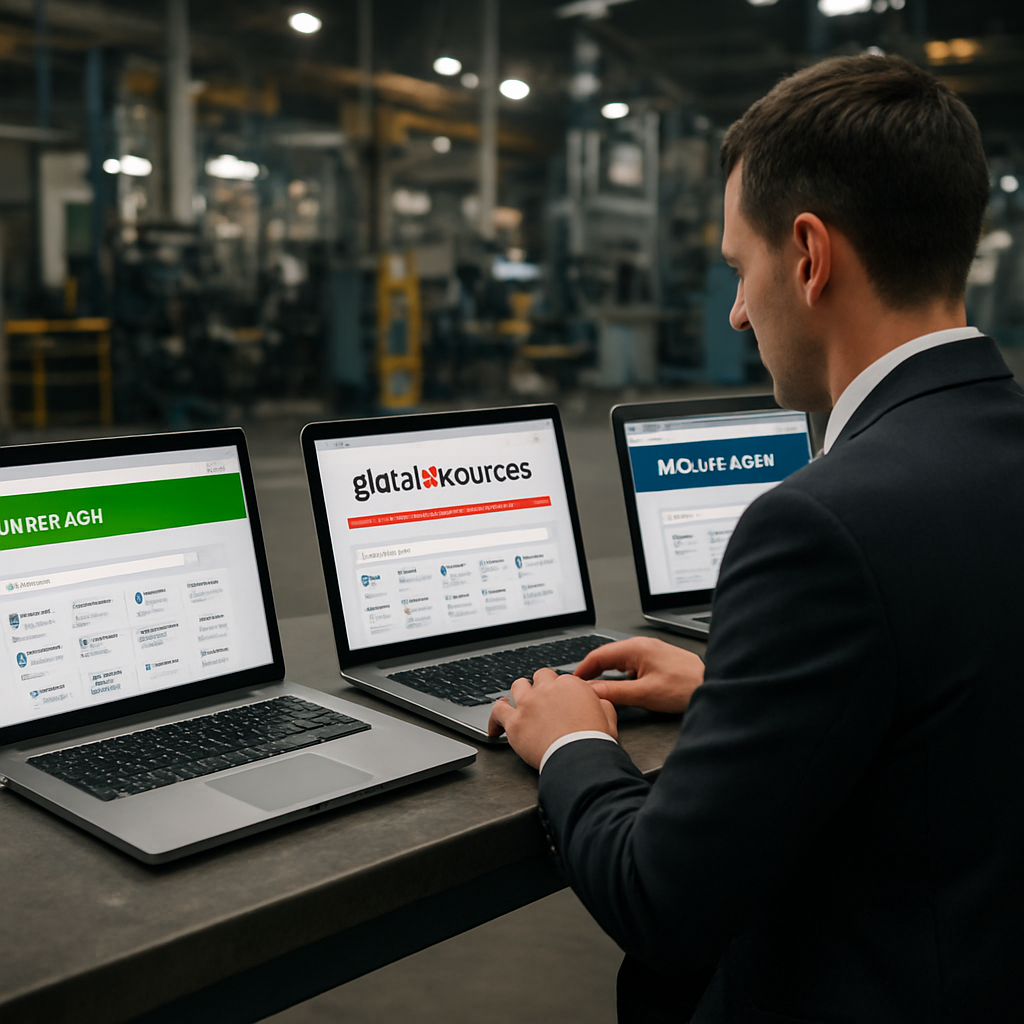
Industrial exchange platforms for manufacturers are online B2B directories, marketplaces, and company databases that help you find suppliers, buyers, distributors, industrial equipment, and sourcing partners. In practice, they are used for supplier discovery, market research, lead generation, RFQs and enquiries, verification, and cross-border sourcing. The right choice depends on what you need most: discovery, quoting, due diligence, or actual transaction support.
That distinction matters because not every platform works the same way. A directory helps you search and shortlist companies. A marketplace is designed to connect buyers and suppliers more directly. A company database gives you broader business intelligence and contact data for research. Some platforms are also more integrated with operations software, such as ERP or WMS, which changes how they fit into a manufacturer’s workflow.
What Industrial Exchange Platforms Are and How Manufacturers Use Them
For manufacturers, the phrase industrial exchange platforms for manufacturers usually refers to digital tools that sit somewhere between a directory and a commercial marketplace. They are most useful when you need to identify potential suppliers, compare options quickly, and start outreach without relying only on trade show contacts or referrals.
Manufacturers typically use these platforms for four main jobs:
- Supplier discovery: finding factories, component makers, equipment vendors, or service providers by category and location.
- Market research: checking how broad a supplier base is in a region or sector before spending time on outreach.
- Lead generation: identifying companies that may be worth approaching for sourcing, distribution, or partnership discussions.
- Verification and due diligence: using platform data to narrow the field before checking licences, certifications, references, and factory details.
One helpful way to think about the category is this: a directory tells you who exists, a marketplace helps you connect and sometimes trade, and a company database helps you research and qualify. Many manufacturers need more than one of these functions, which is why platform choice should be based on the sourcing objective rather than brand recognition alone.
For broad sourcing guidance, Global Sources’ own manufacturer-finding guide is a useful reminder that businesses often combine B2B marketplaces, industry-specific directories, and trade-agency databases depending on region and category. That approach is usually more realistic than looking for a single platform that does everything well.
How to Compare Industrial Exchange Platforms Before Choosing One
The best platform for a manufacturer is the one that matches the sourcing task. Before you choose, compare platforms using the criteria below.
| Criterion | Why it matters | What to look for |
|---|---|---|
| Geography | Some platforms are built for North America, while others are stronger for global or Asia-focused sourcing. | Supplier location coverage, language support, and regional relevance. |
| Supplier verification | Listings are useful, but they do not replace diligence. | Verified suppliers, company checks, profile depth, and support for due diligence. |
| Category coverage | Manufacturing needs vary widely across machinery, components, raw materials, and services. | Number of relevant industrial categories and the quality of filters. |
| Search and filtering | Good search tools save time and improve shortlist quality. | Industry codes, product classes, technical filters, and location filters. |
| RFQ or enquiry support | Some platforms help you request quotes directly; others are mainly for discovery. | RFQ forms, messaging tools, or contact-intake workflows. |
| Data depth | Company-level research needs more than a basic listing. | Contacts, business information, classification data, and profile completeness. |
| Transaction support | Some platforms stop at introductions; others support the commercial flow more directly. | Escrow, payments, dispute tools, or integrations with business systems. |
The key decision is not whether a platform is “good” in the abstract. It is whether it supports your exact sourcing stage. If you are still researching the supplier market, a company database may be ideal. If you are requesting quotes from shortlisted factories, a marketplace or enquiry-driven directory may suit better. If you are moving equipment rather than sourcing a new supplier, an asset exchange platform may be the right tool instead.
Thomasnet: What It Is and When Manufacturers Should Use It
Thomasnet is best understood as a North American-focused supplier discovery platform for industrial buyers and suppliers. It is especially useful when you want to find manufacturers, fabricators, distributors, and service providers in the United States or Canada. According to Global Sources’ sourcing guide, Thomasnet is a major directory for North American sourcing and covers a very wide range of industries and categories.
That geographic focus is its big advantage. If your priority is U.S. or Canadian supply, Thomasnet is a logical first stop because it is built around industrial discovery rather than broad consumer commerce. The platform is particularly relevant when you need engineering-oriented suppliers, industrial parts, manufacturing services, or other B2B industrial categories.
At the same time, that same focus is also its limitation. If your sourcing goal is broader Asia or Europe coverage, Thomasnet may not be the most direct starting point. In that case, a more global B2B marketplace or a worldwide company database may fit better.
Industry comparison coverage from Global Trade Plaza’s industrial equipment marketplace overview also places Thomasnet in the broader class of industrial sourcing tools that are useful for buyers seeking machinery, components, and industrial suppliers. The practical takeaway is simple: use Thomasnet when North American sourcing is the point, not when you need a single platform that spans every region equally well.
When Thomasnet is the better fit
- You want U.S. or Canadian suppliers first.
- You need an industrial directory rather than a consumer marketplace.
- You are sourcing components, fabrication, tooling, or manufacturing services.
- You want to start with a shortlist and then move into direct outreach.
When to look elsewhere
- You need broad Asia-based sourcing.
- You want a platform with stronger trade-show or marketplace activity.
- You need a global company database for early-stage research across many regions.
Global Sources: How It Fits Manufacturer Sourcing
Global Sources is a B2B sourcing platform used by buyers looking for verified suppliers, market insights, and sourcing support, especially for international trade and Asia-oriented procurement. Its own company profile describes it as a platform that helps connect global buyers and suppliers through online marketplace activity, trade shows, magazines, and sourcing apps.
For manufacturers, that mix matters because it is not just a static directory. It combines supplier discovery with trade and market context, which is useful when you need more than a name and contact details. It can support earlier-stage sourcing research and then help move into enquiry-driven supplier conversations.
The platform is also associated with verified supplier positioning, which is valuable when you want a curated B2B sourcing environment rather than an open-ended list of anonymous sellers. In other words, it is designed for trade relationships, not casual product browsing.
CB Insights’ coverage of Global Sources and its competitor landscape places it in the same broader universe as other major B2B sourcing platforms. That reinforces an important point for manufacturers: Global Sources should be assessed as part of a sourcing workflow, not as a generic marketplace that automatically solves vetting, negotiation, and fulfilment on its own.
When Global Sources is a good fit
- You are sourcing internationally and want a platform with global trade orientation.
- You value verified supplier positioning.
- You want a mix of marketplace discovery, trade information, and supplier outreach.
- You are comparing industrial suppliers beyond a single domestic market.
What to watch for
- Do not assume a verified listing removes the need for factory checks.
- Do not assume all product categories or countries are equally strong.
- Do not assume the platform itself completes the commercial transaction for you.
Kompass: What It Is and How Manufacturers Can Use It
Kompass is best described as a global B2B business directory and company database rather than a full marketplace. Its value lies in company-level research, verified data, and early-stage supplier discovery. It is particularly useful when you need to identify companies, classify them by industry, and build a shortlist before deeper outreach.
The available company information for Kompass India describes Kompass as a business directory and business-contact database with international business intelligence functions. That makes it especially relevant to manufacturers who want a broader research layer: not just “who sells this?” but “which company is this, where does it operate, and how can I qualify it before contact?”
This is where Kompass differs from a marketplace. A company database is useful for filtering and due diligence, but it is not the same as a platform that handles the full transaction flow. If you need a place to research companies across many regions before deciding whom to approach, Kompass can be a practical starting point.
Trade resource material also lists Kompass as a global B2B directory in the context of international trade research. That supports its role as a research and discovery tool rather than a transactional exchange venue.
When Kompass is the right tool
- You need broad company discovery across countries and sectors.
- You want verified business information for early-stage due diligence.
- You are building a longlist before direct outreach.
- You want company classification and contact data, not just product listings.
When Kompass is not enough on its own
- You need escrow or built-in transaction handling.
- You want a marketplace that centres on quoting and trade execution.
- You need direct logistics or fulfilment support inside the platform.
Industrial Asset Exchange Platforms for Machinery and Equipment
The search term asset exchange points to a narrower industrial use case: buying, selling, or liquidating machinery and equipment rather than discovering factory suppliers. For manufacturers, this category is relevant when you are disposing of surplus assets, purchasing used equipment, or looking for automation equipment and other industrial machinery.
Asset Exchange Corporation’s equipment listings show that this type of platform can cover new and used machinery, including automation equipment. That is a different function from Thomasnet, Global Sources, or Kompass. Those platforms are primarily about supplier discovery and company research, whereas an asset exchange platform is about equipment movement and resale.
This distinction matters because manufacturers often search under the same broad “industrial platform” idea when they actually have different needs. If you are trying to source a factory partner, you need a directory or marketplace. If you are trying to sell a machine, replace a line, or find used industrial equipment, an asset exchange platform is more relevant.
Use asset exchange platforms when you are:
- Selling surplus machinery after a plant upgrade or closure.
- Looking for used industrial equipment.
- Seeking automation equipment or production assets.
- Managing liquidation or asset disposal.
For that reason, asset exchange belongs in the conversation about industrial exchange platforms, but it should not be confused with the broader supplier-discovery platforms manufacturers often need first.
Verification and Due Diligence on Industrial Exchange Platforms
No industrial exchange platform should be treated as the final word on supplier reliability. A listing can help you find a candidate, but it does not replace direct verification. This is especially important when you are sourcing across borders or dealing with high-value industrial goods.
The strongest platforms in this space help with discovery and filtering, but the manufacturer still needs to verify the company behind the listing. That usually means checking registration details, business address, factory evidence, product fit, references, certifications, and whether the contact is genuinely authorised to negotiate.
Company databases such as Kompass are useful for early-stage research because they provide business information and contact structure. Verified-supplier platforms such as Global Sources can reduce some of the noise. Even so, neither one should replace your own checks.
Before you move from discovery to outreach, it helps to follow a structured verification process. You can use how to verify a Chinese factory as a practical next step if your sourcing target is in China. If you are going to a site visit, the guide on factory tour NDA and IP protection is also a useful companion piece.
In other words, industrial exchange platforms are a starting point for selection, not a substitute for due diligence. The best sourcing results usually come from combining platform research with direct checking, sample evaluation, and careful contract management.
When an Exchange Platform Needs ERP or WMS Integration
Not every platform is only a directory or marketplace. Some exchange-oriented platforms are connected to operational systems such as ERP and WMS, which matters when sourcing is tied to fulfilment, inventory movement, or dropship operations. The Automated Commerce Exchange (ACE) example in the research package is a good illustration of this integration-oriented model.
ACE is described as offering advanced ERP and WMS integration solutions that help brands integrate dropship operations. That suggests a different type of exchange platform: one designed not only for discovery, but also for operational flow.
For manufacturers, this distinction matters because ERP software brings together financials, operations, CRM, ecommerce, and analytics in one management environment. If a platform connects into that stack, it may support a more automated workflow, including inventory visibility and order flow.
That does not mean every industrial exchange platform has ERP or WMS capabilities. Most do not. But if your sourcing process involves ongoing inventory movement, warehousing, or direct-to-customer fulfilment, integration can become a real selection criterion.
You can think of this as a separate layer of platform value:
- Discovery layer: finding suppliers, buyers, or equipment.
- Operations layer: pushing data into ERP/WMS and supporting order flow.
- Execution layer: managing transactions, fulfilment, and inventory movement more directly.
If your business needs sit mostly in the first layer, a directory or company database may be enough. If you need the second or third layer, you should look beyond conventional sourcing directories and evaluate the integration stack carefully.
How to Choose the Right Platform for Your Sourcing Objective
The simplest way to choose between Thomasnet, Global Sources, Kompass, and asset exchange platforms is to start with your sourcing objective.
| Your objective | Best platform type | Why |
|---|---|---|
| Source U.S. or Canadian manufacturers | Thomasnet-style directory | Strong fit for North American industrial supplier discovery. |
| Source internationally with verified suppliers | Global Sources-style B2B platform | Useful for global sourcing and Asia-oriented supplier discovery. |
| Research company details before outreach | Kompass-style company database | Useful for early-stage research, classification, and due diligence. |
| Buy or sell used industrial equipment | Asset exchange platform | Better suited to machinery resale, liquidation, and equipment sourcing. |
| Automate sourcing and inventory workflows | Integration-oriented exchange platform | Relevant when ERP/WMS connectivity matters. |
If you want a broader view of the sourcing workflow after platform discovery, the article on the full China sourcing process walks through vetting, samples, and payment considerations in more detail. That is the right next step once you have identified candidates on a platform.
And if your main challenge is simply making first contact, use how to contact a Chinese manufacturer after finding them online to move from shortlist to outreach with less guesswork.
Practical Takeaway for Manufacturers
Industrial exchange platforms are useful because they shorten the path from “I need a supplier or equipment source” to “I have a qualified shortlist”. But they do not all solve the same problem. Thomasnet is strongest when you want North American industrial suppliers. Global Sources is more suited to international B2B sourcing and verified supplier discovery. Kompass is valuable when your priority is company-level research and early due diligence. Asset exchange platforms serve a different need altogether: buying, selling, or liquidating industrial machinery and equipment.
If you choose the platform based on geography, category, verification depth, and transaction need, you are far more likely to get useful leads and fewer dead ends. That is the real value of industrial exchange platforms for manufacturers: not just access to names, but a smarter first step in the sourcing process.