
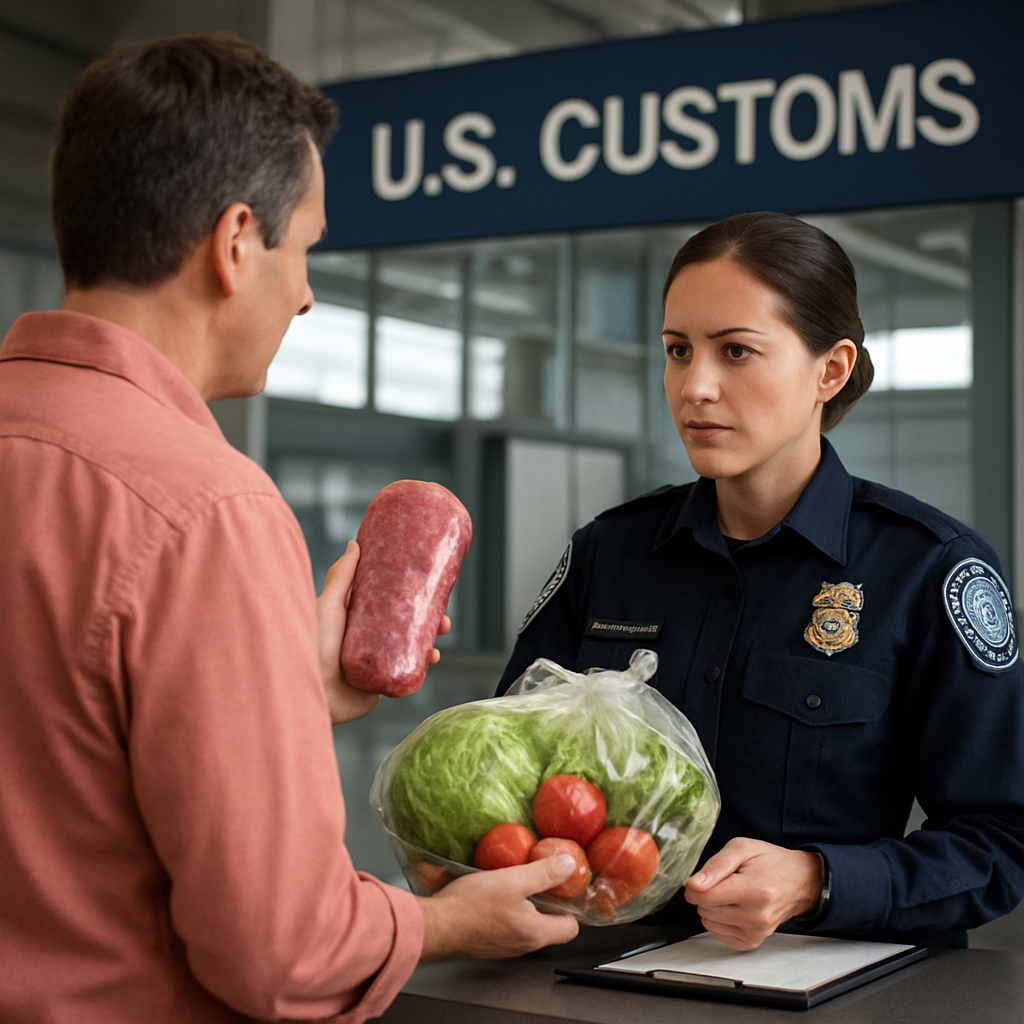
If you are bringing food into the United States, the safest rule is simple: declare it. U.S. travellers must declare meats, fruits, vegetables, plants, seeds, soil, animals, and plant or animal products to Customs and Border Protection, even if the item is sealed, cooked, cured, or bought commercially. Declaration is not the same as automatic refusal; officers or inspectors decide whether the food can actually enter after review.
That distinction matters because many travellers assume “sealed” or “snack food” means “no need to mention it”. In practice, if a food item could fall into an agricultural or animal-product category, it should be disclosed at the border rather than left out.
What food must you declare at U.S. customs?
The most direct answer is that you must declare food and agricultural items that fall under CBP and USDA inspection rules. The U.S. Department of Agriculture’s travel guidance says travellers entering the United States must declare all agricultural and wildlife products to CBP officials, and CBP states that all travellers entering the United States are required to declare meats, fruits, vegetables, plants, seeds, soil, animals, and plant and animal products they may be carrying.
In practical terms, “declare” means telling the officer about the item on your customs declaration or during inspection, not assuming it is allowed because it is in your hand luggage or looks harmless. If you are unsure, disclose it. As USDA explains, even if an inspector later determines that the item cannot enter, declaring it protects you from penalties that can arise from failing to mention agricultural goods in the first place.
You can read the official USDA travel guidance here: USDA guidance for travellers bringing agricultural products into the United States. CBP’s public reminder that travellers must declare meats, fruits, vegetables, plants, seeds, soil, animals, and related products is also posted here: CBP’s declaration reminder for agricultural items.
What happens after you declare food?
Declaring an item does not mean it will automatically be taken away. It means you have told the authorities what you are carrying, and they then decide whether the item may enter. That review can involve an officer at the primary inspection point or a specialist inspection depending on the product.
This is especially important for food because admissibility and declaration are separate questions. A product may be declared and still be allowed in. Another product may be declared and then refused entry because it does not meet U.S. requirements. The key point is that the inspection decision happens after declaration, not instead of it.
If you want a clearer explanation of the customs side of that process, see our guide to what happens if you have nothing to declare at customs. If you are worried about missing something, our article on what happens if you forget to declare items at customs explains the possible consequences and next steps.
Which foods are most likely to need declaration or inspection?
The foods most likely to trigger customs scrutiny are the ones with agricultural, animal, or plant-related risk. A helpful way to think about it is by category rather than by a rigid “allowed” or “banned” list.
- Meat and meat products — fresh, cooked, cured, dried, or processed meat items may still need declaration.
- Seafood — fish, dried seafood, shrimp, shellfish, and similar products can have separate requirements.
- Dairy and eggs — these can be treated differently from ordinary packaged snacks.
- Fresh fruits and vegetables — these are classic agricultural items and are commonly inspected.
- Plants, seeds, and plant products — even small quantities can matter.
- Soil-contaminated items — even soil on boots or equipment can trigger a declaration issue.
The official USDA guidance is clear that animal products are not treated exactly the same way as fruits and vegetables. That means you should not assume one rule covers everything. Seafood can also involve its own checks or restrictions, so a food item that looks like a simple travel snack may still be a regulated product if it is made from animal or marine ingredients.
If your item is plant-related, you may also want to understand plant import rules in more detail. Our article on phytosanitary certificates for importing plants into the USA covers the document side of plant entries and why plant material is taken seriously at the border.
Can I bring dried shrimp to the USA?
Dried shrimp is not a simple “snack food” question. It is a seafood item, so it belongs in the animal-product or seafood category rather than the shelf-stable snack category. That means it should be treated as a food that may need declaration and inspection, and you should not assume that being dried, sealed, or commercially packaged makes it exempt.
The correct approach is to declare it and let CBP or the appropriate inspection authority decide whether it can enter. That is consistent with the broader USDA and CBP rule that animal products and related foods are subject to special checks.
If you are carrying dried shrimp as a personal food item, keep it in its original packaging if possible and be ready to describe exactly what it is. Original packaging may help officers identify the item, but packaging alone does not decide admissibility.
What foods can you not cross the border with?
There is no short universal list that covers every food item for every traveller and every origin country, because admissibility depends on the category, the origin, and the current U.S. requirements. However, the foods most likely to be refused or restricted are usually the same high-scrutiny groups:
- meat and meat products;
- seafood and fish products;
- dairy and egg products;
- fresh produce;
- plants, cuttings, seeds, and propagative material;
- items contaminated with soil or plant debris;
- other agricultural products that may carry pests or diseases.
That is why the best practical answer is not “what can I hide in my bag?” but “what category does this food fall into?”. USDA’s traveller guidance focuses on agriculture risk, not on whether the item looks like a normal snack. Even cooked, cured, dried, or processed foods can still fall within the declaration requirement if they are meat-, seafood-, dairy-, or plant-based items that need review.
What about packaged snacks, condiments, and shelf-stable foods?
Many travellers carry snacks and shelf-stable foods without issue, but that does not create a blanket rule that all packaged foods are exempt. Common examples people often ask about include chips, crackers, cookies, candies, instant noodles, cereal bars, spices, ketchup, mustard, mayonnaise, Marmite, Vegemite, and prepared sauces that do not contain meat. These items may be allowed in many situations, but you still need to consider what they contain and whether they fall into a regulated category.
The useful rule here is that original packaging helps with identification, but it does not guarantee admissibility. A jar, packet, or factory seal is not the same thing as a customs clearance. If a snack contains meat, seafood, dairy, or other restricted ingredients, it may still need to be declared and inspected.
That is why the common traveller advice to “keep it in original packaging” should be treated as a practical tip, not a legal exception. The actual question at the border is whether the item can enter under U.S. requirements.
How food declaration differs from TSA screening
A lot of confusion comes from mixing up TSA screening with customs declaration. These are not the same process. TSA deals with airport security screening before or during boarding. CBP and USDA deal with what you are bringing into the United States at the border.
So, if you are asking, “Can I bring food in a Ziploc bag through TSA?”, that is a security-screening question, not a customs-admissibility rule. A Ziploc bag may be useful for packing or keeping items together, but it does not decide whether the food needs to be declared to CBP or whether it can enter the country.
In other words: even if TSA allows the container through airport security, you may still need to declare the food at U.S. customs. The container type does not replace the customs rule.
What should you do if you are unsure?
If you are not certain whether a food item needs to be declared, declare it. That is the safest and most practical approach for travellers. Border officers are trained to sort out what is acceptable, what needs inspection, and what may need to be surrendered or refused.
A useful rule of thumb is this: if it is food, and especially if it is meat, seafood, dairy, produce, plants, seeds, or anything with agricultural origin, mention it. Do not rely on the fact that it is small, sealed, dried, or commercially packaged.
For travellers bringing in plant-related goods, our guide to phytosanitary certificate for importing plants into the USA is a useful next step. If your question is really about broader customs behaviour rather than food alone, our article on what happens if you have nothing to declare at customs can also help you understand the declaration process.
Commercial food imports follow different rules
This article is about travellers carrying food in baggage, not about commercial food importing. If you are importing food for resale, distribution, or business use, the compliance picture changes significantly. FDA import procedures, prior notice requirements, and, in some cases, importer registration may apply.
For commercial imports, you should not rely on traveller baggage guidance. FDA notes that imported food products are subject to inspection when offered for import at U.S. ports of entry, and importers are responsible for ensuring products are safe, sanitary, and properly labelled under U.S. requirements. That is a different compliance path from a passenger declaration at customs.
If you are dealing with commercial food shipments rather than personal luggage, our article on U.S. importer registration requirements is a better starting point.
Bottom line
If you are wondering what food you need to declare at U.S. customs, the safest answer is: declare food and agricultural items whenever there is any doubt, especially meats, seafood, fruits, vegetables, plants, seeds, soil, and products made from animal or plant ingredients. Declaration does not mean automatic refusal; it means the item is reviewed properly. Packaged snacks may often travel without problems, but original packaging does not override the declaration rule.
When in doubt, tell the officer. That simple step is the best way to avoid avoidable problems at the border.