
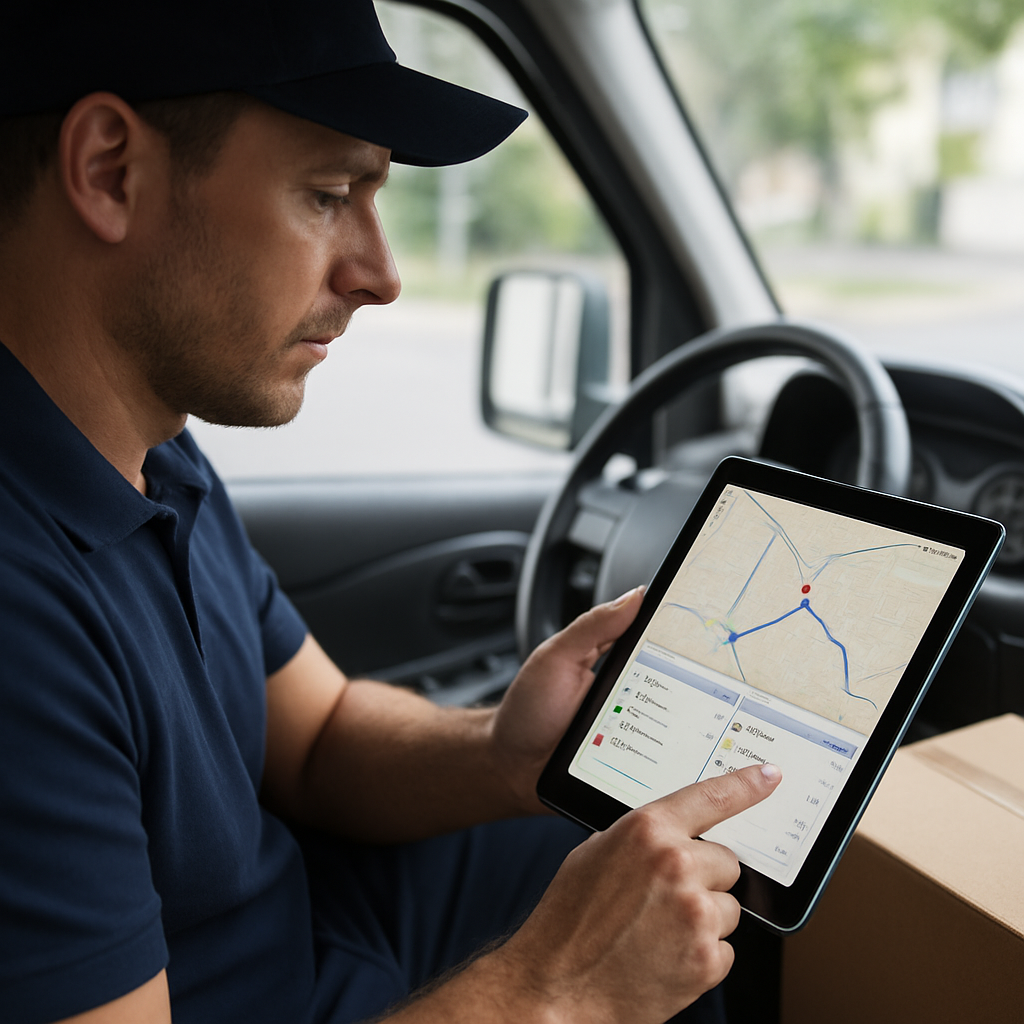
The best software for managing delivery drivers is usually a delivery management platform if you need dispatch, live tracking, proof of delivery, customer updates, and driver communication. If you mainly need routing, a route planner app may be enough. For smaller fleets and solo drivers, a lighter route-planning tool can be the best fit; for growing courier businesses and last-mile operations, an all-in-one platform is usually the smarter choice.
In practice, the right software depends on your fleet size, delivery model, and how much visibility you need over each stop. The strongest tools combine route optimisation, driver apps, real-time tracking, and proof of delivery so dispatchers and drivers are working from the same live plan.
What Is the Best Software for Managing Delivery Drivers?
There is no single universal winner. The best software depends on what your operation needs most:
- Solo driver or very small operation: a free or low-cost route planner can be enough.
- Small fleet: a route planner with driver communication and basic proof of delivery may be ideal.
- Growing courier business: an all-in-one delivery management platform is usually better because it adds dispatch, live tracking, customer notifications, and reporting.
- Larger last-mile operation: enterprise-style software with stronger automation, analytics, and integrations is often worth the cost.
If you are choosing for a shipping company, look beyond route planning alone. Shipping and delivery teams often need dispatch tools, real-time visibility, invoicing support, and operational control across the whole delivery process, not just the route on the day.
One relevant example is Cartrack’s delivery management software, which is positioned around route planning, real-time driver tracking, lower fuel costs, and faster deliveries. That makes it a useful reference point for businesses that want both visibility and route control in one platform.
How to Choose Delivery Software That Actually Helps Your Drivers
The best software for managing delivery drivers should make the job easier for both dispatchers and drivers. Look for these core features:
- Route optimisation: automatic stop ordering, multi-stop route planning, and traffic-aware navigation.
- Real-time tracking: live visibility of driver location and progress.
- Driver app: a mobile app for route lists, navigation, updates, and delivery confirmation.
- Proof of delivery: photo, signature, barcode scan, or timestamp confirmation.
- Customer notifications: ETA updates, delivery alerts, or status messages.
- Dispatch tools: the ability to assign, reassign, and adjust routes quickly.
- Analytics: reporting on miles driven, on-time rate, failed deliveries, and driver performance.
- Integrations: connections with e-commerce, warehouse, CRM, or order systems.
- Ease of use: simple setup for dispatchers and drivers, especially if your team changes often.
These are the features that matter most for day-to-day operations. A platform can look powerful on paper, but if drivers find it clumsy or dispatchers spend too long fixing routes, it will slow the business down rather than improve it.
That is also why route planning and warehouse preparation should be connected. If you want the broader operations picture, it may help to read our guide to warehouse management system features, since scanning, loading, and dispatch often flow into the delivery process.
Best Free Options for Delivery Driver Management
If you are searching for the best software for managing delivery drivers free, it is important to be precise about what “free” means. In this category, free usually means one of three things:
- a free route planner with limited stops,
- a limited free tier with fewer features, or
- a trial period rather than a permanent free plan.
According to the supplied research, Geo2 is described as the strongest free option for drivers handling multiple stops per shift. It is presented as a free delivery route planner on iPhone and Android with 15 stops, route optimisation, delivery list scanning, and proof of delivery included on the free version. That makes it particularly relevant for drivers and very small businesses that mainly need routing and stop management.
That same research also names Circuit and Zeo as alternatives with fewer features on their free plans. Those may still be useful if your needs are simple, but the trade-off is that free plans often cap the number of stops or limit the more business-critical features.
That limitation matters. If you need dispatch, live tracking, customer notifications, team visibility, or deeper reporting, you may outgrow a free route planner quickly. For a solo driver, a free tool can be enough. For an active delivery business, the value usually comes from the paid features.
Route Planning and Optimisation Features to Look For
Route planning is a core part of delivery-driver software, but not all route planners are built for the same type of operation. The best route planner app for your business depends on how many stops you run, how much flexibility you need, and whether you also want dispatcher tools.
Useful route-planning features include:
- Multi-stop routing for daily delivery runs.
- Automatic optimisation to reduce backtracking and wasted mileage.
- Traffic-aware navigation to improve timing across the day.
- Live rerouting when jobs change or traffic slows the route.
- Bulk address import for fast scheduling from spreadsheets or order files.
- Stop ordering based on delivery windows, distance, or priority.
The practical benefit is straightforward: fewer miles, lower fuel use, less dispatch time, and better on-time performance. That is why route planning is often the first feature businesses ask about, even when they later realise they also need tracking, communication, and proof of delivery.
The supplied research suggests a size-based view is the clearest way to compare route planners:
- Geo2 for free multi-stop route planning.
- Routella for an all-in-one setup with planning, driver app, proof of delivery, and live tracking.
- Routific for simple dispatcher workflows.
- Onfleet for larger last-mile operations.
- Route4Me for customisable routing needs.
- RoadWarrior for solo drivers and independent contractors.
If you want a broader comparison of route-planner tools, the article e-commerce last-mile delivery is a useful companion read because it puts delivery costs and tracking into the wider operational context.
Delivery Management Software for Shipping Companies and Last-Mile Teams
If your business operates as a shipping company, courier service, or last-mile delivery team, you usually need more than a standalone route planner. You need software that helps you manage the whole delivery workflow: dispatch, tracking, routes, driver communication, and often invoicing or operational reporting.
That broader category is usually called delivery management software or, in some cases, transport management software (TMS). The supplied research distinguishes this from pure route planning. For example, the Australian Software Advice result describes Consignmate as a cloud-based TMS designed to manage transport operations for carriers and senders. That is a different use case from a simple map-and-route app.
This distinction matters because shipping operations often involve more than just one driver making one route. You may need to coordinate multiple drivers, keep customers informed, monitor delivery status throughout the day, and review performance after the route is complete.
So, for shipping companies, the best software is usually the one that gives you:
- dispatch and reassignment tools,
- real-time driver tracking,
- route planning and route changes,
- driver communication,
- proof of delivery, and
- clear visibility across the fleet.
Which Route Planner Is Best for Different Types of Drivers?
Because the search often overlaps with route-planner queries, it helps to answer that directly. The best delivery route planner app depends on the type of operation you run.
| Use case | Best fit | Why it fits |
|---|---|---|
| Solo driver | RoadWarrior or another lightweight planner | Simple route optimisation and mobile-first use without unnecessary fleet features |
| Small business with limited stops | Geo2 | Free multi-stop planning, delivery list scanning, and proof of delivery on the free plan |
| Small fleet with dispatch needs | Routific or Routella | Good balance of route planning and dispatcher control |
| Growing courier business | Routella or Route4Me | Useful when you need routing plus more custom workflow options |
| Large last-mile operation | Onfleet or a similar enterprise platform | Stronger dispatch, analytics, and scaling features |
Routific is often a good fit when the dispatcher needs a simple view of the day and wants to adjust routes without a complex system. Route4Me is better when customisation matters more. Onfleet is aimed at larger last-mile operations, where the software needs to support heavier workflows and more drivers. RoadWarrior is the better fit for drivers who mainly need route guidance rather than team-wide management.
For a more practical operational perspective, the article start a courier service is useful if you are building or scaling a delivery business and want to see how software fits into the setup process.
Where Cartrack Fits in the Decision
Cartrack logistics is worth mentioning because it appears in the market conversation for a reason: it is positioned as delivery management software with route planning, real-time tracking, and fuel-saving benefits. The key idea in the supplied research is that it helps businesses plan routes, track drivers in real time, cut fuel costs, and deliver faster.
That makes Cartrack relevant for businesses that want fleet visibility, not just navigation. If your priority is monitoring drivers throughout the day, reducing avoidable mileage, and making route changes visible quickly, a platform like Cartrack belongs on the shortlist.
As always, the best choice still depends on your operation. A small team may not need the heavier tracking and management layer. A larger fleet or a business with strict delivery windows may find those features essential.
Which Delivery App Is Most Profitable?
This question is slightly different from software selection, but it comes up often enough to address briefly. Based on the supplied research, Amazon Flex is described as paying the highest consistent rate for parcel delivery, while DoorDash is described as having the highest order volume for food delivery in most U.S. markets.
That does not mean they are always the most profitable for every driver. Profitability depends on your market, vehicle costs, fuel, downtime, and how dense the order flow is in your area. A platform with high order volume can still be less attractive if the pay is weak or the miles are long. Likewise, a higher-paying parcel route may not suit every driver if access, scheduling, or operating costs make it less efficient.
If your real goal is to manage your own delivery drivers rather than choose gig work, this should stay secondary to the main software decision.
What Is the Best Delivery Driver Company to Work For?
For the same reason, this is only a secondary question here. The supplied research only supports a limited answer: Amazon Flex is noted as a strong parcel-delivery option in terms of consistent rate, and DoorDash is noted for high food-order volume in many U.S. markets. That is not a full company comparison, and compensation varies by location and working model.
If you are running a business, the more important decision is not which delivery company to work for, but which software will help your fleet run efficiently, stay visible, and keep drivers productive.
The Practical Bottom Line
If you want the shortest possible answer, here it is:
- Choose a free route planner if you are a solo driver or have a very small number of stops.
- Choose all-in-one delivery management software if you need dispatch, live tracking, proof of delivery, and customer communication.
- Choose a transport-management-style platform if you are managing shipping operations and need broader control across the fleet.
- Choose based on fleet size rather than brand name alone, because the best software for a two-driver operation is not the same as the best software for a large last-mile network.
In other words, the best software for managing delivery drivers is the one that matches how your team actually works: route-first for simple operations, or delivery-management software for anything that needs live control, team coordination, and customer-facing visibility.