
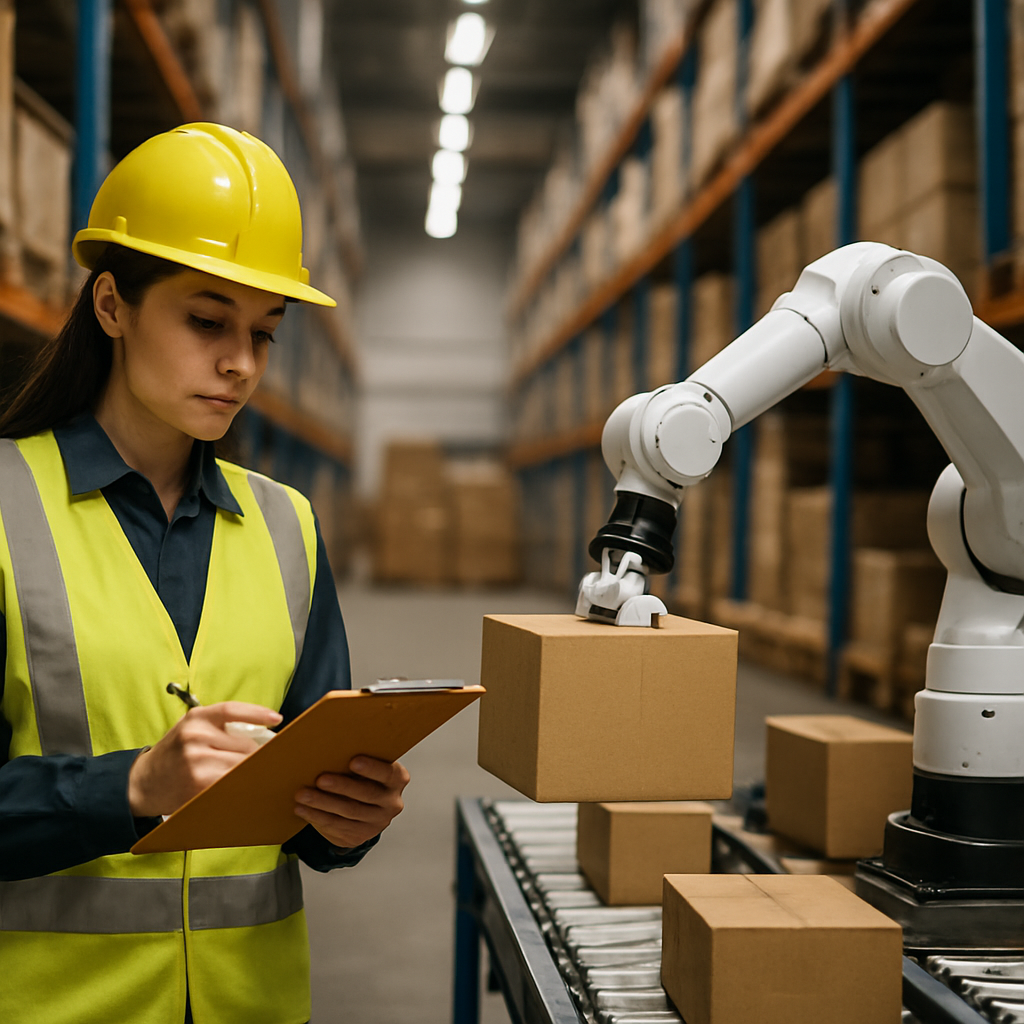
AI can replace parts of logistics work, but it is not replacing logistics as a whole. The clearest change is that routine, repetitive, rules-based tasks are being automated first, while people still handle supervision, exception management, supplier and carrier relationships, judgement, and complex decisions.
So the real question is not whether logistics will disappear. It is which parts of the job AI can do well, which parts it can only assist with, and which parts still need human oversight. In practice, AI is compressing entry-level clerical work and changing how logistics teams operate, rather than making logistics jobs vanish overnight.
Can logistics be replaced by AI?
The best-supported answer is no, not completely. AI is already taking over some tasks inside logistics, especially where the work is repetitive and data-heavy, but logistics itself is still a network of people, processes, contracts, compliance steps, and exceptions that do not run cleanly without human intervention.
That distinction matters. A logistics role can be partly automated without the whole job being replaced. For example, AI may handle quoting, tracking updates, document sorting, and simple customer-service triage, while humans still make trade-offs, resolve problems, and manage relationships. Sources covering current logistics adoption make that pattern very clear: AI is shifting the work, not eliminating the field. For a broader view of why the industry stays complex, see our guide to supply chain management obstacles.
Research from Extern’s supply chain job outlook says the field is not being replaced, but the entry-level layer is shrinking because AI agents are already taking over quoting, tracking, data entry, and paperwork. Similar themes appear in CrimsonLogic’s logistics and customs analysis, which emphasises that AI supports the right person with the right information at the right time rather than replacing judgement. NRC Canada also highlights route planning, delivery scheduling, workforce planning, and road-safety improvements as areas where AI can improve logistics efficiency, not remove the need for human coordination.
Which logistics tasks are most likely to be automated first?
The tasks most exposed to AI are the ones that are repetitive, rules-based, and easy to structure as workflows. In logistics, that usually means:
- data entry and record keeping
- routine quoting and booking
- shipment tracking and status updates
- paperwork processing
- document sorting and basic validation
- routine customer-service triage
- simple exception flagging
This is why the fear often starts with entry-level roles. A new hire in logistics or supply chain has historically spent a lot of time on administrative and clerical work: entering shipments, checking documents, updating systems, and responding to routine requests. AI is particularly strong at that kind of work because it can read, sort, match, and route information faster and more cheaply than a human doing the same manual steps.
Extern notes that logistics agents are already quoting freight, sorting customs documents, and flagging forecast exceptions. The same source also points to planning and recording clerks as a group under pressure. That does not mean every junior role disappears, but it does mean the “first year” of logistics work is being redesigned. In many businesses, fewer people are needed per load or per transaction because software is absorbing the repetitive layer.
That is also the main reason compensation questions come up. The likely change is not a single universal salary drop across logistics. It is task compression: some lower-value tasks disappear, some entry-level jobs become narrower, and more of the work shifts towards oversight, analytics, and exception handling. Because the available evidence does not provide reliable role-by-role wage figures, it would be misleading to claim exact salary changes.
Which logistics jobs are less likely to be fully replaced?
Jobs that depend on judgement, escalation, negotiation, coordination, and context are much harder to replace fully. AI can assist those roles, but it usually cannot take over the full human responsibility attached to them.
The most resilient logistics work tends to involve:
- handling exceptions and unusual cases
- managing suppliers, carriers, and customers
- making trade-offs when priorities conflict
- reviewing compliance and business context
- overseeing teams and process performance
- solving problems that do not fit a simple rule
That is why the question “What supply chain jobs are safe from AI?” is better answered as “Which work patterns are safer?” rather than “Which job titles are immune?” There is no completely future-proof logistics role. But jobs that rely on relationships, judgement, and operational oversight are clearly more resilient than jobs dominated by repetitive information processing.
Will AI replace operations managers?
Not the whole role. AI can take over parts of an operations manager’s workflow, such as status monitoring, reporting, forecasting support, and exception detection. But operations managers still have to manage people, priorities, service trade-offs, customer issues, and operational risks. They are accountable for decisions, not just data.
Equitable Growth’s analysis of generative AI in logistics argues that some logistics occupations have high exposure to task automation, especially administrative and routine cognitive work. That does not mean every manager is replaced. It means many managers will use AI to do parts of their work faster while spending more time on coordination, judgement, and oversight. Likewise, Adecco’s logistics workforce research finds that companies are not yet consistently prepared to use AI well, which reinforces the idea that human leadership remains essential during the transition.
What is AI already doing in logistics today?
AI is already being used as a decision-support and workflow-automation layer across logistics operations. The current use cases are practical, not futuristic.
- Vehicle routing and route planning: AI can help optimise routes, reduce empty miles, and improve delivery efficiency.
- Delivery scheduling: systems can improve time-slot planning and adjust for constraints.
- Demand forecasting: AI can identify patterns and help teams anticipate changes sooner.
- Document sorting and customs support: AI can detect missing information, sort paperwork, and flag anomalies.
- Tracking and visibility: AI can surface exceptions earlier so teams know what needs attention first.
- Workforce planning: tools can support staffing, capacity, and resource allocation decisions.
This is the most important practical change: AI increases visibility and reduces time spent hunting for problems. CrimsonLogic describes AI as moving teams from passive visibility to active visibility, meaning businesses see not just status, but what requires action. That is a significant operational gain, but it is still a support layer. It helps teams respond faster; it does not remove the need for teams.
NRC Canada’s work on logistics AI also points to route planning, delivery schedules, supply-chain decision-making, and workforce planning as core applications. And Thinking Inc’s 2026 logistics guide explains why logistics is especially suitable for AI-assisted operations: multi-party data, cross-border complexity, and real-time decisions create strong opportunities for automation, but also create integration and governance challenges. In other words, logistics is a good AI use case precisely because it is complicated, not because it can be run without people.
If you want a practical example of how AI sits inside the warehouse and operations stack, our article on warehouse management system features shows the kinds of processes where automation, visibility, and control already overlap.
How AI changes logistics costs, productivity, and hiring
The business impact of AI in logistics is less about total replacement and more about productivity, workflow redesign, and a changing mix of jobs.
Companies adopt AI because it can reduce manual workload, speed up routine processing, and cut the number of people required for some repetitive tasks. That can improve margins, especially where transaction volumes are high. It can also reduce the need for large junior teams doing clerical work. The result is a leaner workflow with fewer people doing repetitive tasks and more people managing exceptions, relationships, and higher-value decisions.
That shift affects hiring in a few ways:
- Entry-level roles become narrower: more of the routine work is automated.
- Analytical roles become more valuable: people who can interpret data and work with AI tools are more useful.
- Supervisory roles become more important: human review matters when systems flag exceptions or make recommendations.
- Training matters more: companies need workers who can use digital tools confidently.
Adecco’s logistics research is a useful reminder that many firms are not yet ready for the workforce side of AI. It reports low levels of future readiness, limited AI policy coverage, and weak formal training in many organisations. That suggests the transition is not simply a technology issue. It is also a skills, leadership, and change-management issue.
So if you are asking about the salary angle behind “Can logistics be replaced by AI?”, the honest answer is that AI is more likely to reshape pay structures indirectly than to produce one clear salary trend. Jobs centred on routine processing may face downward pressure because those tasks are easier to automate. Jobs involving judgement, coordination, and supervision are more likely to retain value. But exact salary changes depend on country, company, role design, and adoption speed, and the supplied evidence does not justify exact wage forecasts.
Is there a future in logistics jobs?
Yes, there is still a future in logistics, but the work will increasingly involve AI tools and stronger digital skills. The field is not disappearing; it is changing shape.
The next few years are likely to bring more AI-assisted routing, more automated document handling, more forecasting support, and more system-generated alerts. That means logistics workers will spend less time on repetitive admin and more time on supervision, problem-solving, and coordination. The work becomes more analytical and more exception-driven.
That is why the right five-year question is not “Will every logistics job be replaced?” but “Which parts of the job will be automated, and how do I stay useful as the work changes?” Jensen Huang’s comments, as reported by Business Insider, reflect a widely discussed view in industry: AI will do parts of jobs far better and faster, but it will not do every part of a job. That aligns with the logistics evidence here. The likely future is augmentation, not total substitution.
There are also reasons to think logistics demand will stay strong even as AI adoption rises. Logistics is tied to trade, delivery reliability, customs, supply continuity, and customer service. Those needs do not disappear just because software improves. Instead, the work shifts towards better coordination, faster decisions, and cleaner information flows.
What should logistics workers do now?
If you work in logistics, supply chain, freight forwarding, customs, or operations, the safest move is to become the person who can work with AI rather than compete with it.
- Build the fundamentals. Understand routing, documentation, customs steps, service levels, and exception handling.
- Improve data skills. Learn how to read dashboards, spot bad data, and interpret trends.
- Get comfortable with digital systems. AI works best when people know how to use the tools around it.
- Take one real operations project. The evidence from Extern specifically recommends at least one genuine operations project before applying for jobs.
- Develop judgement and communication. The more your work depends on coordination and problem-solving, the more resilient it becomes.
- Stay open to reskilling. AI adoption will keep changing the mix of tasks inside logistics roles.
That advice also applies if you are aiming for freight, customs, or warehousing work. If you need a better understanding of the human side of forwarding and carrier relationships, our article on freight forwarding companies is a useful companion read. And if your work touches clearance or documentation, you may also find our guide to import customs clearance helpful, because those are precisely the areas where AI can assist but not fully replace judgement.
What this means for logistics teams and employers
For employers, the message is just as clear: the goal is not to replace the entire logistics function with AI. The goal is to remove repetitive work, surface exceptions faster, and let experienced staff focus on decisions, service recovery, and strategic coordination.
That usually means investing in three things at the same time:
- Data infrastructure: AI cannot help much if the underlying data is fragmented or poor quality.
- Workflow design: teams need to know when AI should automate, when it should escalate, and when a human must decide.
- Workforce enablement: staff need training, not just software access.
Thinking Inc’s research points out that many logistics organisations are still early in their AI maturity journey and that a large share of AI initiatives stall because the people and systems side is not ready. That is an important warning. In logistics, bad implementation can create more confusion, not less. A useful way to think about adoption is to treat AI as part of the operating model, not as a magic replacement for staff.
If your operations touch customs timing and deadlines, human oversight stays especially important. Compliance deadlines are not just administrative details; they can affect release timing, payment obligations, and downstream delivery. Our article on customs duty payment deadlines explains why time-sensitive compliance still needs careful human control even when systems are automating parts of the process.
The short answer
Can logistics be replaced by AI? Not fully. AI is already replacing some tasks inside logistics, especially repetitive clerical work, tracking, quoting, paperwork, and routine triage. That means entry-level work is under the most pressure first. But logistics as an industry still depends on human judgement, exception handling, relationship management, compliance awareness, and operational leadership.
The most accurate way to think about the future is this: AI will replace parts of logistics jobs, reshape hiring, and change the skills people need, but it will not eliminate the need for logistics professionals. The people who stay valuable will be the ones who can supervise systems, solve exceptions, manage stakeholders, and make good decisions when the workflow stops being routine.