Evaluating Infor Customs Compliance Software: A Comprehensive Supply Chain Analysis
Understanding Trade Compliance and the Infor Ecosystem
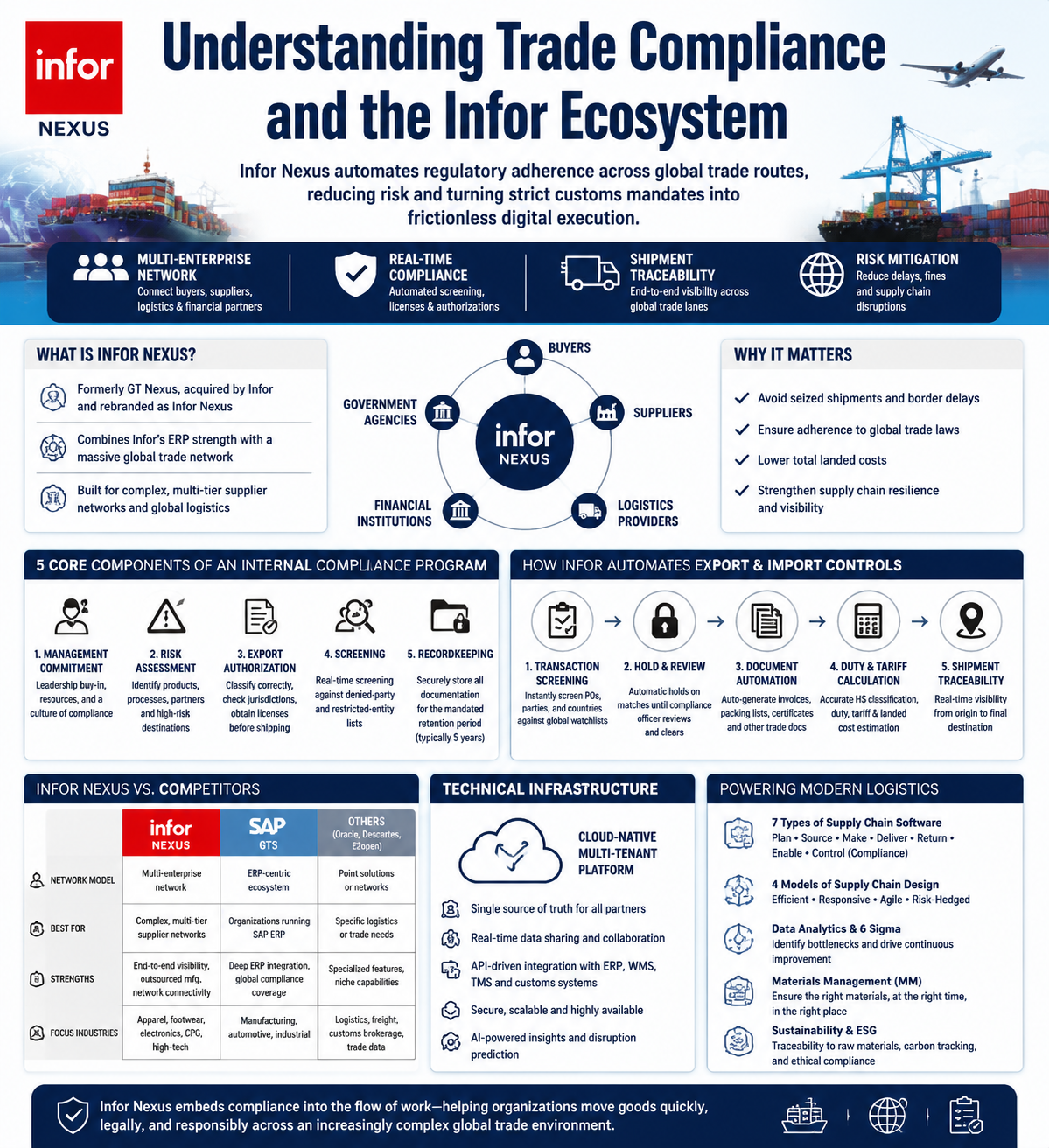
When evaluating the supply chain management company Infor on customs compliance software, the bottom line is clear: Infor Nexus operates as a dominant multi-enterprise network that automates regulatory adherence across complex global trade routes. By seamlessly integrating an Internal Compliance Program (ICP) directly into the procurement and shipping lifecycle, Infor minimizes the risk of international trade violations. Organizations relying on this platform gain immediate access to party screening, precise export authorizations, and real-time shipment traceability. For logistics leaders seeking to mitigate border delays and regulatory fines, Infor delivers an operational framework that translates strict customs mandates into frictionless digital execution.
Which software is commonly used for supply chain management to handle these intense regulatory burdens across international borders? The market offers numerous robust solutions, but Infor frequently emerges as a top-tier choice for massive multinational corporations managing highly complex supplier networks. The platform acts as the nerve center for international logistics, combining broad network visibility with highly specialized trade compliance modules. When goods cross borders, customs authorities demand absolute transparency regarding product origins, exact material compositions, and the ultimate end-users. Failing to provide this documentation instantly can result in seized shipments, massive supply chain bottlenecks, or devastating financial penalties that can cripple a business.
To fully grasp the architecture of this specific solution, one must first understand the historical difference between Infor and Nexus. Previously, GT Nexus operated as a highly respected, independent cloud platform dedicated exclusively to global logistics and trade management connectivity. Infor, a major technology provider owned by substantial private equity, acquired GT Nexus and subsequently rebranded the vast network as Infor Nexus. This strategic acquisition successfully merged Infor’s deep, traditional enterprise resource planning capabilities with a massive, pre-existing network of global buyers, international suppliers, and financial institutions. Supply chain practitioners frequently ask if traditional platforms will be replaced AI technologies in the near future. While artificial intelligence is fundamentally rewiring how data is processed, it is not replacing the foundational systems of record; rather, it is significantly augmenting their capabilities. Infor has heavily embedded advanced AI into its customs compliance software to predict disruptions long before they occur.
Core Principles of an Internal Compliance Program
An Internal Compliance Program for export control serves as a formal set of internal policies, procedures, and controls designed specifically to ensure an organization adheres to strict national and international trade laws. What are the 5 components of a highly functional ICP that can withstand intense government scrutiny? While different global regulatory bodies might emphasize specific regional nuances, building an essential elements guide always requires a focus on management commitment, rigorous risk assessment, strict export authorization protocols, continuous denied-party screening, and meticulous recordkeeping. These core pillars form the absolute foundation of corporate responsibility in global trade execution. Without absolute leadership buy-in and sufficient operational resource allocation, even the most technologically advanced software will ultimately fail to prevent the illegal transfer of sensitive technology.
Risk assessment within a functional ICP requires regular, highly detailed evaluations of company operations to identify specific operational vulnerabilities, highly sensitive products, and potentially high-risk geographic destinations. The U.S. Bureau of Industry and Security (BIS) strictly oversees commercial and dual-use items under the Export Administration Regulations, mandating that companies know exactly where their products are going and who will ultimately use them. Organizations must establish clear, documented protocols for precise product classification and strict jurisdiction checks, applying for required government licenses long before a shipping container ever reaches the physical port. In simple words, if a company attempts to ship a legally restricted item without securing the proper authorization first, the resulting government audit will ruthlessly uncover every systemic failure within the organization’s broader compliance framework.
Routine, automated screening of all active clients, vendors, intermediaries, and supply chain partners against official denied-party and restricted-entity lists represents another non-negotiable defense mechanism. The U.S. Office of Foreign Assets Control heavily enforces economic and trade sanctions, and its extensive restricted lists are updated on a continuous basis. A legally compliant organization simply cannot rely on periodic, annual manual reviews; it must screen every single transaction in real time. For companies looking to fortify their operations, modern trade compliance software automatically updates these critical restricted lists, ensuring that bad actors are flagged instantly before any money changes hands. Furthermore, secure, encrypted recordkeeping systems must store all relevant export documentation, detailed shipping records, and approved licenses for the legally mandated retention period, which typically spans a full five years.
How Infor Automates Export and Import Controls
When analyzing exactly how Infor executes its strict compliance mandates, we can examine some examples of its practical, daily application in the field. The moment a new purchase order is generated within the secure Infor Nexus environment, the system immediately cross-references the transaction against current global denied party lists and specific embargoed country logistics restrictions. If a potential match occurs during this scan, the software automatically places an unyielding hard hold on the transaction, preventing any further financial processing or physical movement of goods until a designated corporate compliance officer officially reviews and clears the case. This highly automated, instantaneous intervention completely removes the dangerous possibility of human error during the vital initial screening phase.
The platform also demonstrates exceptional capability when managing the highly complex, paper-heavy documentation requirements associated with international freight movement. As physical goods move rapidly through the five major flows a modern supply chain relies on—product, financial, information, value, and risk—the software automatically generates and flawlessly compiles the necessary commercial invoices, detailed packing lists, and official certificates of origin. By fully digitizing these historical records, Infor ensures that external customs brokers and strict government agencies receive perfectly formatted, error-free data packets the exact moment a shipment arrives at the national border. This seamless, instantaneous information transfer dramatically accelerates customs clearance times and significantly reduces the risk of expensive demurrage charges at heavily crowded ports.
For large organizations managing massive volumes of inbound freight, robust import compliance automation is just as essential as strict export control. Implementing specialized platforms that offer leading import compliance automation for inbound goods allows companies to precisely calculate complex duties, variable tariffs, and total landed costs long before the physical inventory ever leaves the overseas supplier’s warehouse. Infor utilizes highly advanced algorithms integrated with its supply chain traceability solutions to accurately classify products according to the complex Harmonized System, ensuring that corporate importers pay the exact legal tariff rate. This precise mathematical capability is particularly vital for companies sourcing complex, multi-component manufactured goods from multiple international vendors, where slight product misclassifications can quickly result in massive, unexpected financial liabilities.
Competitive Analysis: Infor Versus SAP and Other SCM Giants
When heavily evaluating enterprise software investments, a natural question always arises for procurement teams: Who are Infor’s main competitors in this highly specific technological niche? The software landscape is fiercely contested by some of the SCM top 10 companies globally, including massive players like SAP, Oracle, Descartes, and E2open. SAP Global Trade Services (GTS) is very often considered the heaviest hitter in the compliance space, seamlessly integrating with the massive, widely adopted SAP ERP ecosystem. Corporate buyers frequently debate fiercely whether a specialized tool like Infor is better or whether SAP best suits their specific, highly customized operational needs. The final answer largely depends on the organization’s existing technological infrastructure and its primary, long-term supply chain focus.
SAP typically dominates heavily within massive organizations that already run core SAP modules for their daily financial and heavy manufacturing operations, as the native, out-of-the-box integration completely eliminates dangerous data silos. However, Infor Nexus shines brightly and consistently outperforms competitors for companies that rely heavily on outsourced, contract manufacturing and complex, multi-tier global supplier networks. The Infor Nexus platform was built strictly from the ground up as a true multi-enterprise network, making it exceptionally strong at deeply connecting completely disparate trading partners across the globe. For companies heavily involved in fast-moving apparel, seasonal footwear, and high-tech component manufacturing, Infor’s unique network-centric approach often provides vastly superior end-to-end visibility compared to traditional, inside-out ERP architectures.
Other significant industry players also offer highly compelling, feature-rich solutions that successfully address key issues in complex international logistics. To remain fiercely competitive against the biggest players in the SCM industry, Infor continues to invest heavily in its advanced sustainability tracking and rigorous ESG reporting capabilities. As powerful governments worldwide implement increasingly strict regulations regarding carbon emissions and forced labor, the unique ability to accurately trace a product’s origin completely back to the raw material level has become a massive, undeniable competitive advantage. The largest company in any given sector cannot ignore these mandates, pushing them toward specialized compliance frameworks rather than relying on basic, generalized tools.
The Technical Infrastructure Powering Modern Logistics
Modern, highly resilient supply chain management relies on incredibly sophisticated, cloud-based technical frameworks to securely process millions of concurrent, high-value transactions. Exploring the 7 types of supply chain software—ranging broadly from demand planning and physical execution to network visibility and strict trade compliance—reveals exactly how deeply interconnected these digital systems have truly become. Modern organizations very often deploy four models of supply chain design, depending entirely on their specific strategic need for rapid agility versus strict cost efficiency, and the chosen software must adapt seamlessly to these high-level strategic choices. By intelligently utilizing advanced data analytics and rigorous 6 sigma methodologies, successful companies can identify the exact operational bottlenecks in their daily customs clearance processes and swiftly implement targeted, data-driven improvements to significantly reduce total cycle times.
The underlying technical architecture of Infor Nexus heavily leverages modern, multi-tenant cloud computing to successfully provide a single, undeniable version of the truth for all connected network participants. When a contract manufacturer, a third-party logistics provider, and a global financing bank all look at the exact same transaction record simultaneously, costly disputes regarding the C’s pillars of professional supplier communication—clear, concise, concrete, correct, coherent, complete, and courteous messaging—are practically eliminated entirely. This highly shared, transparent visibility extends very deeply into the vital P’s procurement strategies, ensuring that daily purchasing decisions align perfectly with both strict financial targets and rigid legal compliance mandates. If a monitored supplier has program deficiencies regarding their legally required safety or ethical certifications, the automated system immediately restricts their ability to receive any new purchase orders.
Understanding fundamental Materials Management (MM basic principles is absolutely necessary to fully appreciate how physical inventory accurately flows through this highly complex digital ecosystem. A multinational corporation simply cannot maintain consistent market dominance if its global supply chain constantly suffers from unpredictable regulatory delays at the border. By deeply embedding an aggressive, highly automated trade compliance program directly into the daily operational workflow, a platform like Infor ensures that all physical goods move quickly, safely, and entirely legally across all international borders. As the global trade environment grows increasingly complex and heavily regulated by multiple jurisdictions, relying on outdated manual processes or disconnected spreadsheets is simply no longer a viable, long-term strategy for corporate survival.





One Comment