Infor Nexus for Customs & Trade Compliance: Capabilities, Limits and Evaluation Checklist
 Import Export
Infor Nexus can be evaluated as a multi-enterprise supply-chain platform that may support trade-compliance-related workflows, supply-chain visibility, collaboration, documentation and traceability. It is not, however, safe to assume that every Infor Nexus deployment includes customs filing, classification, sanctions screening, export controls or tariff-and-duty calculation. A buyer should confirm the licensed products and services, country coverage, data sources, integrations and operating model for their own trade lanes before treating the platform as a compliance solution.
This guide evaluates Infor Nexus against the questions that matter to customs, supply-chain, procurement, IT and compliance teams:
- import controls, classification, tariffs, duties and landed-cost inputs;
- export-control workflows, including classification, licences and approvals where applicable;
- sanctions and denied-party screening;
- documentation, traceability, broker or filing connectivity and audit evidence;
- ERP, supplier and shipment-data integration;
- governance, exception handling and implementation ownership; and
- fit versus ERP-native and specialist global-trade tools.
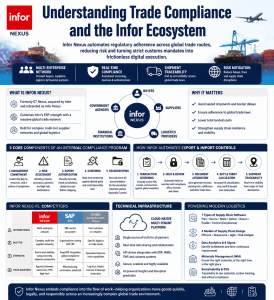
Evaluating Infor Customs Compliance Software
What Infor Nexus is—and what to verify for customs compliance
Infor Nexus is positioned within Infor’s broader supply-chain-management offering as a multi-enterprise network: a platform intended to connect buyers, suppliers, logistics providers and other trading partners around shared supply-chain processes and information. Its heritage includes GT Nexus, the cloud network that Infor acquired and subsequently brought into the Infor Nexus brand. That background helps explain why supplier collaboration, order and shipment visibility, and network participation are important considerations in an Infor Nexus evaluation.
Those strengths do not automatically answer a customs-compliance requirement. Customs compliance, global trade management, export controls and supply-chain visibility overlap, but they are different functions. Visibility can show where a shipment is and who supplied it; it does not by itself determine a tariff classification, establish licence eligibility or make a customs declaration correct.
Infor’s supply-chain-management information can provide useful vendor context. During discovery, ask Infor to identify precisely which components, partner services, data subscriptions and integrations are included in the proposed scope, and which workflows remain with an ERP, customs broker, freight forwarder or internal team.
Best fit and areas to validate carefully
- Infor Nexus may merit a shortlist where supplier-network coordination, outsourced or contract manufacturing, purchase-order and shipment collaboration, and cross-party visibility are material to the operating model.
- Validate carefully where the business needs jurisdiction-specific customs filing, extensive tariff or trade-remedy analysis, formal export-licence management, sophisticated screening policies, preferential-origin analysis or highly specialised local customs processes.
- Start with the existing landscape. The practical fit depends on the ERP and product-master environment, countries and trade lanes, broker model, transaction volume, product complexity and the capability of the internal compliance team.
Customs compliance, trade compliance and visibility are not the same thing
Supply-chain software is not one category. ERP, planning, warehouse and transportation systems each address different parts of the flow of goods. Multi-enterprise networks and visibility tools coordinate information among partners. Global-trade and customs-compliance tools focus on regulatory controls and trade data. A business may use one platform for several functions, or connect specialist systems.
Customs and trade compliance are cross-functional controls rather than a final task at the border. They draw on sourcing, supplier data, product master data, procurement, order management, shipping, brokerage, finance and records management.
| Area | Plain-language purpose | What a buyer should map |
|---|---|---|
| Supply-chain visibility and collaboration | Shares order, production, shipment and supplier information across trading partners. | Whether the required parties, events and documents are connected and usable in the chosen workflow. |
| Import and customs compliance | Supports the information and controls needed to import goods lawfully and manage customs exposure. | Classification, origin, valuation, duty/tax/fee treatment, broker hand-off, declarations and post-entry needs. |
| Export compliance | Controls exports that may be subject to classification, licensing, destination, end-use or end-user restrictions. | Jurisdiction and classification data, licence decisions, approvals, holds, releases and records. |
| Sanctions and denied-party screening | Checks relevant parties and transactions against applicable restricted-party and country controls. | Screening points, list source, matching, review process, rescreening and evidence. |
| Tariff, duty and origin management | Uses product and transaction facts to estimate or determine applicable border charges and preference opportunities. | Data source, update process, origin evidence, valuation inputs, applicable measures and expert review. |
For every required workflow, record whether it is delivered by a documented Infor capability, an integration, a partner service or a manual control. This prevents a visibility feature, a document repository or a broker connection from being mistaken for a complete regulatory control.
Infor Nexus customs and trade-compliance evaluation matrix
The following is an evaluation checklist, not a confirmed feature list. Use it in requirements workshops and demonstrations, then record the evidence received for the specific Infor solution being considered.
| Requirement area | Business question | Workflow to verify | Data or integration dependency | Evidence to request | Accountable owner |
|---|---|---|---|---|---|
| Product classification | Can products be classified, reviewed and governed for the relevant jurisdictions? | Creation, versioning, approval, effective dates and exception handling. | Product master, technical specifications and classification data. | Demonstration using representative products; data model and audit trail. | Trade compliance and product-data owner |
| Tariff, duty and landed cost | Can the business use reliable trade data for its planning or entry processes? | Duty/tax/fee logic, updates, origin and valuation inputs, corrections. | Tariff data service, origin, valuation, trade lane and product data. | Data-source description and test calculations for real scenarios. | Customs, finance and sourcing |
| Origin and preference | Are origin and preferential-treatment needs in scope? | Supplier evidence collection, origin review and preference reporting. | Bill of materials, supplier declarations and manufacturing data. | Configured workflow and sample supporting evidence. | Customs and sourcing |
| Import documentation and broker hand-off | Can required transaction information reach the broker or filing process accurately? | Document collection, validation, transmission, acknowledgements and exceptions. | Order, shipment, commercial and broker interfaces. | Interface design, error handling and test transaction. | Logistics and customs |
| Export controls | Can export-control reviews be routed and evidenced? | Classification, licence review, approvals, holds/releases and record retention. | Product, customer, destination, end-use and licence information. | Role-based workflow demonstration and audit record. | Export compliance |
| Sanctions screening | Are the right parties and transactions screened at the right points? | Matching, alert review, disposition, rescreening and escalation. | Customer, supplier, consignee, bank, address and shipment data; screening data provider. | List/update process, match examples and case-management audit log. | Sanctions compliance |
| Auditability and records | Can the business reconstruct what happened and who approved it? | Search, immutable history where required, document linkage and reporting. | User identity, transaction events and document repository. | Audit-report example and retention configuration. | Compliance, legal and IT |
| Supplier traceability | Can supplier and origin information support the intended compliance processes? | Supplier onboarding, attestations, document collection and exception follow-up. | Supplier participation and master-data governance. | Supplier journey, completion metrics and exception workflow. | Sourcing and supplier management |
Import compliance: assessing tariffs, duties and customs data
Import compliance is more than producing commercial paperwork. An importer may need reliable controls over tariff classification, country of origin, customs value, duty and tax inputs, applicable trade measures, broker instructions, entry corrections and audit support. The exact treatment depends on the jurisdiction, product facts, origin, valuation, current law and the particular transaction.
When evaluating Infor for import compliance, ask who owns each classification and how changes are controlled. A workable process normally needs a source for tariff data, an update process, clear effective dates, technical product information and a review route for uncertain classifications. It should also show how country-of-origin and valuation data are supplied, checked and passed to downstream processes.
Use representative products to test the proposed workflow. Include a product with multiple materials or components, an origin change, a supplier change and a trade lane with meaningful duty exposure. Ask the vendor and your customs specialists to explain what data is used, what the output represents, what assumptions apply and how an exception is corrected. No software output should be treated as a legal conclusion without the appropriate internal review.
For inbound programmes, it can also be useful to compare the requirements with specialised platforms that offer leading import compliance automation for inbound goods. The purpose is not to assume that one category always wins; it is to identify whether a proposed Infor scope covers the import controls the business actually needs.
Infor’s supply chain traceability solutions may be relevant where origin, supplier or product-history information needs to be collected across a network. Confirm whether the required origin evidence, classification governance and customs workflow are available in the proposed design rather than assuming traceability alone provides them.
Export compliance: test controls beyond shipment documentation
Export documentation and export-control compliance are related but distinct. A commercial invoice or packing list may be necessary for a shipment, yet export controls can also require decisions about product jurisdiction or classification, destinations, end users, end use, licences and internal approvals. The rules and obligations vary substantially by jurisdiction and transaction.
For an export-compliance assessment, test whether the solution can support the organisation’s required workflow for:
- maintaining product jurisdiction and export-classification information;
- linking customer, consignee, destination and end-use information to the transaction;
- routing potentially controlled transactions for compliance review;
- recording licence determinations, conditions and approvals where applicable;
- applying a controlled hold or release process if that is part of the company’s policy;
- handing approved instructions and documents to freight forwarders or other execution partners; and
- retrieving the decision history and supporting records during an audit or internal review.
Software can make a workflow more consistent and visible, but it does not replace legal determinations, product-classification decisions or the company’s own export-compliance programme. A qualified legal or compliance professional should validate controls against the laws that apply to the business.
Sanctions and denied-party screening: questions to ask Infor
Sanctions and denied-party screening require more than a claim that a system screens names. A buyer should establish who is screened, when screening occurs, which data sources are used, how potential matches are reviewed and how decisions are retained. The appropriate design depends on the organisation’s risk assessment and applicable law.
Ask Infor or any proposed service provider to demonstrate the following points in the intended configuration:
- the entities and data fields that can be screened, such as customers, suppliers, consignees, intermediaries, banks and addresses;
- screening points in the customer, supplier, order, shipment and payment lifecycle;
- the restricted-party or sanctions-list data provider, update approach and geographic scope;
- match settings, transliteration and other match-quality controls relevant to the business;
- how a possible match is assigned, investigated, documented, escalated and closed;
- whether and how previously cleared parties or open transactions are rescreened under the company policy;
- the relationship between an alert and any transaction hold, release or downstream execution step; and
- the audit logs and reports available to compliance management.
Screening technology can help identify names or transactions that need review. It does not independently resolve beneficial ownership, end-use, diversion risk or legal-risk determinations. Those require appropriate investigation, governance and escalation.
Turn an internal compliance programme into software evaluation criteria
An Internal Compliance Programme (ICP) is a set of policies, procedures and controls used to manage trade-compliance risk. The exact contents should be tailored to the organisation and the laws that apply to it. As an evaluation framework, five practical areas are particularly useful: governance, risk assessment, classification and authorisation controls, screening and escalation, and records and auditability.
| ICP area | What to ask of the system | What remains the company’s responsibility |
|---|---|---|
| Governance | Can roles, approvals, segregation of duties and escalation paths be configured and reported? | Setting policy, assigning accountable people and funding the programme. |
| Risk assessment | Can risk attributes, alerts and exception queues be surfaced in relevant workflows? | Identifying high-risk products, destinations, customers, suppliers and trade lanes. |
| Classification and authorisations | Can classifications, licences, conditions, effective dates and approvals be maintained with evidence? | Making defensible legal and technical determinations and applying for authorisations where needed. |
| Screening and escalation | Can potential matches be routed, reviewed and documented according to policy? | Choosing the policy, investigating alerts and deciding whether activity may proceed. |
| Records and auditability | Can transaction history, documents, decisions and user actions be retrieved? | Defining retention requirements and ensuring they meet applicable legal and business obligations. |
Retention periods, screening requirements and recordkeeping obligations vary by jurisdiction, product, transaction and applicable law. Obtain advice from qualified legal and compliance professionals rather than relying on a generic software configuration as a statement of legal compliance.
Implementation, integration and data readiness
Enterprise compliance automation succeeds or fails on operating discipline as much as software functionality. A strong demonstration should be followed by an implementation assessment that covers the information entering the workflow, the people who resolve exceptions and the systems that execute or report the transaction.
- Master data: assess completeness and ownership of product descriptions, classifications, origin, valuation inputs, parties, addresses and legal entities.
- Integration: map the ERP, procurement, order-management, warehouse, transportation, broker and freight-forwarder interfaces. Define the system of record for each critical field.
- Supplier participation: establish which suppliers must submit origin, manufacturing, document or traceability data, and how missing or conflicting data is chased.
- Roles and exceptions: design queues, approval limits, service expectations and escalation routes for classification uncertainty, document failures and screening alerts.
- Testing: run representative trade lanes, products, parties and exception cases through the full process before relying on it operationally.
- Security and audit readiness: involve IT and security teams in access controls, data handling, logging, reporting and evidence retrieval.
- Ongoing maintenance: assign responsibility for regulatory and data updates, user training, configuration changes and periodic control reviews.
Software can support, but cannot replace: legal interpretation, product and export classification decisions, licence decisions, escalation judgements, supplier-data stewardship and executive compliance governance.
Proof-of-capability scenarios for a vendor demonstration
Feature lists are not enough. Ask the vendor to use controlled examples based on your own products, countries, systems and roles. The following scenarios reveal both capability and operational dependencies:
- New imported product: introduce a product requiring classification and landed-cost review, including the source and approval of the product data.
- Supplier or origin change: change the supplier or origin and show the resulting review, downstream impact and audit history.
- Possible denied-party match: create a potential match, then show assignment, investigation, documented disposition, release or escalation and reporting.
- Controlled export: use an export that needs internal classification or licensing review and demonstrate how the transaction is prevented from moving ahead until the company’s authorised decision is recorded.
- Broker or customs-document exception: show an incomplete or conflicting document/data case, correction workflow, communication with the relevant partner and final evidence.
- Audit request: retrieve the transaction history, involved parties, data changes, approvals and linked documents for a completed shipment.
Request a written response identifying what is standard functionality, what needs configuration, what relies on an integration or partner, and what remains manual. That distinction is often more valuable than a broad statement that a platform “supports compliance”.
Comparing Infor Nexus with SAP, Oracle, Descartes, E2open and specialist tools
There is no universal best customs-clearance or trade-compliance platform. SAP, Oracle, Descartes, E2open and other providers may all be relevant depending on the requirement. ERP-native options can be attractive where the organisation wants tight alignment with an established ERP and product-master environment. Network-oriented platforms such as Infor Nexus may be especially relevant when collaboration with a large, distributed supplier and logistics network is central to the problem. Specialist global-trade products may deserve close review where regulatory depth in specific jurisdictions is the primary driver.
The useful comparison is fit-based rather than a claim that one vendor consistently outperforms another. For broad context on trade-compliance software categories, see modern trade compliance software; use vendor material as a starting point for questions, not as a substitute for validating a proposed solution.
| Decision criterion | Question for Infor Nexus and alternatives |
|---|---|
| Current systems and master data | Which system owns products, classifications, parties, origin and shipment data, and how will data conflicts be handled? |
| Supplier collaboration | How effectively can the required suppliers, manufacturers, brokers and logistics providers participate in the workflow? |
| Trade-compliance depth | Which import, export, screening, licensing, tariff, origin and recordkeeping workflows are demonstrably covered? |
| Filing and broker connectivity | Which countries, broker relationships, message formats and acknowledgements are within scope? |
| Geographic coverage | Does the proposed design support the actual countries, entities and trade lanes, including local regulatory requirements? |
| Implementation model | What configuration, data cleansing, integration, supplier onboarding and change management are required? |
| Reporting and auditability | Can compliance and internal-audit teams produce the required evidence without manual reconstruction? |
| Total operating ownership | Who maintains data, handles alerts, manages regulatory change and supports users after go-live? |
Conclusion: when to shortlist Infor Nexus
Infor Nexus may be worth shortlisting for organisations that need multi-enterprise visibility and collaboration alongside compliance-related workflows, particularly where supplier-network coordination, outsourced manufacturing or cross-party shipment information is important. Its suitability should be demonstrated against the company’s actual customs, import, export, sanctions and tariff requirements—not inferred from a general supply-chain platform description.
Organisations with deep jurisdiction-specific filing, classification, screening, licensing, tariff or preferential-origin requirements should validate those workflows, data sources, integrations and implementation responsibilities in detail. Build a documented requirements matrix, test representative scenarios and compare the result with the existing ERP environment and relevant specialist alternatives. That approach produces a more reliable decision than treating any single platform as an automatic solution to every trade-compliance obligation.


One thought on “Infor Nexus for Customs & Trade Compliance: Capabilities, Limits and Evaluation Checklist”