Systems Delivering Top Accuracy in Customs Duty Estimation and Reconciliation
 Import Export
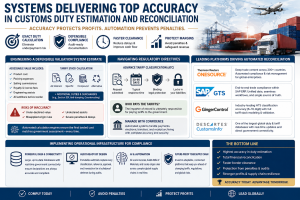
The systems delivering top accuracy in customs duty estimation and reconciliation combine deep, data-sensitive HTS classification engines with automated tariff stack modeling. Leading platforms—such as GingerControl for iterative classification, Descartes CustomsInfo for massive global trade databases, Thomson Reuters ONESOURCE, and SAP GTS for enterprise ERP-integrated workflows—provide the exact defensive infrastructure needed to avoid audits. To navigate modern global trade, importers and brokers must abandon manual spreadsheet estimations in favor of reconciliation-grade software that calculates the complete tariff stack. Absolute accuracy ensures corporate profit margins remain entirely intact while simultaneously mitigating the threat of devastating financial penalties from federal authorities.
Systems Delivering Top Accuracy in Customs Duty Estimation and Reconciliation
Engineering a Defensible Valuation System Estimate
Establishing a reliable valuation system estimate stands as the absolute bedrock of global trade compliance for modern logistics operations. When compliance officers ask exactly how the assessable value calculated for duty impacts bottom-line profit margins, the core answer lies in strict adherence to statutory frameworks. Rather than relying on simple baseline product costs, a complete assessable value must incorporate packing expenses, selling commissions, royalty fees, and specific licensing arrangements before the goods ever physically cross a border. Misinterpreting these highly technical financial variables leads directly to underpayment, triggering aggressive and prolonged audits from federal authorities who actively monitor these exact declarations. Importers must clearly recognize that precision at this initial foundational stage dictates the entire financial trajectory of a specific international shipment.
The underlying formula for calculating import duties extends far beyond merely finding a base rate on a static spreadsheet provided by a vendor. Trade professionals must simultaneously account for the four main types of tariffs: ad valorem, specific, compound, and alternative duties, all while factoring in rapidly shifting geopolitical surcharges like Section 301. Advanced compliance software continuously updates this dense mathematical logic, ensuring the final landed cost estimate perfectly mirrors the actual government assessment generated at the port. Without this automated, systemic oversight, logistics teams routinely miscalculate their financial obligations by thousands of dollars. Such repeated accounting errors completely obliterate anticipated profit margins when retroactively corrected by border enforcement units many months after the physical goods have entered domestic commerce.
Failing to maintain this necessary level of mathematical rigor inevitably leads to the most common violations flagged during intense regulatory audits across the supply chain. Organizations frequently under-declare commercial value, misapply complex rules of origin, or completely fail to declare critical engineering assists provided to foreign manufacturing partners. These entirely unforced errors result in staggering financial penalties, severe cargo delays, and the potential permanent loss of importing privileges. Implementing an automated, reconciliation-grade calculation engine eliminates these human oversights by forcing users to systematically validate every single data point against current regulatory standards before transmission. Consequently, businesses successfully protect their massive supply chains from catastrophic disruptions while maintaining total financial transparency with international governing bodies.
Navigating the Complexities of Regulatory Directives
A highly proactive approach to regulatory alignment dramatically reduces operational friction when clearing expensive, high-value freight through international ports. Corporate logistics leaders frequently debate why it is useful for an importer to seek out advance tariff classification from federal agencies prior to initiating massive manufacturing runs overseas. Securing a binding decision creates an impenetrable legal shield against any future disputes regarding product categorization, effectively locking in your exact tax liabilities for the duration of a specific program. Rather than guessing which specific rate applies to a newly engineered composite material or complex electronic device, companies obtain absolute certainty directly from the governing body itself. This strategic proactive step fundamentally removes ambiguity from long-term financial forecasting and broad supply chain planning.
The exact timeline for securing these vital legal protections varies considerably, prompting many eager supply chain directors to ask how long a ruling takes once the formal request is submitted to the authorities. Generally, standard electronic submissions receive a comprehensive response within thirty to ninety days, depending entirely on the specific product's technical complexity and current administrative port backlogs. During this mandatory waiting period, companies must meticulously track previous CBP rulings related to similar commodities to accurately gauge potential outcomes and adjust their import strategies accordingly. Accessing historical rulings allows trade teams to construct a highly defensible, legally sound argument supporting their preferred classification, greatly minimizing the distinct risk of an unfavorable government determination.
Understanding the exact mechanisms of international taxation thoroughly answers the persistent question of exactly who pays the tariff fees during a cross-border commercial transaction. In almost all standard global commercial agreements, the domestic importer of record bears the absolute ultimate financial responsibility for settling these government invoices upon port entry. Fortunately, robust, automated software is available for customs brokers to systematically manage these complex fiscal disbursements across thousands of daily shipments without losing track of a single cent. These specialized platforms aggregate the required funds, execute highly secure electronic transfers directly to the national treasury department, and immediately archive the official receipt for future regulatory auditing purposes.
Leading Platforms Driving Automated Reconciliation
The current logistics technology market offers a highly sophisticated tier of trade management solutions designed specifically for massive operational scale. Thomson Reuters ONESOURCE Global Trade stands out among competitors by providing incredibly deep, multi-country trade content spanning more than two hundred distinct regulatory jurisdictions. This expansive platform is specifically tailored for broad enterprise risk management, executing automated compliance checks seamlessly across sprawling global operations without generating performance lag. By strictly standardizing trade data across different corporate subsidiaries, ONESOURCE completely eliminates the severe localized discrepancies that frequently trigger aggressive government investigations. It operates functionally as a centralized command center for multinational corporations navigating inherently hostile global regulatory environments.
For large organizations heavily invested in specific legacy enterprise architectures, native software integration remains a mandatory procurement requirement rather than a simple luxury feature. SAP Global Trade Services (GTS) offers highly comprehensive, end-to-end operational workflows directly inside established SAP enterprise environments. This profound level of deep integration allows for the flawless execution of extremely complex customs declarations and rigorous financial reconciliation without ever manually exporting data between disparate third-party systems. By treating trade compliance as a core structural component of the broader enterprise resource planning ecosystem, SAP GTS ensures that procurement, shipping, and finance departments constantly operate from a single, uncorrupted, unified source of truth.
To effectively handle the most intricate iterative classification challenges, highly specialized validation systems have emerged to aggressively pressure-test data before it ever reaches the final filing stage. GingerControl excels specifically in this exact space, delivering exceptional, unmatched accuracy at the six-to-ten-digit HTS level by utilizing advanced logic-driven classification and full structural tariff stack modeling. This unique capability perfectly aligns with the industry's desperate need for absolute precision, as heavily detailed in a recent industry analysis of the top customs duty estimation systems. By thoroughly validating the declared value, geographical origin, and specific classification logic prior to submission, these platforms successfully catch catastrophic errors while they can still be corrected cheaply at a desk rather than expensively at a bustling port.
Implementing Operational Infrastructure for Compliance
Transitioning completely from manual spreadsheet oversight to automated system validation requires fundamentally rewiring an organization's broad approach to supply chain data management. Companies must prioritize sourcing systems that offer immense databases capable of seamlessly executing rapid logic checks without system timeouts. Descartes CustomsInfo exemplifies this strict requirement by housing one of the largest comprehensive global duty and tariff databases currently available to the commercial importing sector. Its highly robust digital connectivity to government portals guarantees that every single electronic declaration perfectly matches current statutory requirements. Implementing such a system immediately and drastically reduces the severe administrative burden on internal compliance officers, empowering them to focus entirely on strategic growth initiatives rather than basic data entry.
The proper deployment of these advanced software systems directly influences a company's fundamental ability to withstand a focused assessment from hostile federal regulators. Accurate, completely immutable audit trails explicitly prove that an organization exercises the required reasonable care in its daily shipping operations. A comprehensive overview of modern customs compliance software emphasizes that government auditors look specifically for documented, systemic controls rather than occasional heroic data-entry efforts by individual, stressed employees. When a software system automatically logs every single classification decision, regulatory cross-reference, and managerial approval, it successfully constructs an impenetrable defense against severe allegations of corporate negligence. This specific digital paper trail is exactly what separates industry leaders from heavily penalized, struggling competitors.
Future-proofing a massive global supply chain demands continuous, strategic investment in highly adaptable, connected digital infrastructure. Emerging artificial intelligence technologies actively scan commercial invoices to intelligently build massive bills of materials, instantly tracking complex origin rules across highly fragmented, international manufacturing networks. Leading industry executives consistently review the top 10 customs clearance solutions in 2026 to absolutely ensure their chosen technology stack remains actively ahead of rapidly shifting geopolitical tariffs. Securing the absolute highest accuracy in daily duty estimation and long-term financial reconciliation is clearly no longer just a basic regulatory necessity. It operates instead as a distinct, highly powerful competitive advantage that actively protects incoming revenue, heavily accelerates border crossings, and explicitly guarantees total operational resilience.