
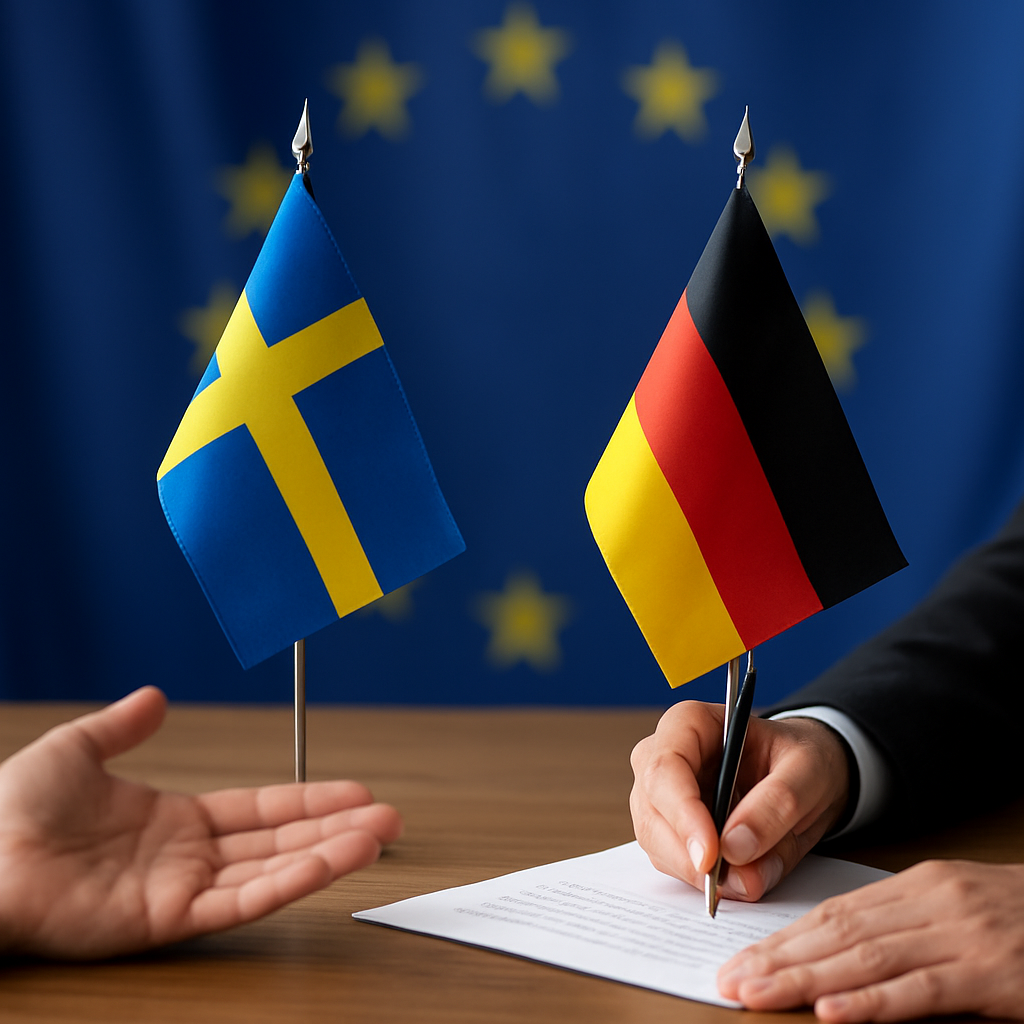
Sweden’s biggest trading partner is the European Union if you mean the bloc as a whole. If you mean a single country, Germany is Sweden’s largest individual trading partner in the supplied trade evidence, and it also ranks first on both the export and import side in the sources reviewed.
That distinction matters because trade data can be ranked by total trade, exports, or imports. Those three views do not always produce the same headline answer. For Sweden, the broad picture is consistent: the EU dominates overall trade, while Germany is the leading individual country partner.
Who Is Sweden’s Biggest Trading Partner?
On a bloc basis, the European Union is Sweden’s largest trading partner. A recent trade overview from Blooming Trade Data says that trade with other EU member states accounted for 60.3 percent of Sweden’s total foreign trade in 2024, with the EU taking the largest share of both exports and imports. That makes the EU the clearest answer if the question is about Sweden’s biggest trading partner overall.
On an individual-country basis, Germany comes first. The same source identifies Germany as Sweden’s leading country partner, followed by Norway, the Netherlands, Denmark, and the United States. Earlier and related trade references also place Germany at or near the top of Sweden’s country-by-country rankings, which is why it is the most useful single-country answer to the question.
So the short answer is:
- Largest trading partner as a bloc: the European Union
- Largest individual country partner: Germany
Why Different Sources Can Seem to Give Different Answers
When readers ask who Sweden’s biggest trading partner is, they are often mixing together three different measurements:
- Total trade – exports plus imports combined
- Exports – where Sweden sells its goods and services
- Imports – where Sweden buys goods and services
That is why one source may emphasise the EU as Sweden’s largest overall partner, while another may highlight Germany as the biggest single-country market or supplier. The ranking can also shift slightly depending on the year and dataset used, so it is best to qualify the answer rather than present it as permanent and identical across every table.
If you want to compare trade costs or customs treatment behind those flows, it is also worth separating the commercial side from the compliance side. A useful primer is our guide on custom duty vs VAT, which shows why import-side charges should not be confused with the country ranking itself.
Sweden’s Main Trading Partners by Country
Beyond the EU bloc answer, the countries that recur most often in Sweden’s trade profile are Germany, Norway, the Netherlands, Denmark, the United States, and Finland. The exact order changes depending on whether the dataset is measuring exports, imports, or total trade, but Germany is consistently near the top.
| Partner | How it appears in the supplied evidence | What it means for the reader |
|---|---|---|
| Germany | Top individual country partner; first for imports and first for exports in the supplied evidence | Best single-country answer to the question |
| Norway | Repeatedly appears among Sweden’s main partners | Important neighbour and major trade counterpart |
| Netherlands | Listed among leading partners in the broader trade picture | Significant EU trade partner in the network |
| Denmark | Appears among top partner countries for exports and trade | Key nearby market and logistics corridor partner |
| United States | Appears among top export destinations and as Sweden’s important non-EU agricultural export market | Major partner, but not Sweden’s largest overall partner |
| Finland | Included among top export destinations in the supplied evidence | Another important Nordic trade relationship |
Exports: Where Sweden Sells Most
On the export side, the supplied evidence shows Germany at the top among individual countries. Norway and the United States also appear among Sweden’s leading export destinations, with Denmark and Finland recurring as well. This fits the broader pattern of Swedish trade: it is strongly concentrated in nearby European markets, especially within the EU.
A World Bank WITS trade summary also shows Germany as a major export destination in Sweden’s trade profile, with Norway close behind in the same period. While the exact percentages differ by year and dataset, the general ranking pattern is stable: Germany is the leading country destination in the evidence supplied here.
The structure of Sweden’s exports is also important. Sweden is not simply shipping raw materials abroad; it earns much of its export income from advanced industrial sectors. That is why the export ranking is closely tied to the country’s manufacturing base and not just to geography.
Imports: Where Sweden Buys Most
On the import side, Germany is again the key country partner in the supplied evidence and is identified as Sweden’s most important import partner. That matters because some readers assume “biggest trading partner” only means the largest export market. In Sweden’s case, Germany matters on both sides of the ledger.
Imports and exports can differ because a country may buy heavily from one partner while selling heavily to another. Sweden’s data does not show that split as sharply as some countries’ trade profiles do, because Germany sits at the top of both sides in the supplied evidence.
What Drives Sweden’s Trade and Economy?
Sweden’s trade profile makes more sense when you look at the structure of its economy. Sweden is a trade-oriented country with goods and services trade representing a very large share of GDP. One supplied source describes trade in goods and services as accounting for 89 percent of GDP in a recent year, underscoring how deeply integrated Sweden is with external markets.
That same trade profile is linked to a strong industrial base. The supplied research highlights key sectors such as automotive manufacturing, pharmaceuticals, and machinery. These are the kinds of industries that generate high-value exports and keep Sweden closely connected to European supply chains and global buyers.
In other words, Sweden’s trade strength is not accidental. It reflects a high-income economy that relies heavily on international exchange, advanced production, and access to external markets. The country’s prosperity is closely tied to being embedded in the European market and the wider global trading system.
For readers who want to understand the wider trade environment behind that integration, our article on supply chain challenges is useful background, because trade rankings can shift when logistics, capacity, or routing conditions change.
Where Does the United States Rank in Sweden’s Trade?
The United States is a significant trade partner for Sweden, but it is not Sweden’s largest overall partner in the supplied trade evidence. It appears among Sweden’s top export destinations and is also identified as Sweden’s most important non-EU agricultural export market in the USDA exporter guide. That makes the U.S. commercially important, even though Germany and the EU are larger in the overall trade picture.
The U.S. relationship is worth separating into two parts. First, the general trade relationship is substantial: Sweden and the United States exchange a large volume of goods and services each year, and U.S. trade data places Sweden as a meaningful bilateral partner. Second, the agricultural and related-products channel is especially important outside the EU, where the United States stands out as Sweden’s leading non-EU market in that category.
So if you are asking whether the United States is one of Sweden’s biggest partners, the answer is yes. If you are asking whether it is Sweden’s biggest partner overall, the answer is no, based on the supplied evidence.
For businesses moving goods between Sweden and the U.S. or any other major market, it can help to understand execution as well as ranking. Our guide to customs broker vs importer of record explains the practical compliance roles that sit behind cross-border trade.
What Sweden’s Biggest Source of Income Question Really Means
Some readers ask this question because they are really trying to understand what Sweden’s economy depends on. That is a broader question than trade-partner ranking. The supplied evidence supports a clear answer about Sweden’s trade orientation, but it does not support a single simple “biggest source of income” ranking for the whole economy.
What can be said confidently is that Sweden’s economy is strongly supported by external trade and by advanced industries that sell into foreign markets. Goods and services trade makes up a very large share of economic activity, and sectors such as machinery, automotive manufacturing, and pharmaceuticals are central to that model. So if you are looking for the main driver behind Sweden’s international earnings, trade and export-oriented industry are the right starting point.
That said, income sources in a modern economy are broader than exports alone. Domestic consumption, services, investment, taxes, and public-sector activity all matter too. So it is better to say that Sweden is a highly trade-oriented economy than to claim that trade is its only or even sole source of income.
Practical Takeaway for Importers, Exporters, and Analysts
If you need the shortest possible answer, use this:
- Sweden’s biggest trading partner overall: the European Union as a bloc
- Sweden’s biggest individual trading partner: Germany
- Most important recurring partners after Germany: Norway, the Netherlands, Denmark, the United States, and Finland
For trade professionals, the more useful insight is that Sweden’s trade is concentrated in Europe, deeply linked to the EU market, and supported by high-value industrial exports. That combination explains why Germany appears so prominently across export and import rankings and why the EU dominates the larger trade picture.
If you are planning shipments, distribution, or market entry work tied to Sweden, it may also help to review our guide to international freight forwarding companies, especially when you are comparing routes, transit times, and partner markets across Europe and beyond.