
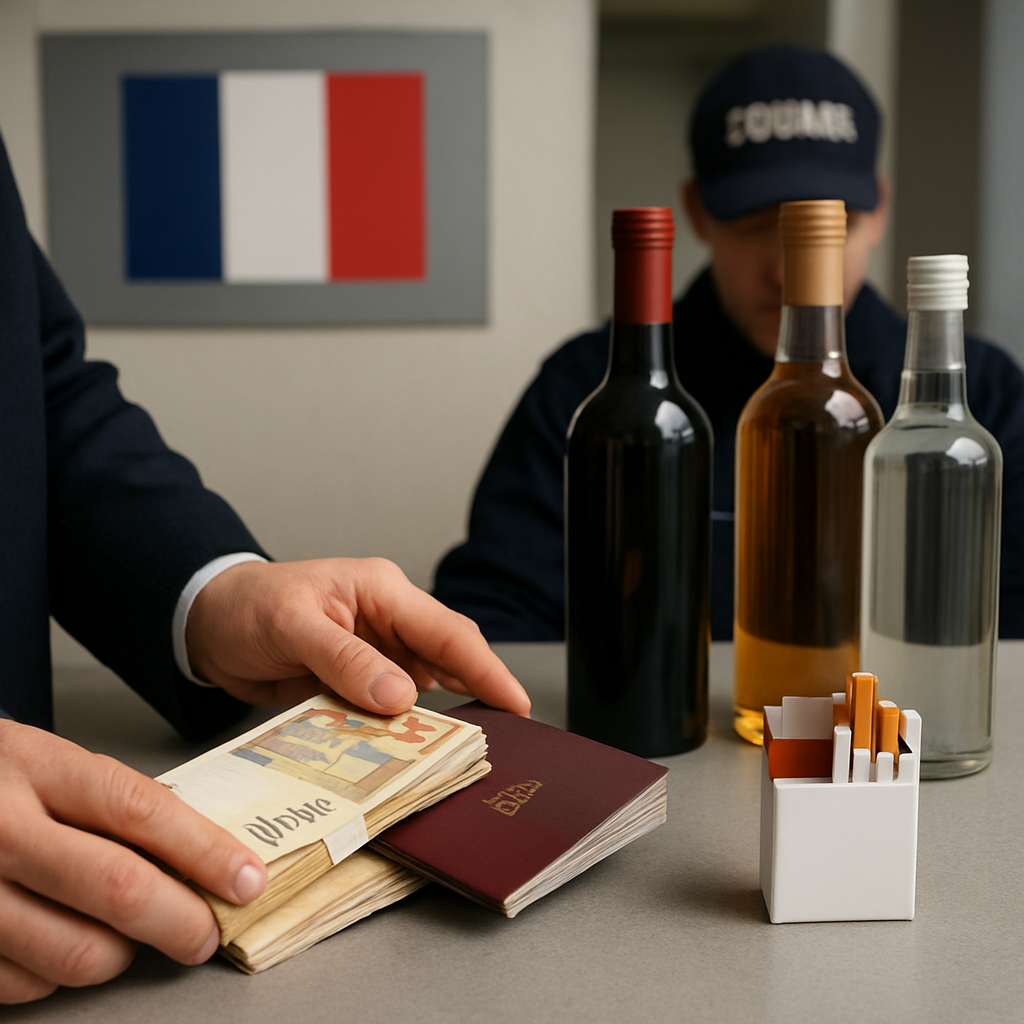
If you are entering France from outside the EU, you must declare goods that exceed your allowances, items subject to restrictions or special conditions, and cash of EUR 10,000 or more (or the equivalent in another currency). Declaring something at French customs is not the same as banning it: many items can still be brought in, but they may need to be declared and may trigger customs duty, VAT, or other import conditions.
The basic rule is set out by French customs: goods imported from non-EU countries must be declared to customs, and applicable customs duties and VAT must be paid. For the official customs framework, see the French Customs portal.
What you must declare when entering France
The practical answer is that you should declare anything that is not covered by your traveller allowance, anything that is controlled by customs rules, and anything that may require tax or duty payment. That includes:
- cash at or above the declaration threshold
- alcohol and tobacco above the relevant allowance
- food items that are subject to import conditions
- medicines that may be restricted or require special handling
- plants and plant products that may be controlled
- electronic devices or other goods if they are new, in quantity, or otherwise subject to customs review
In other words, customs declaration is not just about one category. It is about whether the item falls within the rules for personal imports, restricted goods, or taxable imports. If the goods are coming from a non-EU country, the declaration requirement is especially important because duties and VAT may apply.
If you want a broader explanation of how customs charges work once goods are declared, see our guide on customs duty vs VAT.
How much cash must be declared at French customs?
Travellers entering France must declare cash of EUR 10,000 or more, or the equivalent in other currencies. This is a declaration rule, not a ban on carrying the money. If you are carrying that amount or more, you need to be prepared to report it to customs.
The key point is that the threshold applies to cash and cash-equivalent funds, not just euro notes. If you are carrying foreign currency, the equivalent value still matters. Do not assume that only euros count.
For travellers who carry large sums across borders, the main lesson is simple: if the amount reaches the threshold, declare it before or when required by customs control. If you are looking at cash rules in another jurisdiction for comparison, our article on cash declaration rules is a useful reference point.
Alcohol and tobacco: what travellers can bring and when to declare it
Alcohol and tobacco are among the most common customs-sensitive items for travellers. They are treated separately, and you should not assume that an allowance for one covers the other.
The evidence supplied for tobacco gives the following allowance example: 40 cigarettes, or 20 cigarillos, or 10 cigars, or 50 grams of tobacco. If you are above those amounts, you should expect customs scrutiny and possible declaration requirements.
Alcohol is also subject to limits and import conditions, but the exact quantity allowance was not verified in the supplied sources here. So the safe rule is: do not assume alcohol is unlimited. If you are carrying alcohol into France, check the current customs guidance before you travel, and declare any quantity that exceeds the applicable allowance or falls under customs control.
For an official starting point on customs rules, use the French Customs portal. If you are specifically trying to understand how a common personal item can trigger customs formalities, our guide to what to declare for electronics shows how declaration rules can apply to ordinary traveller goods in other customs systems.
| Category | What the supported guidance shows | Practical takeaway |
|---|---|---|
| Cash | Declare EUR 10,000 or more, or equivalent foreign currency | Declaration required; not a ban |
| Tobacco | 40 cigarettes, or 20 cigarillos, or 10 cigars, or 50 grams of tobacco | Above the allowance, expect declaration and possible charges |
| Alcohol | Subject to limits and import conditions | Check current rules; do not assume unlimited entry |
Other common items that may need to be declared
Food, medicines, plants, and electronic devices are all common categories that can be carried into France, but they may be subject to limits, conditions, or declaration requirements. The important distinction is between an item being allowed in principle and an item being free from customs rules. Those are not the same thing.
For example, food items may be acceptable in some traveller situations, but that does not mean all food is automatically admissible or exempt from controls. Medicines may be allowed for personal use, yet still be subject to conditions depending on the product. Plants and plant products can be closely controlled for biosecurity reasons. Electronic devices may be brought in for personal use, but quantity, value, and purpose can affect how customs treats them.
The safest approach is to assume that any item outside ordinary personal baggage, any new item carried in quantity, or any product with special import conditions may need to be declared. That is especially true if you are entering from a non-EU country. French customs specifically notes that goods imported from non-EU countries must be declared and may be subject to customs duties and VAT.
For a related practical example of how a common personal item can attract customs attention, see our article on importer of record, which helps explain responsibility when goods trigger formal customs handling.
What happens after you declare goods at French customs
Declaration is not just paperwork. Once goods are declared, customs may assess whether duty, VAT, or other import conditions apply. That means the declaration can lead to a financial charge, additional questions, or a customs review of the goods themselves.
For travellers, the practical process is straightforward even if the outcome is not always the same: declare what must be declared, provide the information customs asks for, and be ready for duties or taxes if the goods fall within the taxable import rules. If you are carrying goods that exceed allowances or sit in a controlled category, it is better to declare them than to risk problems later.
If you are handling declarations more formally or want to understand how responsibilities are allocated, our article on customs broker responsibilities is a useful next read.
What about Paris airport customs and clearance time?
People often ask how long it takes to clear customs in Paris airport, but there is no reliable fixed time to give here. Clearance depends on the airport, passenger volumes, your baggage, and whether you need to declare goods. The practical point is that if you have declarable items, you may need to go through a customs control step rather than simply walking through.
So if you are travelling through Paris and carrying cash, alcohol, tobacco, food, medicines, plants, or electronics that may be subject to rules, be prepared to stop and declare them. The safer and faster route is to have your goods and documents ready before you reach customs.
Quick checklist before you travel to France
- Check whether you are arriving from a non-EU country.
- Declare cash of EUR 10,000 or more, or the equivalent in another currency.
- Check alcohol and tobacco allowances before packing.
- Keep tobacco within the supported allowance if possible: 40 cigarettes, 20 cigarillos, 10 cigars, or 50 grams of tobacco.
- Be careful with food, medicines, plants, and electronics, as they may be subject to limits or conditions.
- Remember that declared goods may be liable for customs duties and VAT.
- When in doubt, declare the item rather than hoping it will be ignored.
In short, the answer to what items need to be declared at customs in France is: anything above your allowance, anything restricted or controlled, and any cash at or above the reporting threshold. The safest approach is to treat the customs declaration as a real compliance step, not a formality.