
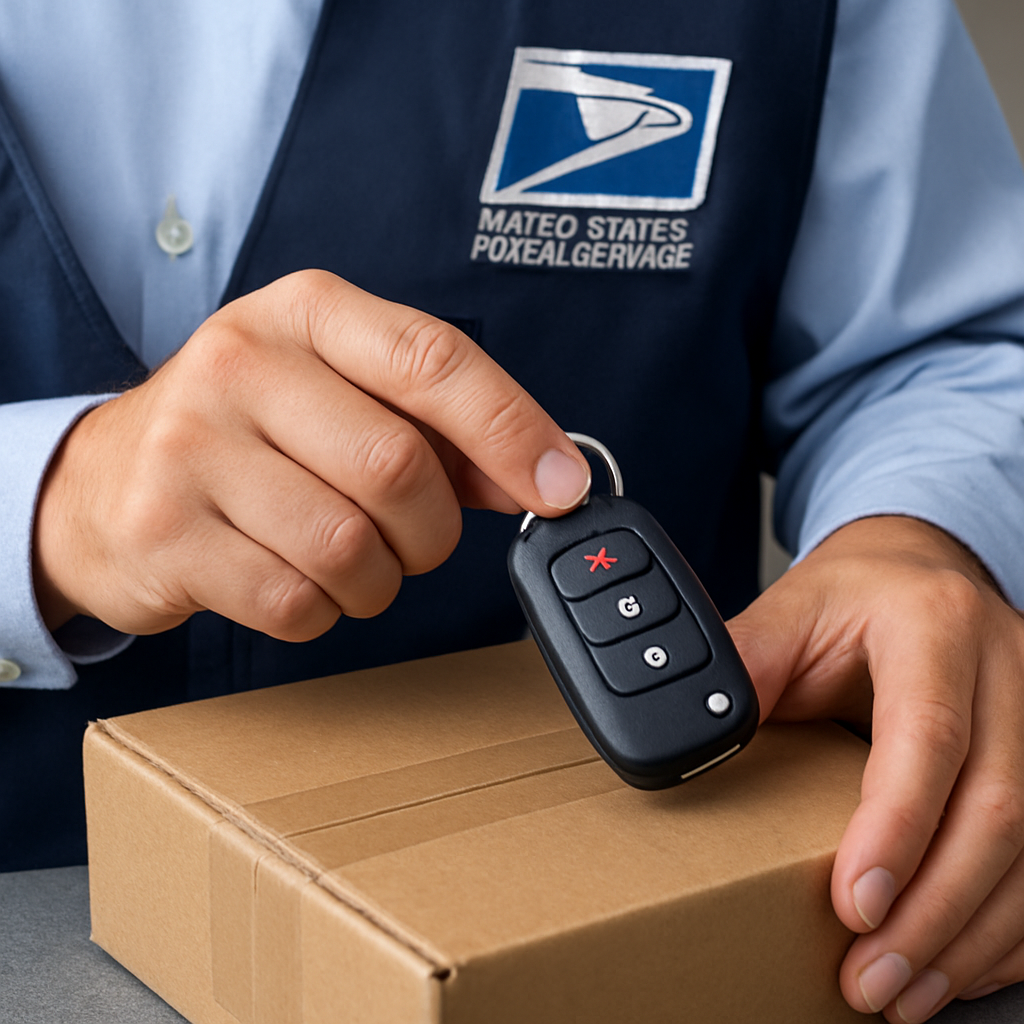
Yes, a car key fob with a battery can generally be mailed if the battery is the kind the carrier allows and the package is prepared under the relevant rules. For USPS, the key point is not that it is a car key fob, but whether the battery is installed in the device and whether the shipment is domestic or international. The rules are different for a fob with an installed lithium battery, a loose spare battery, and a package going overseas.
If you are mailing a replacement key fob, a spare remote or a used fob sold online, the safe starting assumption is: check the battery type, keep the battery installed if that is how the device is meant to ship, and verify the service before you send it. USPS’s lithium battery rules are set out in its Postal Explorer and Publication 52 guidance, and the broader hazmat framework is explained by PHMSA in its lithium battery guidance.
Can You Mail a Car Key Fob With a Battery?
In most everyday situations, yes. A car key fob is treated as a small piece of equipment that contains a battery. That matters because USPS allows lithium metal and lithium-ion cells and batteries installed in or packed with equipment to be mailed under the right conditions. The rule is about the battery’s relationship to the device, not about the device being a car key fob specifically.
This means the practical answer depends on what is inside the fob:
- Installed battery in the fob: often mailable, subject to the applicable USPS domestic or international rules.
- Loose spare battery by itself: treated differently and may have stricter limits.
- Non-lithium battery: different rules may apply, so do not assume the same treatment.
For the USPS-specific domestic rule, the authoritative wording is in USPS Packaging Instruction 9D in Postal Explorer and related Publication 52 material. For international shipments, USPS publishes separate conditions in Packaging Instruction 9E.
USPS Domestic Rules for Key Fobs and Other Devices With Installed Batteries
For domestic mail, USPS says lithium metal and lithium-ion cells and batteries installed in or packed with equipment are mailable by air or surface transportation, as long as the shipment meets USPS requirements. A key fob with its battery installed fits the same general category as other small consumer devices that contain batteries.
That said, “mailable” does not mean “send it any way you like.” The package still has to comply with USPS packaging, quantity and marking rules that apply to the exact battery type and shipment type. The details matter because lithium batteries can present a short-circuit and fire risk if they are damaged or packed badly.
Here is the practical domestic distinction:
| Shipment type | General USPS position | What to watch |
|---|---|---|
| Key fob with battery installed | Generally mailable domestically if it meets USPS conditions | Battery type, packaging, and service choice |
| Battery packed with equipment | Generally mailable domestically if it meets USPS conditions | Whether the battery is properly protected and declared as required |
| Loose battery alone | Different rules may apply | Labelling, quantity limits and service restrictions can be stricter |
This is the same underlying issue raised by people who ask whether they can mail a cell phone with a battery by USPS or whether they can ship lithium-ion batteries by Priority Mail. The answer depends on whether the battery is installed in equipment, what kind of battery it is and what USPS service you are using.
What about USPS Priority Mail?
Do not assume every USPS service handles battery shipments in exactly the same way. Even when a battery-in-device shipment is allowed, the mail class and route still matter. If you are using Priority Mail or another air-transported service, the shipment must still fit the applicable USPS and DOT rules for lithium batteries in equipment. In other words, the fob itself does not create the problem; the battery and the service do.
What Labels or Markings Are Needed for a Battery-Inside-Equipment Shipment?
The correct outside-of-box marking depends on three things: the battery type, whether the battery is installed in equipment or packed with equipment, and whether the shipment is domestic or international. That is why one simple printable label is not always the right answer.
For a domestic shipment, you need to follow the USPS rule that applies to the battery type and packaging method. For an international shipment, USPS’s instructions are more restrictive and can prohibit lithium battery markings in certain cases. The presence or absence of a mark is not something to guess at.
Here is the safest way to think about the label question:
- Lithium battery mark: may be required for some battery shipments, depending on the applicable rule.
- UN3481: this identifier is used in USPS’s international instruction for lithium-ion batteries contained in equipment.
- Class 9 label: a different hazmat marking used in some battery shipment contexts, but not something to add casually.
- No lithium battery markings: in some international cases, USPS states that no lithium battery markings are permitted.
So if you are trying to determine the correct exterior marking, you need to know the battery chemistry and whether the battery is installed in the device. The question is not simply, “Is this a key fob?” It is, “What kind of battery is in it, and where is it going?”
Can I print my own UN3481 label?
Do not treat “printable label” as a universal yes. A printable UN3481-style label may be relevant in some shipment scenarios, but only where the rules actually call for that marking. USPS’s international guidance is especially important here because, for certain international mailings, lithium battery markings are not permitted at all. So printing a label at home is not the first question; the first question is whether the shipment is one that should carry that marking in the first place.
If you need to identify the correct mark or label, use the battery type, shipment mode and destination rules to determine it. If any of those variables are unclear, confirm them before you print or apply anything to the parcel.
How to Package a Car Key Fob Safely for Mailing
Whatever service you use, the basic safety goal is the same: prevent short circuit and movement inside the parcel. PHMSA’s battery guidance and general hazmat transport references stress that lithium batteries must be protected against short circuit and packaged so they do not rub against conductive materials or shift around in transit.
A sensible packaging approach for a car key fob is:
- Make sure the battery is properly installed in the fob if it is meant to remain installed.
- Keep the device from turning on accidentally.
- Wrap or cushion the fob so it does not move inside the box.
- Use a strong outer box that will protect the item in transit.
- Do not let the battery or device contact metal objects, loose hardware or other conductive material.
- Seal the parcel securely and apply only the markings that actually apply to that shipment.
Those steps are about risk reduction, not about inventing a special car-key-fob-only method. The same safety principle applies to other battery-containing devices such as phones, remotes, watches and cameras.
PHMSA’s public battery information is a useful starting point for general safety, and carrier-specific instructions matter too. For carrier-side practical guidance, FedEx also explains the importance of proper battery classification and packaging in its battery shipping guidance.
Can I Mail a Key Fob With a Battery Internationally?
International shipping is where the answer becomes much more limited. USPS says lithium metal and lithium-ion batteries are mailable internationally only in limited quantities and only when they are properly installed in the equipment they operate. They must also be accepted by the destination country as listed in the USPS Individual Country Listing in the International Mail Manual (IMM).
That means a key fob with a battery may be mailable to one destination and unacceptable to another. You cannot assume international acceptance just because the package is small or the battery is installed. Destination-country rules control the result.
There is also an important distinction between ordinary international mail and APO/FPO/DPO mail. USPS treats APO, FPO and DPO destinations under separate conditions, so they are not the same as regular international destinations. The international instruction in USPS Packaging Instruction 9E is the place to check for those details.
For readers who want the broader rules on prohibited and restricted items, our guide on what you’re not allowed to ship internationally is a useful companion, as is our USPS international shipping restrictions guide.
Why international rules are stricter
International battery shipments involve both carrier rules and destination-country acceptance. A package can be acceptable under USPS rules and still be refused by the destination country. That is why you should never treat a domestic battery shipment as automatically exportable.
In practice, the international checklist is shorter and stricter:
- Confirm the battery type.
- Confirm that the battery is installed in the equipment it operates.
- Check the destination-country listing in the IMM.
- Check whether any lithium battery marking is allowed or prohibited.
- Verify whether the destination is an APO/FPO/DPO location with separate conditions.
Standalone Batteries Are Different From Batteries Installed in Equipment
One of the easiest mistakes is confusing a battery inside a device with a loose battery in a box. Those are not treated the same way. A key fob with the battery installed is generally viewed as equipment containing a battery. A loose AA battery, by contrast, is a standalone battery shipment and may face different packaging and marking requirements.
This distinction is why a search such as “can you send AA batteries in the mail” leads to a different rule set from “can I mail a car key fob with battery.” The fob is the equipment; the AA battery is the battery by itself. Likewise, a cell phone with a battery and a car key fob with a battery are both examples of equipment containing a battery, but each still has to be checked against the exact service and battery type rules.
So, if you are mailing a key fob, do not remove the battery just because you assume all batteries are easier to send separately. In some cases, the opposite is true. The safer route is to keep the battery in the device if that is the normal configuration and then check the carrier’s actual rules for that shipment.
Should You Check USPS, UPS, or Another Carrier Before You Ship?
Yes. Always verify the exact service before you send the parcel, especially if there is any chance the battery is lithium-based. PHMSA’s battery flyer and carrier guidance both make the same basic point: battery shipments can require different paperwork, labels or service restrictions depending on the carrier and route.
That matters if you are deciding between USPS and UPS for a key fob shipment. USPS may be the simplest option for some domestic battery-in-device mailings, but UPS or another carrier may be better suited in other cases, particularly if the destination, service level or battery configuration changes the rule set. The right answer is not universal.
Use this quick check before you buy postage:
- What battery is inside the fob?
- Is the battery installed in the device?
- Is the shipment domestic or international?
- Does the destination country accept the item?
- Does the carrier/service you want to use allow that exact configuration?
If you cannot answer those questions confidently, stop and check the carrier’s current rules before mailing. That small delay is much better than having the parcel rejected, returned or handled as an improper hazmat shipment.
Practical Bottom Line
If your question is simply, “Can I mail a car key fob with a battery?”, the practical answer is usually yes for a properly prepared domestic shipment with an installed permitted battery. But the real answer depends on the battery type, whether the battery is installed in the fob, the mail class, and whether the parcel is going inside or outside the United States.
For USPS, the key rules to remember are:
- Installed-in-equipment lithium batteries are treated differently from loose batteries.
- Domestic and international mail are not governed by the same rules.
- International shipments depend on destination-country acceptance and the IMM.
- Markings and labels depend on the exact battery and shipment type.
- The battery must be protected against short circuit and packaged securely.
When in doubt, check USPS first, then verify the destination and the service you plan to use. That is the safest way to mail a key fob without creating a delivery problem or a hazmat issue.