
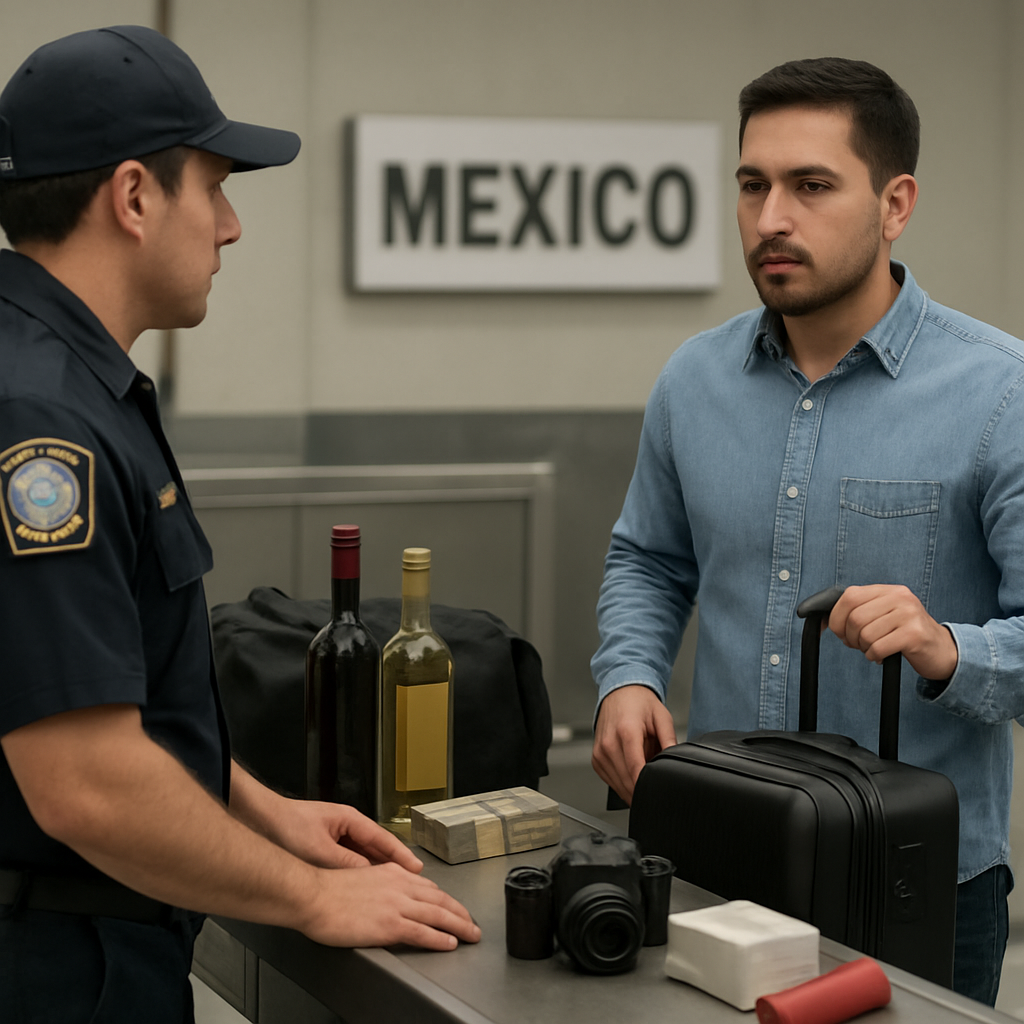
If you are asking how much stuff you can bring into Mexico, the short answer is: you can bring in a duty-free amount of merchandise, but anything above that allowance must be declared, and some items are restricted or prohibited regardless of value. In the supplied current guidance, the merchandise allowance is described as US$500 per person for goods, while personal effects are treated separately from new merchandise.
That means the real question is not just “how much can I carry?”, but also “what kind of items are they?”, “are they personal belongings or new goods?”, and “do they fall under a separate rule such as alcohol, cash, food, plants, or medicines?”
Mexico duty-free allowance: how much you can bring and what to declare
The most useful way to think about Mexico customs is to separate personal effects from merchandise. The supplied consular guidance and secondary customs references treat everyday personal belongings differently from new items you are bringing in for use, gifts, or resale.
In current 2026-oriented guidance, the duty-free merchandise allowance is described as US$500 per person. If the value of your merchandise is above that amount, you should declare it. One of the supplied sources also explains that customs handling can change depending on the value and the route you use, with self-declaration applying in some cases and broker involvement for higher-value consignments in more commercial situations.
For a practical overview of how that works at the border, see the discussion of Mexico customs compliance rules. That article is more commercial than traveller-focused, but it helps explain why declaration and documentation matter so much in Mexico.
Personal effects versus merchandise
This distinction matters because the customs allowance is not meant to cover every item in the same way. Personal belongings such as clothing you are wearing or carrying for the trip are generally treated differently from new merchandise. The supplied consular guidance lists examples of baggage and personal items separately from the goods and declarations category.
In other words, customs is usually interested in what you are importing as goods, not just what you are travelling with as normal luggage. If you are carrying brand-new goods, large quantities, or items that look like commercial stock, you should expect more scrutiny than for ordinary personal luggage.
What happens if you go over the allowance
If the value of the goods is above the allowance, the safe assumption is that they need to be declared. One supplied source describes self-declaration for some value ranges and notes that higher-value goods may require a customs broker. Another source describes a flat-rate assessment in some border scenarios. The exact handling can depend on the value, category, and entry mode, so you should not assume that every over-limit case is processed the same way.
The important point is simple: do not try to pass excess goods through as if they were duty-free. Keep receipts where possible, be ready to explain the value, and declare accurately if customs asks.
Alcohol allowance in Mexico: beer, wine, and liquor limits
Alcohol is one of the most common follow-up questions, and the supplied evidence is clear enough to answer it directly: travellers aged 18 and older may bring up to 3 litres of beer or liquor and 6 litres of wine.
That means beer is allowed, but it counts within the beer-or-liquor limit. You cannot treat beer as unlimited just because it is not wine. If you exceed the allowance, one supplied source says customs can assess a flat 19% tax on the excess.
For the consular wording behind this allowance, see the supplied guidance from the Mexican consulate’s luggage and objects guidance. A second source gives the same alcohol limits and the 19% excess-tax treatment in its customs overview.
So if your main concern is, “Can you bring beer to Mexico?”, the answer is yes, within the 3-litre allowance for beer or liquor per adult traveller. If you are carrying more than that, it becomes a declaration-and-tax issue rather than a simple yes/no allowance question.
How much cash you can bring into Mexico and when to declare it
Cash is a separate declaration rule from the merchandise allowance. According to the supplied consular guidance, if you enter or leave Mexico with US$10,000 or more in cash, checks, money orders, other cashable documents, or a combination of these, you must declare it.
This is not the same as the duty-free allowance for goods. You may be under the merchandise limit and still need to make a cash declaration if you are carrying enough money or negotiable instruments.
The same source says failing to declare amounts above the threshold can trigger penalties, including a fine of 20% to 40% of the exceeding amount. It also states that failing to declare US$30,000 or more can lead to imprisonment and seizure of the funds if lawful origin is not demonstrated.
That is why the best practice is to treat cash as its own customs-compliance issue. If you are carrying substantial funds for travel, business, property, or family reasons, do not assume the merchandise allowance covers it.
Restricted items in Mexico: pocket knives, liquids, food, medicine, and other common questions
Many travellers want a simple list of what Mexico may restrict at the border. Based on the supplied live sources, the items that repeatedly appear as restricted or prohibited include:
- plants and plant parts, including fruits and vegetables;
- animals and animal products;
- dairy products;
- fresh meat;
- seeds;
- guns and ammunition;
- some over-the-counter medicines;
- certain controlled or psychotropic substances unless proper documentation is shown.
Mexico customs and consular guidance also indicate that medicines can require special care. In the supplied consular source, psychotropic substances and cannabis are mentioned as needing a prescription, physician details, and only the amount needed for the trip. In other words, medicine is not a category to guess about at the border.
For a broader shipping-and-restrictions context, you can also see our guide to international shipping restrictions. That article is aimed at parcels rather than travellers, but it is useful background if you are comparing courier rules with luggage rules.
Can I bring a pocket knife to Mexico?
The supplied evidence does not give a precise Mexico customs rule for pocket knives, blade length, or whether a pocket knife is treated as a prohibited or restricted item in every circumstance. Because of that, it would be unsafe to state a definite yes or no here.
The cautious answer is that travellers should verify knife rules with Mexican customs, the airline, or the border authorities before travel, especially if the knife is more than a simple personal tool. Since weapons and restricted items are broadly regulated, it is better to check in advance than to assume it will be acceptable.
Is Mexico strict about liquids in carry-on?
The supplied customs sources do not directly answer carry-on liquid limits. That matters because this is usually an airline or airport security issue rather than a Mexico customs allowance question.
So the accurate answer is: the evidence here does not support a Mexico-specific carry-on liquids rule. If you are flying, check the airline and airport security rules for cabin baggage rather than treating this as a customs-duty issue.
Food, plants, animals, and medicines
If you are carrying food or plant-based items, be especially careful. Fresh fruit, vegetables, seeds, and many animal products can trigger inspection or be refused. The same goes for fresh meat and dairy products. These are the kinds of goods that often cause problems because they can be subject to agricultural or sanitary controls rather than just ordinary customs valuation.
Medicines deserve separate attention as well. Even when a medicine is for personal use, some products may require a prescription or additional documentation. If the medicine is controlled or psychotropic, the supplied consular guidance indicates you should carry the prescription and physician contact details and bring only the quantity needed for the trip.
What happens at customs if you go over the limit
If you exceed the allowance, the correct next step is to declare the goods rather than try to blend them into your luggage unnoticed. The supplied sources describe a declaration process that may vary by value and route, with some cases handled through self-declaration and higher-value or commercial cases potentially requiring a customs broker.
At a high level, the process works like this:
- Identify whether the item is personal baggage, merchandise, cash, or a restricted product.
- Check whether it falls inside the relevant allowance or threshold.
- If it is over the limit, declare it.
- Be prepared for duty, a flat tax, or additional review depending on the item and value.
- Keep receipts and supporting documents in case customs asks for proof of value.
For readers interested in how stricter customs processing and brokerage can affect imports, our article on Mexico customs compliance rules explains why accurate declarations matter more than ever. If you are crossing by land and want the border context, what a port of entry means can help you understand the mechanics of the crossing itself.
Quick reference: what matters most
| Category | Supplied rule | Practical takeaway |
|---|---|---|
| Merchandise | US$500 per person duty-free in current guidance | Declare goods above the allowance |
| Personal effects | Treated separately from merchandise | Do not assume new goods are covered the same way |
| Alcohol | 3 litres of beer or liquor and 6 litres of wine for travellers 18+ | Beer is allowed within the stated limit |
| Cash and monetary instruments | US$10,000 or more must be declared | Applies to cash, checks, money orders, and similar instruments |
| Restricted goods | Food, plants, animals, weapons, some medicines, and other regulated items may be restricted | Check carefully before travelling |
If you are still wondering “how much stuff can I bring into Mexico?”, the safest summary is this: bring ordinary personal effects as needed, use the current duty-free merchandise allowance for goods, declare anything over the limit, and treat alcohol, cash, food, plants, medicines, and weapons-related items as separate compliance issues. When in doubt, declare first and ask questions before you cross.