
How to Buy from Alibaba and Sell on Amazon: Legal, Shipping, and FBA Basics
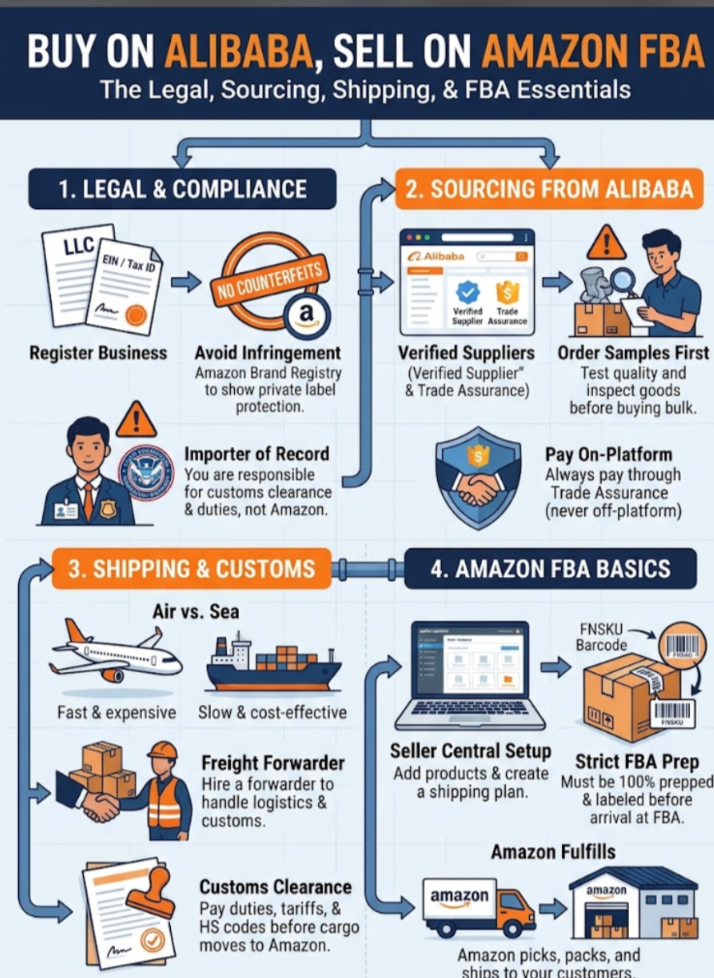
Yes, you can buy products from Alibaba and resell them on Amazon, but only if the product, the listing, the import process, and your Amazon account all comply with the relevant rules. Alibaba sourcing does not automatically make an item eligible to sell on Amazon, and it does not remove your responsibility for intellectual property checks, import compliance, or Amazon policy compliance.
If you want the simple version: find a suitable product and legitimate supplier on Alibaba, confirm the product can be sold legally, arrange payment and shipping, send the inventory to Amazon FBA if that is your fulfilment model, and then manage the listing and margins carefully. The detail matters, because the biggest mistakes usually happen around supplier trust, customs, and whether the product is actually allowed to be resold.
Can You Buy from Alibaba and Sell on Amazon Legally?
Yes, it can be legal to resell items sourced from Alibaba on Amazon when you follow Amazon’s Seller Agreement and the applicable import laws and regulations. That is the key point: the legality question is not about Alibaba alone. It depends on the specific product, whether you have the right to resell it, whether it is compliant in your destination market, and whether your shipping and customs process is handled correctly. The same basic answer is reflected in practical seller guidance from WorldFirst’s guide to buying from Alibaba and selling on Amazon and Threecolts’ 2026 guide.
What you should not assume is that every Alibaba product is automatically listable or safe to sell. You still need to check for:
- Amazon policy compliance for the product category and listing model.
- Import compliance, including duties, customs clearance, and product restrictions.
- Intellectual property risk, such as trademarked brands, copyrighted designs, patents, or unauthorised replicas.
- Brand or marketplace restrictions from the supplier or rights holder.
In practice, a product can be perfectly legitimate to source from Alibaba and still be a bad Amazon choice if it triggers IP complaints, fails product compliance checks, or arrives with customs problems.
How to Source on Alibaba and List on Amazon Step by Step
The basic workflow is straightforward, but each stage has decisions that affect your costs and risk. Seller guides commonly describe the process in a similar order: create an Alibaba account, search for a product or supplier, specify your quantity and product specifications, contact the supplier, make payment, receive the inventory, and then prepare the Amazon side of the listing and fulfilment.
1. Create your Alibaba account and define the product you want
Start with a clear product idea. Before you contact suppliers, decide what you are trying to sell, what problem it solves, and what version you want to source. The more specific you are, the easier it is to compare suppliers on like-for-like terms.
At this stage, think through:
- Product category and expected demand.
- Target price on Amazon.
- Expected landed cost, including shipping and duties.
- Whether you want a generic item, a custom variant, or packaging changes.
2. Search for suppliers and compare options
Alibaba is a B2B sourcing platform, so you are usually looking for manufacturers or wholesalers rather than a retail seller. Compare suppliers on product fit, responsiveness, minimum order quantity, stated capabilities, and buyer protection features. For a broader supplier-selection framework, see Export Import Academy’s guide on comparing Alibaba with other sourcing options.
Do not choose only on price. A supplier that looks cheapest on paper can become expensive once you add poor communication, inconsistent quality, slow production, or customs problems.
3. Contact the supplier and ask the right questions
Once you have shortlisted suppliers, contact them and ask for the details that matter for Amazon selling. This is where you confirm whether the supplier can meet your product specifications, packaging requirements, labelling needs, and timeline.
A useful next step is to ask for written confirmation where appropriate. If you plan to sell the item on Amazon, ask whether there are any brand restrictions, IP concerns, or limitations on resale. Export Import Academy has a practical guide on how to contact and verify a Chinese manufacturer that is useful at this stage.
4. Confirm pricing, quantity, and specifications
Before you pay, make sure the quotation matches what you actually want. This includes unit price, sample cost, tooling or customisation charges, packaging, lead time, and the exact order quantity. If the supplier’s quotation is vague, ask them to restate it clearly.
You should also calculate your real landed cost, not just the product price. That means:
- Product cost
- International freight
- Customs duties and import fees
- Inspection or quality-control costs
- Amazon fees
- Returns or damaged stock allowance
5. Make payment safely and keep the paperwork
Paying safely is part of the process. Supplier guidance consistently recommends using Alibaba’s Trade Assurance where possible, because it gives you an added layer of buyer protection if the purchase order terms are not met. Trade Assurance is helpful, but it is not a magic shield; it reduces risk rather than removing it entirely.
Keep records of the order confirmation, invoice, messages, product specifications, and shipping terms. Those documents matter if there is a dispute later, and they can also help if customs or Amazon asks questions about the shipment.
6. Receive inventory and prepare it for Amazon
After production and shipping are complete, the inventory needs to be received, checked, and routed correctly. If you are using Amazon FBA, the goods can be sent to Amazon fulfilment centres where Amazon handles storage, packing, shipping, and returns for those units. Where applicable, FBA products can also qualify for Prime, which is one reason many sellers prefer this model.
7. Create or prepare the Amazon listing
Receiving stock from Alibaba does not automatically create a sellable Amazon listing. You still need to prepare the Amazon-side listing correctly, make sure the product is eligible, and ensure the listing content, identifiers, and category compliance are handled properly. In other words, the sourcing step and the listing step are related, but they are not the same thing.
How Alibaba Inventory Gets Shipped to Amazon FBA
If you are using the resale/FBA model, the basic idea is simple: you buy inventory from an Alibaba supplier, move it through the shipping process, and send it to Amazon’s fulfilment network. Amazon then stores the stock, packs customer orders, ships them, and handles returns for that inventory.
This is different from assuming that “Amazon will sell it for you automatically”. Amazon does not source the product for you, choose the supplier for you, or solve your customs issues. You still have to organise the supply chain.
Reseller/FBA versus dropshipping
There are two different models commonly discussed in this space:
- Reseller / FBA: you buy inventory in bulk, ship it to Amazon, and Amazon fulfils customer orders from its warehouse network.
- Dropshipping-style selling: you list first and then source the item after a customer buys. Some seller guides describe this as possible, but it creates a very different operational and compliance picture.
For most beginners, the FBA route is easier to understand because the inventory is in place before customer orders come in. That usually gives you more control over quality, availability, and shipping speed to the buyer.
Why a freight forwarder matters
A freight forwarder can organise shipping, handle documentation, and help move goods from China into your destination market. In the Amazon-FBA context, that often means coordinating the move from the supplier to the fulfilment centre, dealing with customs forms, and making sure the shipment is routed correctly.
This is especially important because import clearance and import fees have to be handled properly. If a shipment is not cleared, it can be held or rejected. A freight forwarder does not guarantee a perfect outcome, but it can reduce the number of operational mistakes that cause delays.
For a deeper explanation of this part of the process, see Export Import Academy’s guide to finding a shipping forwarder in China and the article on freight versus shipping.
Customs and duties are part of the first test order too
Do not treat customs costs as something that only matters once you buy in bulk. One of the most important recent changes in sourcing from China is that duties and customs handling can affect even smaller test orders. According to Threecolts’ sourcing guide, sellers should factor customs and duties into early orders rather than assuming a simple low-value parcel process. That same source warns that Amazon will not act as importer of record or cover unpaid duties, and uncleared shipments can be held or rejected at port.
That means your first test order should be planned like a real commercial shipment, not like a casual online purchase.
How to Find a Trustworthy Alibaba Supplier
Alibaba is not automatically unsafe, but supplier vetting matters. The platform connects buyers with manufacturers and wholesalers, which means the quality of your outcome depends heavily on the supplier you choose.
Look for Trade Assurance and verified status, but do not rely on them alone
Trade Assurance is valuable because it is meant to protect your money if the purchase order agreement is violated. Verified supplier status is also useful because it indicates that Alibaba has assessed some aspects of the supplier’s business presence. However, neither signal removes all risk. A verified supplier can still be unsuitable for your product, and Trade Assurance does not prevent every dispute or quality problem.
A practical starting point is to choose suppliers that offer Trade Assurance, respond professionally, and can document their capabilities. The YouTube source in the research package also highlights using verified suppliers and Trade Assurance as part of scam avoidance, which is consistent with the wider supplier-safety advice from Wise and WorldFirst.
Use due diligence before you place an order
Beyond Alibaba profile signals, you should actively verify the supplier. Useful steps include:
- Ask for company and product details in writing.
- Check whether the business looks real and consistent across communications.
- Request samples where appropriate.
- Confirm production capability, lead time, and quality-control process.
- Ask directly whether there are any Amazon-selling restrictions or IP issues.
If you want a more detailed verification workflow, Export Import Academy has a separate guide on how to verify a Chinese factory before ordering.
Consider inspection and third-party support for higher-value orders
If the order matters enough to hurt your margins or reputation, use a third-party inspector before the goods leave China. That is especially sensible when you are testing a new supplier, ordering customised stock, or buying a product category that is vulnerable to defects.
Export Import Academy’s article on hiring a third-party inspector in China can help if you want to build quality control into the process rather than hoping the shipment is correct.
Ask for written confirmation about IP or marketplace restrictions
One especially important precaution is to get written confirmation when appropriate that the supplier has no known restriction on your reselling plan. Amazon’s seller forums repeatedly advise sellers to confirm in writing that there will be no intellectual property complaints or restrictions when selling the items on Amazon. That does not guarantee immunity from claims, but it is better than relying on a verbal yes.
Can You Make $1,000 a Month Selling on Amazon?
Some sellers do make meaningful income selling Alibaba-sourced products on Amazon, but there is no guaranteed monthly amount. The evidence in the research package includes reported examples of sellers earning real money with the model, including one Yahoo Finance case study describing a seller making around $3,000 a month from Amazon sales of Alibaba-sourced products, and another report on a seller scaling to substantial monthly sales. Those examples show that the model can work, but they are not typical guarantees.
The more realistic answer is that your profit depends on the numbers. Monthly income can rise or fall based on:
- Purchase price from the supplier
- International freight and customs costs
- Amazon referral and FBA fees
- Returns, defects, and damaged inventory
- Advertising and ranking costs
- How much competition the product has on Amazon
So, yes, it is possible to build a business that reaches $1,000 a month or more, but that outcome is not automatic and should not be assumed before you test the product, calculate margins, and validate demand.
Can You Trust Chinese Sellers on Amazon?
The safer framing is not whether you can “trust Chinese sellers” in general, but whether you can vet the specific supplier you are dealing with. Many sellers in China are legitimate manufacturers or wholesalers, and Alibaba is widely used for sourcing. At the same time, buyer due diligence is essential because the platform contains a wide range of supplier quality levels.
Trust signals to look for include:
- Trade Assurance availability
- Verified supplier status
- Clear and responsive communication
- Consistent product specifications
- Willingness to provide samples and documents
- Written confirmation on resale, brand, or IP restrictions where relevant
If you want to reduce risk further, you can also use a sourcing agent in China, especially if you are new to cross-border supply chains or need help managing communication and negotiation. Export Import Academy has a useful guide on using a sourcing agent in China.
Is Temu the Same as Alibaba?
No, Temu and Alibaba are not the same platform. They serve different roles in ecommerce and sourcing. Alibaba is primarily known as a B2B sourcing platform connecting buyers with manufacturers and wholesalers, while Temu is a separate marketplace/retail commerce platform. For an Amazon seller looking to source inventory, Alibaba is the more relevant platform because it is built around supplier and manufacturer sourcing.
This distinction matters because if your goal is to buy inventory for resale, you need a sourcing workflow, not just a consumer shopping app experience.
Common Mistakes to Avoid When Buying from Alibaba and Selling on Amazon
Most problems in this business model come from ignoring one of four areas: product compliance, supplier quality, logistics, or profit maths. The following mistakes are common and expensive:
- Assuming the product is automatically allowed on Amazon. It is not.
- Skipping IP checks. Trademark and patent issues can create serious problems.
- Choosing only on unit price. Cheap goods can become expensive after freight and duties.
- Ignoring customs paperwork. A poorly documented shipment can be held or rejected.
- Trusting supplier claims without verification. Profiles alone are not enough.
- Ignoring Amazon fees and returns. These can destroy a margin that looks healthy on paper.
If a supplier dispute does happen, it also helps to know your escalation options. Export Import Academy’s article on what to do if an Alibaba order goes wrong is useful for that scenario.
A Simple Way to Judge Whether the Model Makes Sense
Before you commit money, ask yourself these five questions:
- Can I legally resell this product on Amazon?
- Do I understand the total landed cost, not just the supplier price?
- Have I checked the supplier’s credibility and product consistency?
- Do I know how the inventory will be shipped, cleared, and received by Amazon?
- Does the expected margin still work after fees, shipping, and returns?
If the answer to any of those is unclear, pause and verify before placing an order. Alibaba-to-Amazon can be a workable model, but it succeeds because the seller manages the details carefully, not because the platforms themselves make the process effortless.