
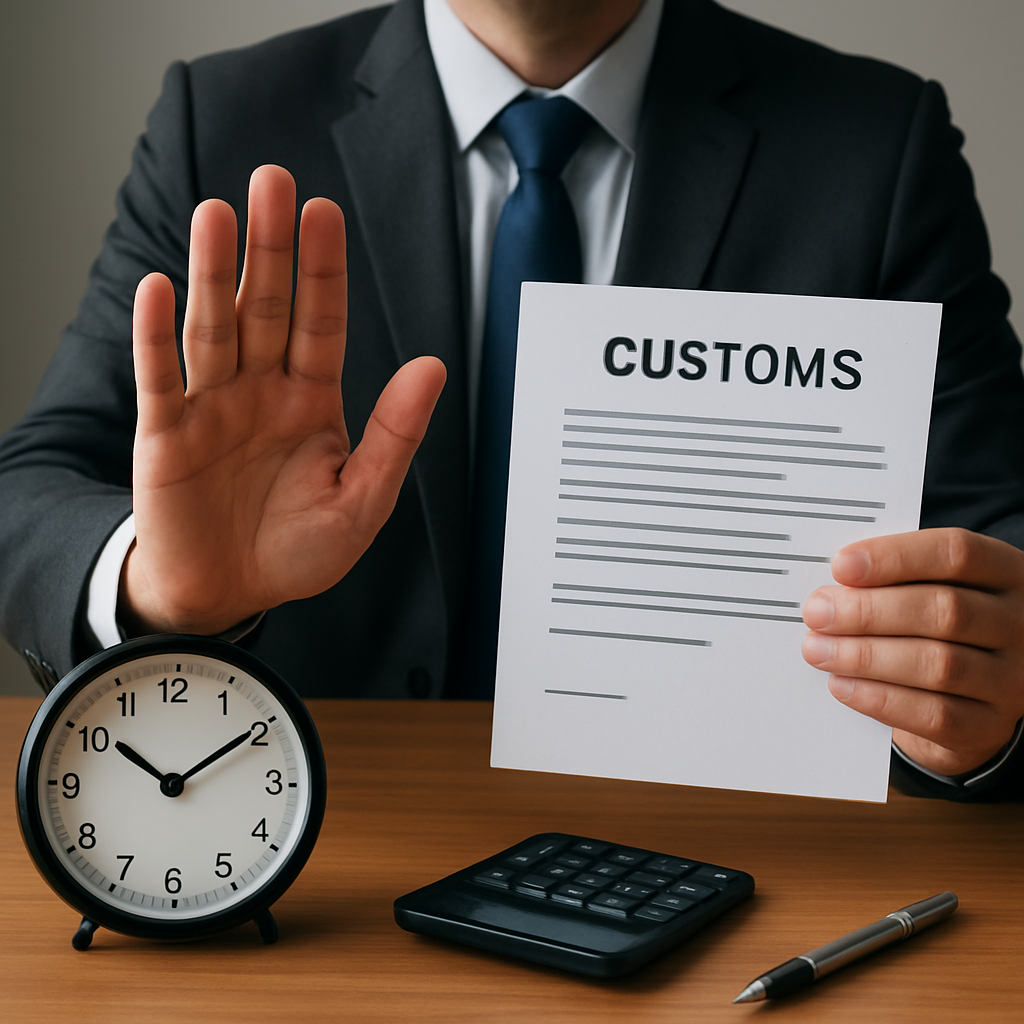
The penalty for late filing of a bill of entry in customs depends on the country and the specific customs regime involved. In some systems, late filing can trigger a late-filing charge, liquidated damages, or an immediate demand for payment; in others, it may expose the importer to broader customs penalties if the delay is tied to a reporting breach or unpaid duty. The key point is that missing the filing deadline can create exposure even if the goods themselves are otherwise admissible.
Just as important, the bill of entry deadline is separate from duty payment. Filing late is one problem; not paying duty is another; and failing to declare goods or making a false declaration is a different violation again. If you are dealing with an actual late filing, the first step is to identify the jurisdiction, the filing document in question, and whether any relief or mitigation process is available.
What Is the Penalty for Late Filing of a Bill of Entry in Customs?
Late filing can lead to a customs charge or penalty that is specific to the regime you are dealing with. For example, in the U.S. customs context, if the entry summary documentation is not filed on time, the port director may make an immediate demand for liquidated damages in the full amount of the bond, as reflected in eCFR Title 19, Part 171. That is not the same thing as a routine late fee; it is an enforcement consequence tied to the filing obligation.
In India, the research package indicates a late-filing charge pattern of ₹5,000 per day, rising to ₹10,000 per day after the first three days, when the bill of entry is not filed on time. That charge should be treated as jurisdiction-specific, not universal. It is a useful example of how customs administrations may penalise delay, but it should not be assumed to apply elsewhere.
So the direct answer is this: late filing can trigger customs penalties, late-filing charges, liquidated damages, or other enforcement action, depending on the country and filing regime. The exact amount and remedy depend on the applicable customs rules.
When Do You File a Bill of Entry?
A bill of entry is generally filed as part of the import clearance process after goods arrive, not at any open-ended time the importer chooses. The event that starts the clock is usually the arrival of the goods and the customs filing process that follows. That is why the deadline matters operationally: if the filing is not lodged within the permitted window, the importer may lose the chance to clear the goods smoothly and may face charges or demands.
The practical rule is simple: do not assume that goods can sit in customs without a deadline. The exact filing window varies by country and customs regime, so the importer, broker, or agent should verify the local rule before relying on any timing assumption. If you are working under Indian rules, check the applicable bill of entry deadline carefully. If you are working under U.S. customs procedures, confirm whether the issue is the entry, the entry summary, or a related filing obligation.
| Issue | What it means | Why it matters |
|---|---|---|
| Late filing | The required customs document was not filed on time | Can trigger late fees, liquidated damages, or other penalties |
| Duty non-payment | Customs duty was assessed but not paid | Can lead to collection action, demands, and enforcement steps |
| Failure to declare | Goods were not declared at all | Can lead to separate undeclared-goods penalties |
| Misdeclaration | Incorrect or false information was given | Can trigger fraud, negligence, or other penalty frameworks |
Bill of Entry Late Filing Charges in India
If you are looking specifically for India’s bill of entry late filing charge, the research package points to a reported structure of ₹5,000 per day, increasing to ₹10,000 per day after the first three days. That is a country-specific fee arrangement and should be treated as such. It is useful for understanding the seriousness of a missed filing deadline, but it is not a global customs rule.
The research also indicates that refund or relief may be available where there was sufficient cause for the delay. In other words, the existence of a late charge does not always mean the importer is permanently stuck with it. Relief is not automatic, however. The available outcome depends on the facts, the documentation, and the customs authority’s discretion.
If you are trying to recover late filing charges, preserve evidence of the reason for the delay, the date the goods arrived, the date filing was actually completed, any notices received, and any correspondence with the customs broker or customs authority. That record can matter if you are preparing a petition or request for relief.
Can Late Filing Penalties Be Reduced or Refunded?
Yes, in some cases customs penalties can be mitigated, reduced, or refunded, but relief is discretionary and fact-specific. Under the U.S. customs mitigation framework discussed in CBP’s penalties programme, customs uses petitions for relief and mitigation guidelines to decide whether and how to reduce a penalty. The agency’s approach is meant to deter noncompliance, but it also recognises that not every breach deserves the maximum response.
The supplied regulatory material in 19 CFR Part 171 shows that mitigation can depend on factors such as cooperation, remedial action, the nature of the violation, and whether there was sufficient cause for the delay. In the cited regulatory context, the material also notes that if notifications were made more than 30 days after a due date, the penalty may be mitigated upon payment of 50 per cent of the assessed amount, but not less than $1,000. That is a specific mitigation rule, not a promise of relief in every case.
As a practical matter, a successful petition usually depends on documentation. Customs authorities generally want to see proof of why the filing was late, what you did to correct the issue, and whether you acted promptly once the error was discovered. If there was a genuine administrative failure rather than deliberate avoidance, that can help support a request for mitigation.
What should you include in a mitigation request?
- The date the goods arrived and the date the filing was due
- The actual filing date
- A clear explanation of the cause of delay
- Evidence of remedial action
- Any correspondence showing prompt cooperation
- Proof of payment if the authority requires partial settlement before considering relief
What Happens If You Don’t Declare Goods to U.S. Customs?
Failure to declare goods is a different customs violation from late filing of a bill of entry or entry summary. In the U.S., undeclared goods can trigger penalties under 19 U.S.C. § 1497. The supplied live source material indicates that the maximum penalty can be up to six times the duty owed on the undeclared merchandise. That is a serious exposure and should not be confused with a routine late filing issue.
There is also a practical enforcement consequence if the assessed penalty is not paid. The government may bring a lawsuit in federal district court to recover the amount as a judgment. Once a judgment is obtained, the government can use collection tools such as liens, garnishment, or seizure of assets to satisfy the debt. In other words, ignoring the penalty is not a strategy.
If you want a more detailed explanation of undeclared goods, exemptions, and next steps, see what happens if you forget to declare items at customs.
How do customs know if you don’t declare?
At a high level, customs authorities use inspection, documentary review, risk targeting, and enforcement checks to identify undeclared goods. The important point for importers is not the exact method, but the fact that undeclared items can be discovered through routine customs controls as well as targeted enforcement. For that reason, the safest approach is always full and accurate declaration.
What Happens If Customs Duty Is Not Paid?
Duty non-payment is another separate issue that often arises alongside late filing. If customs duty is assessed and not paid, the importer can face demand notices, collection action, and further enforcement consequences. In the U.S. customs framework, the exact operation of duty collection depends on the underlying entry and the customs process involved, but the practical result is that the debt does not simply disappear.
The live source material on CBP penalties confirms that customs enforcement includes penalties, liquidated damages, petitions for relief, and compliance alternatives. If a duty debt remains unpaid, the importer should expect follow-up action rather than silence.
For practical next steps on settling duty obligations, see how to pay duties and taxes for imported goods. You may also find time limit for customs duty payment helpful if you need to understand deadlines and what happens after a missed payment.
Practical steps if duty remains unpaid
- Confirm the amount assessed and the due date.
- Check whether the amount is a duty, tax, fee, or penalty.
- Contact your broker or customs representative immediately.
- Keep proof of all communications and payments.
- If the amount is disputed, consider whether a petition or protest is available.
How Long Can Customs Pursue a Penalty?
The research package indicates that under 19 U.S.C. § 1621, CBP generally has five years from the date of a violation to bring an action to recover unpaid duties or assess a penalty. That is a limitations period for customs enforcement, not a claim that a customs violation stays on a personal record in the way some people mean when they ask that question.
That five-year window can matter a great deal in audits, prior disclosures, and penalty proceedings. In some situations, waivers may extend the time available to CBP. So while customs does not have unlimited time, the enforcement period is long enough that delayed issues can remain live for years.
If you are dealing with an unresolved customs matter, do not assume it is too old to matter. Verify the date of the alleged violation and whether any waiver or extension applies before taking that position.
What Is the Maximum Penalty for Customs Misdeclaration?
Misdeclaration is not the same as late filing. It is a broader customs offence involving incorrect, false, or misleading information in the import process. The supplied live research on 19 U.S.C. § 1592 import violations shows the general penalty framework for fraud, gross negligence, and negligence.
Under that framework, the maximum penalty exposure can vary depending on the level of culpability:
- Fraud: up to the domestic value of the merchandise
- Gross negligence: up to the lesser of the domestic value or four times the loss of duties
- Negligence: up to the lesser of the domestic value or two times the loss of duties
That is separate from the late filing of a bill of entry, but many searchers mix these issues together. A late filing does not automatically mean fraud. At the same time, a false declaration can carry a much more serious penalty than a simple missed deadline.
Can prior disclosure help?
Yes, prior disclosure can reduce exposure when it is made before CBP begins an investigation into the matter. The live source material indicates that a voluntary prior disclosure, accompanied by an explanation and payment of owed duties, can be a significant mitigating factor. Timing matters: the disclosure must come before CBP starts its investigation for it to count as voluntary in that sense.
Mitigating factors may include CBP error, cooperation, immediate remedial action, inexperience, a prior good record, inability to pay, and the fact that CBP already knew about the violation but did not alert the importer sooner. These factors do not erase the violation, but they can materially affect the outcome.
Late Filing vs Failure to Declare vs Misdeclaration
It is worth separating these three issues clearly because importers often confuse them.
- Late filing means the required customs document was filed after the deadline.
- Failure to declare means goods were not declared at all.
- Misdeclaration means the declaration was made, but the information was false, incomplete, or misleading.
The penalty for each can be very different. Late filing may lead to a late fee, liquidated damages, or a petition-based penalty. Failure to declare can trigger undeclared-goods penalties such as the U.S. 19 U.S.C. § 1497 framework. Misdeclaration can lead to fraud, gross negligence, or negligence penalties under customs penalty provisions. Treating all three as the same issue is one of the most common compliance mistakes.
If you want a broader overview of the underlying compliance issues, see three key areas of customs compliance.
What Should You Do If Your Bill of Entry Is Already Late?
If the filing is already late, act quickly. Customs systems are generally less forgiving when an importer waits to see whether the problem goes away. A prompt response can make the difference between a reduced charge and a more serious enforcement outcome.
- Confirm the jurisdiction and filing regime. Do not assume the same rule applies everywhere.
- Check whether the delay can be explained. Documentary evidence matters.
- Submit the filing or correct the filing immediately.
- Preserve proof of the circumstances. Keep emails, notices, timestamps, and broker records.
- Ask whether mitigation, petition, or refund relief is available.
If a customs fee or demand notice has already arrived, you may also find why am I being charged a customs fee helpful for understanding the next practical step.
Key Takeaways
Late filing of a bill of entry can trigger customs charges, liquidated damages, or other penalties, but the exact result depends on the jurisdiction and the type of filing involved. In India, the research package points to a reported late-filing charge of ₹5,000 per day, rising to ₹10,000 per day after the first three days. In the U.S., late entry-summary filing can lead to immediate demand for liquidated damages under the customs penalty framework, while undeclared goods and misdeclarations fall under different and often more serious penalty provisions.
If you are facing a late filing, the most important steps are to identify the applicable rule, act quickly, preserve evidence, and explore mitigation or relief where the law allows it. If duty is unpaid, or if the issue is really a declaration error rather than a timing issue, the potential consequences are different and should be handled accordingly.