Avoiding CBP Violations: Best Customs Compliance Tools in Logistics
 Import Export
Navigating CBP Violations: Strategic Defenses and the Best Customs Compliance Tools in Logistics.
The fastest way to cripple a logistics operation is through U.S. Customs and Border Protection penalties resulting from poor data governance. CBP violations stemming from misclassification or faulty rules of origin can trigger devastating financial audits. The definitive solution for modern freight forwarders is deploying enterprise-grade trade management software. By integrating specialized platforms like CargoWise and SAP GTS, logistics professionals can automate restricted party screening, ensure accurate tariff applications, and digitize documentation. Securing the supply chain today requires treating regulatory adherence as an automated, technologically enforced operational standard rather than a reactive afterthought.
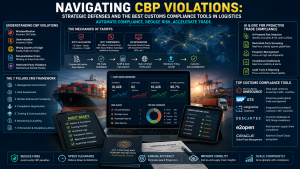
Avoiding CBP Violations: Best Customs Compliance Tools in Logistics
Understanding CBP Violations and the True Cost of Non-Compliance
Operating across international borders subjects logistics providers to intense scrutiny from global regulatory bodies. Among the most stringent enforcers is U.S. Customs and Border Protection, which aggressively monitors incoming freight for regulatory adherence. Routine CBP violations typically revolve around the three key areas of customs compliance: product classification, accurate valuation, and the verified country of origin. Failing to substantiate any of these foundational elements invariably triggers an audit, thrusting a company into a prolonged investigation that drains resources. Shippers often underestimate how quickly minor clerical errors multiply across thousands of shipments, transforming simple administrative oversight into massive financial liability.
Recognizing what kinds of discrepancies attract federal attention is the first line of defense. The most common violations include using incorrect Harmonized System (HS) codes to bypass tariffs, under-declaring shipment values to reduce tax burdens, and falsifying origin certificates to benefit from free trade agreements. To effectively prevent these unforced errors, organizations frequently model their internal protocols on the widely recognized 7 pillars CMS framework originally outlined by federal authorities for robust corporate governance. This structure demands written policies, designated oversight committees, targeted employee training, and continuous internal auditing to maintain a flawless operational record.
Federal expectations for supply chain transparency have evolved well beyond manual paperwork. Regulatory bodies actively evaluate whether a company has a formal compliance structure resembling an OIG program, which establishes clear channels for reporting discrepancies and enforcing internal standards. Companies relying entirely on legacy spreadsheets or fragmented emails inevitably fall behind. Modern logistics operations must adopt comprehensive software ecosystems designed specifically to intercept errors before a commercial invoice ever reaches the customs broker.
The Mechanics of Tariffs: Navigating Duty Calculations and Global Frameworks
Customs clearance requires an intricate understanding of international taxation structures and surcharges. Depending on the importing country, an importer must properly calculate duty by aggregating the cost of the goods, insurance, and freight (CIF). In various emerging markets and major trading hubs, you will encounter distinct tax layers such as BCD and SWS in customs processing—referring directly to Basic Customs Duty and the Social Welfare Surcharge. Miscalculating these stacked percentages not only leads to significant border delays but also results in retroactive penalties when authorities reconcile the accounts during post-entry audits.
Handling these complex calculations manually across different global jurisdictions is mathematically perilous. Advanced logistics technology relies heavily on robust architecture where an integrated EDI system calculates many types of duty instantaneously based on live regulatory feeds. Electronic Data Interchange (EDI) facilitates a direct, secure pipeline between the freight forwarder's operating system and the government’s automated portals, such as the U.S. Automated Commercial Environment (ACE). This direct machine-to-machine communication strips away the latency and human error inherent in manual data entry.
Deploying these digital pipelines completely redefines how a broker processes heavy commercial invoices. When a shipment arrives at a port, the underlying software instantly cross-references the declared HS codes against current tariff schedules. The platform automatically adjusts for regional trade agreements, anti-dumping provisions, and specialized surcharges without requiring human intervention. Consequently, the customs broker simply reviews the finalized computation for anomalies, allowing high-volume shipping operations to maintain aggressive velocity while remaining fully compliant with global border policies.
Leveraging AI and GRC Elements for Proactive Trade Compliance
Artificial intelligence is systematically rewriting the rules of global trade management. Leading software vendors are aggressively embedding AI regulatory technology and top GRC elements into their platforms, fusing Governance, Risk, and Compliance directly into the daily logistics workflow. This paradigm shift means the software no longer just records data; it actively interrogates it. Predictive algorithms scan commercial descriptions, identify conflicting HS codes, and flag suspicious supplier behaviors in real-time. By automating the restricted party screening process, companies guarantee continuous checks against global denied-party and sanction lists before any cargo is loaded onto a vessel.
Visibility is practically useless without context, which is why software architecture heavily emphasizes advanced user interfaces. The industry's premier platforms provide robust compliance dashboards and exception management tools that isolate problematic shipments from the thousands of flawless ones. When logistics executives ask how to build a unified monitoring framework that actually prevents fines, the answer lies in exception-based monitoring. Instead of flooding operators with endless streams of normal transaction data, these dashboards instantly highlight missing export licenses, flagged entities, or sudden tariff rate changes, allowing compliance officers to intervene precisely where their expertise is required.
Achieving this level of predictive risk management requires dismantling internal data silos. An effective management platform in 2026 functions as a single source of truth across the entire organization, seamlessly connecting procurement, shipping, and finance. When an auditor eventually knocks on the door, having a centralized, AI-backed system allows a company to instantly produce the required audit trails. Comprehensive logging of data changes, approvals, and broker entries demonstrates systemic control, effectively limiting corporate liability and proving to regulators that the company actively polices its own supply chain.
Reviewing the Top Customs Compliance Tools in the Logistics Industry
Selecting the appropriate technology stack depends entirely on the scale, architecture, and specific geographic footprint of the logistics provider. A thorough review of the best customs compliance tools in the logistics industry reveals a highly competitive market tailored to different enterprise needs. For example, Thomson Reuters ONESOURCE dominates the market for organizations requiring deep automated trade content, offering exhaustive tariff classification and screening databases spanning more than 200 countries. Conversely, SAP Global Trade Services (GTS) serves as the premier choice for massive multinational corporations that require their automated declarations tightly interwoven into the broader SAP enterprise resource planning environment.
Freight forwarders seeking a fully unified operating system frequently gravitate toward CargoWise Customs, which blends global forwarding logistics with native customs clearance connections in over 60 countries. Descartes similarly ranks as a top-tier provider by offering robust commercial customs databases alongside seamless U.S. ACE filings and importer self-filing workflows. For companies operating highly decentralized networks, E2open provides unmatched multi-partner supply chain compliance, while Oracle Global Trade Management natively secures businesses already entrenched in the Oracle Cloud ecosystem.
Regardless of the specific brand, any viable trade management software must execute several foundational technical requirements flawlessly to justify its enterprise licensing costs. An objective trade compliance software comparison highlights several mandatory capabilities that logistics managers must mandate during procurement, ensuring their investment actively mitigates risk on a global scale. Procurement teams must scrutinize these functional areas before deploying any new system across their operations.
- Intelligent Classification and Filing: The platform must feature systemic algorithms or AI-driven lookup capabilities to assign the correct Harmonized System codes effortlessly. Once classified, the system must establish direct API or EDI connectivity with customs authorities to transmit filings without manual keystrokes. This direct integration explains how clearance data is instantly recorded and acknowledged by the governing port authority, effectively preventing documentation mismatches.
- Continuous Screening and Historical Auditing: A premier tool must execute rigorous, continuous restricted party screening against frequently updated global sanction lists to prevent severe federal penalties. Simultaneously, it must generate immutable audit trails logging every data modification, broker entry, and managerial approval. This comprehensive logging acts as the ultimate defense mechanism, demonstrating exactly why rigorous corporate governance succeeds during a formal customs investigation.
Building a Resilient and Future-Proof Logistics Infrastructure
Securing a global supply chain is not a static achievement; it requires a perpetual commitment to refining internal processes alongside advancing technology. Modern regulatory environments demand that companies move beyond reactive penalty management and adopt highly aggressive, proactive compliance postures. By integrating dedicated customs compliance software, importers and freight forwarders can systematically map their vulnerabilities and build automated safeguards against them. This technological foundation empowers organizations to scale their shipping volumes confidently without proportionally increasing their administrative headcount or expanding their exposure to federal fines.
The intersection of global politics, shifting trade agreements, and fluctuating tariffs guarantees that the international logistics landscape will remain heavily regulated. Relying on institutional memory or the isolated expertise of a few seasoned customs brokers is a catastrophic business strategy. True resilience is achieved by institutionalizing that expertise directly into the software architecture. As artificial intelligence models become increasingly sophisticated at interpreting dense legal texts, the systems managing your freight will soon autonomously adapt to new legislative rulings the moment they are published.
Ultimately, successful international trade hinges on an organization's capacity to prove its integrity to government agencies. Deploying best-in-class trade software transforms a fragmented shipping department into a highly disciplined, audit-ready operation capable of moving cargo across any border without hesitation. By prioritizing accurate data governance, investing in the right digital tools, and rigorously enforcing internal standards, logistics leaders can protect their profit margins while simultaneously accelerating their global delivery networks. The future of freight forwarding belongs exclusively to those who master the digital border.