How to Find, Evaluate, and Retain Expert Trade Compliance Consultants
 Import Export
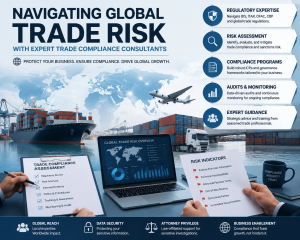
Navigating Global Trade Risk With Expert Trade Compliance Consultants.
To find trade consultants for regulatory risk, organizations must evaluate three primary channels: major global advisory firms, specialized trade law practices, and independent expert networks. Navigating export controls under the Bureau of Industry and Security (BIS), International Traffic in Arms Regulations (ITAR), and sanctions enforced by the Office of Foreign Assets Control (OFAC) requires vetting external partners based on technical jurisdiction, internal audit capabilities, and proven industry track records. Securing the right trade risk advisor hinges on defining whether your organization requires short-term tariff classification audits, long-term regulatory frameworks, or full-scale supply chain risk assessments.
How to Find, Evaluate, and Retain Expert Trade Compliance Consultants
Where to Source Qualified International Trade and Regulatory Risk Consultants
Sourcing qualified trade advisors begins with understanding the distinct categories of consulting providers active in the global marketplace. Organizations seeking broad enterprise-wide governance frequently review Gartner's market overview of global trade compliance advisory services to evaluate large accounting and management entities. While executives often ask who the Big 5 consultancy firms are when seeking household corporate brands, modern international trade compliance is heavily served by the Big 4 accounting powerhouses alongside multidisciplinary advisory firms like FTI Consulting and Alvarez & Marsal. These expansive organizations offer multi-jurisdictional reach and deep bench strength, making them well-suited for multinational conglomerates undergoing massive operational overhauls or cross-border mergers.
For businesses seeking agile, specialized expertise without the overhead of global conglomerates, independent expert networks and boutique practices provide targeted alternatives. Platforms such as Umbrex connect corporate trade directors with vetted, independent international trade advisors who possess decades of focused field experience. Concurrently, specialized trade compliance practices, including firms like Guidepost Solutions and specialized trade compliance consultancies, focus almost exclusively on import-export mechanics, customs audits, and export administration compliance. These boutique teams often deliver rapid turnarounds on Harmonized System (HS) code classification projects and specialized export control compliance reviews.
A third vital avenue includes law-affiliated advisory groups and specialized international trade legal practices. Firms like Womble Bond Dickinson and trade groups conducting international trade compliance risk evaluations offer a unique structural advantage: the ability to conduct internal investigations under attorney-client privilege. When an organization suspects a potential violation of export control laws or sanctions regulations, engaging a law-affiliated trade consultant ensures that sensitive findings, gap analyses, and voluntary self-disclosures remain protected while corrective action plans are engineered.
Evaluating Scope, Credentials, and Core Governance Models
Before initiating contact with external advisors, enterprise leadership must clearly articulate the project scope and internal operational needs. Selecting the right advisor depends on whether the mandate requires a discrete, short-term audit—such as verifying Export Control Classification Numbers (ECCN) or evaluating duty drawdown eligibility—or the construction of an overarching Internal Compliance Program (ICP). Organizations evaluating supply chain trade compliance management services must determine if they need external support for daily transactional clearances or strategic regulatory risk governance across multi-tiered international vendor networks.
Vetting candidate credentials requires rigorous scrutiny of industry-specific experience and familiarity with enforcement agencies. Qualified trade consultants must demonstrate direct operational mastery of regulations governed by U.S. Customs and Border Protection (CBP), the Department of Commerce’s Bureau of Industry and Security (BIS), and the Treasury Department’s Office of Foreign Assets Control (OFAC). Furthermore, because international trade data contains highly sensitive commercial secrets and technical information subject to strict export restrictions, organizations must verify that prospective consulting firms maintain robust data encryption, secure cloud infrastructure, and strict non-disclosure protocols before sharing supply chain documentation.
Effective trade advisory engagements rely on structured governance models that align external expertise with internal accountability. Experienced regulatory consultants assist corporate boards in building robust operational safeguards modeled after established financial oversight systems, such as the institutional four pillars of control—governance, risk assessment, control activities, and continuous monitoring. Applying these four pillars ensures that trade compliance policies are not merely passive manual entries but active operational checks integrated directly into Enterprise Resource Planning (ERP) software and logistics workflows.
- Regulatory Interpretation and Policy Synthesis: Consultants must possess the analytical capability to translate complex, fast-changing trade legislation and geopolitical sanctions into clear, actionable operational guidelines for logistics, procurement, and sales teams. This skill ensures that front-line employees understand exact boundaries without slowing down everyday commercial execution.
- Data Analytics and Transactional Auditing: Mastery over large data sets is essential for conducting thorough audit sampling across thousands of line-item customs entries, bills of lading, and automated screening logs. Advisors use these technical audit capabilities to pinpoint systemic tariff misclassifications or hidden transaction anomalies before government auditors identify them.
- Cross-Functional Leadership and Crisis Management: When regulatory inquiries or customs holds occur, advisors must seamlessly coordinate across legal, supply chain, executive leadership, and external regulatory bodies. Effective trade leaders manage high-pressure situations by deploying structured corrective action plans that mitigate financial penalties while maintaining ongoing commercial viability.
Identifying Red Flags in Export Transactions and Sanctions Screening
A primary responsibility of trade compliance consultants is training internal teams to detect and neutralize transaction anomalies. Executives often ask what is a red flag in export transactions. In regulatory terms, a red flag represents an abnormal circumstance or transaction indicator that signals a heightened danger that exported items, software, or technology may be diverted to unauthorized end-users, blocked entities, or prohibited military end-uses. Identifying these subtle warning signs early is essential for maintaining compliance with the Export Administration Regulations (EAR) and preventing severe civil or criminal liability.
Under federal export regulations, businesses are legally prohibited from turning a blind eye to suspicious transaction details. The Bureau of Industry and Security imposes an affirmative duty on exporters to investigate all red flags before proceeding with a shipment. Simply delegating shipping arrangements to an external freight forwarder or customs broker does not relieve the primary exporter of legal responsibility. When suspicious indicators arise, companies must pause the transaction, conduct thorough due diligence, and, if concerns cannot be satisfactorily resolved, refrain from the sale or report the circumstance to federal enforcement authorities.
Consultants systematically audit sales pipelines and order logs against established regulatory warning indicators to catch compliance breaches before goods leave the loading dock. Recognizing these common types of anomalies requires establishing structured screening protocols across customer onboarding, order processing, and final distribution channels.
- Evasive End-User and End-Use Disclosures: It is a major red flag when a prospective customer is reluctant to provide complete end-user documentation, refuses to sign standard end-use certificates, or gives vague answers regarding whether the ordered equipment is intended for domestic use or overseas re-export. Legitimate commercial buyers can easily describe how, where, and by whom a specialized product will be utilized.
- Technical Incompatibility and Business Mismatch: Compliance alarms must sound if a customer’s stated line of business is completely inconsistent with the technical capabilities of the ordered goods, such as a small agricultural firm ordering advanced semiconductor manufacturing components. Similarly, ordering sophisticated dual-use technology for delivery to a region lacking the underlying industrial infrastructure strongly suggests intended illegal diversion.
- Abnormal Logistics, Out-of-Way Routing, and Cash Payments: Requesting unusual transport routes through known transshipment hubs, insisting on delivery to a vague freight forwarder address, or offering to pay in full via cash for expensive industrial machinery represent major red flags. These irregular transactional behaviors are classic techniques used by sanctioned entities to obscure the final destination and eliminate paper trails.
Understanding Consulting Fees, Compensation Structures, and Market Rates
Understanding the financial aspects of hiring external expertise requires examining how much a compliance consultant costs across different engagement structures. Advisory fees vary significantly based on firm size, geographic region, technical specialization, and project complexity. Common fee structures include hourly billing for ad hoc advisory work, fixed-fee arrangements for discrete deliverables like mock customs audits or program manual creation, and ongoing monthly retainers for outsourced chief compliance officer services.
When evaluating individual proposals, corporate buyers frequently ask is $100 an hour is good for consulting services in the regulatory space. While $100 per hour represents a reasonable fee for general administrative compliance support or junior entry-level analysts, experienced trade compliance consultants and specialized legal advisors typically command between $250 and $600+ per hour. Top-tier partner-level expertise from specialized legal practices or major global firms can easily exceed $800 per hour for high-stakes enforcement defense, making it critical for businesses to align the cost of advice with the severity of their risk exposure.
To put external consulting rates in perspective, organizations must also consider internal salary benchmarks across the broader compliance sector. When analyzing what regulatory consultants make in corporate or advisory roles, market data reveals that entry-to-mid-level trade compliance specialists earn an average salary of around $80,000 USD in the USA. Senior directors, trade attorneys, and principal consultants are typically paid substantially higher base salaries alongside performance bonuses, frequently reaching $180,000 to $300,000+ annually depending on their specialized sector expertise and geographic location.
Career Trajectories, Corporate Stress, and the Impact of AI on Trade Advisory
Despite the high-stakes environment surrounding international trade law, working in trade compliance is far from a stagnant or dead-end job. Navigating complex export controls, customs tariffs, and foreign policy sanctions provides professionals with deep operational visibility into global supply chains, corporate governance, and international risk mitigation. This multidisciplinary exposure frequently opens career pathways toward senior executive roles, similar to how a veteran JPMorgan officer or enterprise risk executive leverages regulatory expertise to step into Chief Compliance Officer, Chief Risk Officer, or Chief Operating Officer positions.
However, the demanding nature of regulatory enforcement can create intense workplace pressure, particularly within specific high-risk sectors. Companies operating in dual-use technology manufacturing, defense contracting, global e-commerce logistics, and fast-scaling biotech are frequently viewed as stressful companies for compliance professionals. These fast-paced organizations operate under relentless commercial pressure to ship goods quickly, requiring trade compliance officers to make immediate, highly consequential decisions that balance revenue goals against severe federal regulatory penalties.
As artificial intelligence and automated screening platforms proliferate across global trade management systems, industry leaders often inquire whether human regulatory consultants will be replaced by AI technologies. While machine learning algorithms excel at processing massive datasets, flagging routine restricted parties, and automating tariff code suggestions, AI cannot replace human legal interpretation, strategic negotiation with customs authorities, or the complex decision-making required during voluntary self-disclosures. The demand remains highest for human trade experts who utilize AI tools to enhance operational speed while applying sophisticated ethical and legal judgment to safeguard global business operations.


One thought on “How to Find, Evaluate, and Retain Expert Trade Compliance Consultants”