FedEx Local Delivery Restriction: What Delivery Not attempted Means
 Import Export
FedEx Local Delivery Restriction: What It Means and How to Resolve It
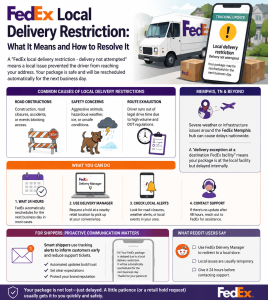
When your tracking screen displays a "FedEx local delivery restriction - delivery not attempted" notice, it indicates that your package was physically on the delivery truck, but a localized issue prevented the driver from safely reaching your door or completing their route. This status acts as a temporary pause, typically triggered by unexpected roadblocks, aggressive animals, gated community access failures, or sheer route exhaustion. The most actionable takeaway is to simply wait twenty-four hours; FedEx automatically reschedules these packages for the following business day. By checking for local alerts, you can anticipate redelivery without needing immediate customer support intervention.
FedEx Local Delivery Restriction: What It Means and How to Resolve It.
Delivery Updated: Your Package May be late due to Local Delivery Restrictions
Seeing this alert pop up on your tracking screen instantly sinks your heart. It usually hits right when you need that package the most. This specific status update means the local distribution center has encountered a physical or logistical roadblock preventing its trucks from reaching your neighborhood. Sometimes it is a severe weather event flooding the main highway. Other times, it is a completely mundane issue like a local parade closure, heavy road construction, or a gated community changing its access codes without notifying the carrier. When FedEx flags a local delivery restriction, the driver literally cannot complete the final mile.
What can I do if FedEx keeps delaying my package?
Do not just sit there hitting refresh on your tracking page. You have options. First, try calling the local dispatch facility directly. Skip the 1-800 national number if you can track down the local hub's direct contact info, and ask them to hold the package at the facility for pickup. This bypasses the delivery route bottleneck entirely. Alternatively, use the FedEx Delivery Manager tool to reroute your shipment to a nearby authorized pickup location, like a Walgreens or Dollar General. If the delay drags on for days, contact the original shipper immediately. They hold the actual account with the carrier and possess far more leverage to initiate a trace.
What do delivery restrictions mean?
In logistics terms, a restriction is any external factor stopping a delivery truck from completing its assigned route. These roadblocks fall into a few distinct categories. You might be dealing with municipal restrictions, such as strict weight limits on residential bridges preventing a heavy step van from crossing. Or perhaps local ordinances prohibit commercial deliveries after certain hours in your specific zoning district. To understand the exact mechanics behind these frustrating roadblocks, you can review what a FedEx local delivery restriction means for daily route planning. Essentially, the driver hit an unavoidable wall, logged the exception code, and pushed your stop to the next business day.
What is FedEx's policy for late delivery?
Here is the unvarnished truth regarding refunds. FedEx does offer a Money-Back Guarantee for specific premium services like Priority Overnight. If they miss the promised delivery time by even sixty seconds, the shipper is entitled to a full refund of transportation charges. However, there is a massive catch. This guarantee flies completely out the window the second a delivery exception occurs due to circumstances beyond their control. Weather delays, natural disasters, and local road closures completely void the refund policy. If your package is delayed strictly due to a local routing restriction, FedEx claims zero financial liability.
What does "Delivery updated" mean on FedEx tracking?
That vague notification simply means the original estimated arrival time is dead. The routing algorithm has officially recalculated. The system pushes this generic alert whenever a physical scan event actively changes the projected delivery window. Maybe a truck broke down in transit. Maybe the sorting facility is severely understaffed today. By checking the exact tracking code history, you can often see the underlying FedEx status that triggered the automated update. It is the system's automated way of resetting your expectations. The package is not lost. It just is not arriving when they initially promised, and the software is frantically updating the timeline to reflect reality on the ground.
Decoding the Delivery Exception Local Delivery Restriction
When analyzing modern logistics tracking, encountering a "FedEx local delivery restriction - delivery not attempted" notice can immediately spark severe anxiety for an expectant recipient. This specific update indicates that a highly localized, temporary physical barrier prevented your delivery driver from physically accessing your front door or finalizing their assigned route for that specific shift. Unlike a lost parcel or a misrouted shipment that ends up in the wrong state, the item is entirely safe and accounted for within the carrier's possession. The driver simply encountered an insurmountable hurdle in the final mile of transit and was forced to return the package to the local sorting facility at the end of the day to maintain operational security.
The visual indicator for this frustrating event is often the infamous FedEx yellow exclamation mark delay flashing aggressively across your mobile tracking application. This bright warning symbol serves as an automated digital flag, designed to alert both the shipper and the receiver that the standard delivery timeline has officially been interrupted by a delivery exception: local delivery restriction. While it certainly looks intimidating on a smartphone screen, the exclamation mark is merely an informational tool used by the carrier's software. It bridges the communication gap between the delivery van navigating your neighborhood and the corporate tracking servers updating your browser in real time.
Understanding this classification helps eliminate unnecessary panic and allows you to set realistic expectations. A local restriction means the package successfully survived the cross-country cargo flight, made it through the regional sorting hub, and completed the morning truck loading process without a single hitch. The breakdown occurred purely at the neighborhood level. Whether it was a spontaneous street fair blocking the main avenue or a sudden severe thunderstorm rendering your steep driveway unsafe, the driver made a calculated safety or logistical decision to abort the drop-off. Consequently, the tracking system automatically logs the event to maintain a transparent chain of custody for the merchant and the buyer.
Identifying the Core Causes of Final-Mile Delivery Failures
The most frequent culprit behind a local delivery restriction involves unexpected physical obstructions actively blocking the driver's designated route. Heavy road construction, municipal utility work, or even an unannounced neighborhood block party can completely sever vehicular access to a residential street. Delivery drivers operate large, cumbersome step vans that cannot easily execute a three-point turn in a tight cul-de-sac filled with heavy paving equipment or temporary barricades. When confronted with these immovable barriers, the driver has no logical choice but to bypass the address, securely retain the package on the vehicle, and logically code the failure as a delivery not attempted due to local conditions.
Safety hazards present another massive, often overlooked barrier to successful package placement. Aggressive, unrestrained dogs roaming a front yard instantly disqualify a home from receiving a delivery that day, as drivers will not risk a severe bite simply to drop off a parcel. Similarly, during the harsh winter months, heavily iced staircases or deeply unshoveled walkways create an unacceptable liability for the carrier. Drivers are strictly instructed by corporate safety managers to never risk personal injury or a workers' compensation claim by navigating treacherous private property. If the physical environment looks remotely dangerous, they will immediately trigger a delivery exception and drive safely to the next stop on their itinerary.
Finally, sheer logistical exhaustion frequently causes these specific tracking updates during periods of incredibly high shipping volume. A driver may simply run out of available working hours before reaching the very end of their route. Department of Transportation regulations place rigid, inflexible caps on how many consecutive hours a commercial driver can legally operate a vehicle to prevent fatigue-related accidents. If a driver hits their strict legal time limit, they must return to the depot immediately, regardless of how many packages remain undelivered on the shelves. This unbending operational reality frequently results in a blanket restriction scan being applied to all remaining parcels on that specific truck until the next morning.
Why Your Package May Be Late: Local Delivery Restrictions in Memphis, TN, and Beyond
Because Memphis serves as the global primary super-hub for all major FedEx air operations, localized issues in this specific geographic area can cause massive downstream ripple effects across the entire country. People constantly search the internet for reasons why their tracking states their package may be late, local delivery restrictions in Memphis, TN, incorrectly assuming the physical problem is occurring right outside their own house. In reality, massive severe weather events, sudden ice storms, or localized infrastructure failures immediately surrounding the massive Memphis airport can temporarily freeze outbound operations. When the hub cannot process outbound flights efficiently, the tracking system may occasionally code the delay using local restriction terminology, deeply confusing recipients who live hundreds of miles away in perfectly sunny weather.
This geographic confusion often leads anxious customers to frantically ask, what does a delivery exception at a destination FedEx facility mean in the grand scheme of transit? This specific phrasing indicates that the package successfully arrived at the final local warehouse closest to your home, but an internal operational issue prevented it from being loaded onto the neighborhood delivery van. The destination facility might be experiencing an extreme volume surge following a major retail holiday, suffering from acute localized staffing shortages, or dealing with a broken mechanical conveyor belt. The package is sitting perfectly safe inside a climate-controlled building just a few miles from your house, temporarily paralyzed by internal warehouse friction.
Distinguishing between a street-level restriction and a destination facility exception requires carefully reading the highly detailed tracking notes provided in the carrier's portal. A street-level restriction heavily implies that the package was physically traveling through your specific neighborhood and failed at the absolute last second due to an external factor. A facility-level exception means the package never even made it onto the delivery vehicle that morning. Recognizing this subtle difference allows you to set highly accurate expectations for redelivery. If the problem is trapped at the facility, it might take a few days for the logistical backlog to completely clear. If the problem was simply on your street, redelivery is almost certainly happening the very next morning.
Actionable Steps to Resolve Delivery Exceptions Quickly
The absolute most effective response to a local delivery restriction is simply practicing a little bit of patience and giving the system time to correct itself. In the vast majority of scenarios, FedEx operates on a highly automated system of redelivery, meaning they will inherently try to deliver the package again on the very next normal business day without any prompting. You do not need to call a toll-free number, wait on hold for an hour, or fill out a complicated online form to trigger this second attempt. The local sorting facility automatically re-scans the package overnight, assigns it to a fresh truck in the early morning, and sends it back out for delivery once the neighborhood obstruction has presumably cleared. Understanding this internal workflow saves you immense amounts of time and frustration.
For those who absolutely cannot wait for the system to process the redelivery automatically, you can leverage official corporate tools to intervene in the process. You will frequently see anxious buyers posting questions about whether your package may be late due to local delivery restrictions on FedEx Reddit, looking for insider tips from off-duty drivers and logistics experts. The most common and reliable advice found in these communities is to leverage the official FedEx Delivery Manager portal. Through this highly secure digital tool, you can actively request that the package be intercepted and held securely at a nearby retail partner, such as a local pharmacy or a dedicated shipping center, entirely bypassing the problematic residential drop-off. You can learn more about how delivery statuses work through resources like what does FedEx local delivery restriction mean.
- Proactive Retail Holding: By redirecting your valuable shipment to a secure, well-lit retail location, you completely eliminate the variable of unpredictable residential roadblocks and hazardous weather conditions. The retail centers feature dedicated commercial loading docks and highly consistent operating hours, guaranteeing that the driver can easily complete the drop-off on their next route cycle without incident.
- Checking Local Municipal Alerts: Before calling customer service to aggressively complain about a missed delivery, briefly check your local town's social feeds or municipal website for unannounced street closures or utility emergencies. Understanding the exact nature of the neighborhood roadblock prevents you from demanding a redelivery that the driver is physically incapable of completing due to active police cordons or massive construction vehicles.
If the tracking status remains entirely unchanged after a full forty-eight hours, you must thoughtfully escalate the situation by directly contacting official customer support. Sometimes, a poorly written driver's note can leave a package stuck in administrative limbo at the local terminal, requiring human intervention. A quick phone call allows a customer service representative to read the internal dispatcher notes, identify the exact reason for the persistent failure, and manually push the package back into the active delivery queue. For broader context on how carriers manage massive international bottlenecks, you might review how shipments are cleared and delivered by brokers for DHL, FedEx, and UPS. This human intervention is rarely needed, but it serves as a highly powerful fail-safe when automated sorting systems stall.
How Shippers Handle the "Your Package May Be Late — Local Delivery Restrictions" Dilemma on Reddit
From a strict corporate business perspective, managing consumer anxiety surrounding delivery delays is a highly expensive and incredibly tedious operational burden. When e-commerce customers encounter a sudden tracking delay, their first instinct is almost always to blame the retail brand rather than the physical shipping carrier. Frustrated buyers routinely flock to internet forums, typing frantic searches for your package may be late local delivery restrictions, " and " reddit, seeking validation and demanding immediate refunds from the original merchant. This rapid escalation forces brands to dedicate massive amounts of customer service payroll simply to explain that a local delivery truck was blocked by a garbage truck or a severe snowstorm. The financial impact of these support tickets rapidly eats away at thin retail profit margins.
To aggressively combat this operational friction, high-volume shippers are increasingly adopting proactive tracking software that automatically intercepts these delivery exception codes in real-time. Instead of passively waiting for the customer to discover the yellow exclamation mark and panic, the brand immediately fires off a reassuring, highly detailed automated email or text message. This customized message calmly explains that a minor local restriction has temporarily paused the delivery, assuring the buyer that the carrier will automatically attempt redelivery tomorrow. You can read more about resolving these specific issues on the official page covering what a delivery exception means. By controlling the narrative early, merchants successfully defuse the tension and prevent the customer from furiously dialing the support hotline.
Ultimately, deeply understanding the intricate mechanics of these carrier restrictions protects both the consumer's peace of mind and the retailer's bottom line. While a localized barrier may temporarily halt the physical movement of a cardboard box, it represents a highly routine, easily solvable logistical hiccup rather than a catastrophic permanent loss. By allowing the automated redelivery systems to function seamlessly exactly as designed and intelligently utilizing retail hold locations when necessary, buyers can navigate these minor inconveniences without any stress. The next time your tracking screen flashes a delivery not attempted warning, you will know exactly why it happened and precisely how to handle it.
One thought on “FedEx Local Delivery Restriction: What Delivery Not attempted Means”