Best CBP E-Commerce Compliance Platforms for International Shipping in 2025-2026
 Import Export
Best CBP E-Commerce Compliance Platforms for International Shipping in 2025-2026.
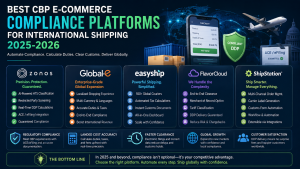
The global suspension of the de minimis exemption in 2025 forced direct-to-consumer brands to completely rebuild their logistics infrastructure overnight. The U.S. Customs and Border Protection (CBP) now demands formal entry filings, exact Harmonized Tariff Schedule (HTS) classifications, and upfront duty payments for nearly all low-value inbound shipments entering the USA. To survive this regulatory shift and maintain rapid delivery speeds, retailers must integrate specialized trade compliance software directly into their digital storefronts. The best CBP e-commerce compliance platforms for international shipping in 2025-2026 include Zonos, Global-e, Easyship, FlavorCloud, and ShipStation. These specific solutions actively automate landed cost calculations, screen for restricted parties, and guarantee Delivered Duty Paid (DDP) clearance at the border, ensuring that your international packages reach customers without unexpected government holds or hidden penalty fees.
Best CBP E-Commerce Compliance Platforms for International Shipping in 2025-2026
What Are Some Reliable Cross-Border E-Commerce Platforms?
For massive global reach, platforms like Global-e, FlavorCloud, and Zonos dominate the market by calculating landed costs instantly. They completely automate international tax collection right at the checkout screen.
When you expand overseas, you absolutely need systems that process complex duty calculations without hesitation. Legacy apps simply choke under pressure. Fast-growing brands trust modern networks because many of these providers act as the merchant of record. They absorb the massive legal headaches of foreign tax compliance. This setup ensures your inventory sails through customs checkpoints without a hitch. If you want a deep dive into the top performers, this comprehensive guide to CBP compliance platforms reveals exactly how these specific tools eliminate surprise government holds. Picking the right one saves you thousands in hidden border penalties.
What Specific Software Do Shipping Companies Actually Use?
Top logistics providers rely heavily on specialized Automated Broker Interface (ABI) software to transmit entry data straight to U.S. Customs. These massive digital pipelines secure automated, lightning-fast clearances for serious freight volumes.
Major carriers do not use standard retail plugins. They operate on an entirely different level of digital infrastructure. Shipping giants deploy heavy-duty compliance engines built to talk directly to federal servers. When thousands of imported packages hit a port simultaneously, this software fires off the mandatory Type 86 clearance data in a fraction of a millisecond. Transparency matters here. Federal border authorities actually publish the official ABI software vendors list to show exactly which tech companies hold the keys to the customs gate. You need vendors from that exact list to move high-volume cargo legally.
Which Enterprise Platforms Perform Better Than Shopify?
While Shopify remains an absolute powerhouse for domestic retail, specialized platforms like Easyship and FlavorCloud perform significantly better at managing intense global duty regulations. They embed advanced cross-border tax logic directly into their core architecture.
Shopify gives you incredible storefront design flexibility. But out of the box? It struggles with the sheer mathematical complexity of international customs laws. Merchants usually end up stacking multiple expensive apps just to figure out what a buyer in Germany owes in import taxes. Dedicated platforms fix this mess immediately. They calculate those exact duties with total precision. By integrating robust trade compliance software, these platforms guarantee Delivered Duty Paid (DDP) shipments. They completely kill the nightmare scenario where a customer rejects a package simply because of shock border fees.
Is International E-Commerce Still Worth It in 2026?
Yes, selling internationally remains incredibly profitable right now, provided you automate your customs procedures to survive stricter border enforcement. Sellers who actively leverage modern compliance tech continue capturing massive overseas market share.
The old days of blindly tossing a box on a cargo plane are dead. New government mandates require exact digital filing for every single consumer product entering the country. Sure, it sounds intimidating. But it actually wipes out your lazy competitors overnight. If you implement the right customs automation tool, you instantly gain a massive advantage over sellers who refuse to adapt to the rules. The global market still hungers for high-quality imported goods. You just have to play by the government's digital rules to reach those buyers.
Navigating the 2025 CBP Regulatory Shift
The era of shipping low-value goods across borders with minimal documentation officially ended when CBP systematically suspended the longstanding de minimis exemption. For decades, international sellers enjoyed a highly streamlined path into American markets, moving millions of parcels duty-free as long as their declared value remained under the $800 threshold. That massive loophole closed completely following sweeping executive orders. Lawmakers and customs authorities cited severe national security concerns and immense tariff revenue losses, prompting a massive policy overhaul that now requires formal or informal entries for every single non-postal shipment. This regulatory change rewrote the playbook for any company operating sites internationally. Retailers can no longer slap a basic label on a package and hope it clears customs seamlessly.
This aggressive policy shift immediately crushed merchants relying on cheap, slow logistics networks that deferred customs responsibilities to the final mile. Retail operators suddenly realized they needed advanced software just to legally put a box on a cargo plane. Sellers scrambling to adapt often ask what good cross-border e-commerce platforms provide a legal way to ship internationally without bankrupting their profit margins. The answer requires moving entirely away from basic label printers and investing in true trade compliance engines. If your current software stack cannot automatically generate a digital commercial invoice or calculate ad valorem tariffs in real time, your inventory will sit idle in a customs warehouse, racking up massive storage fees. You simply cannot operate manually in a digitized enforcement environment.
Smaller entrepreneurs often misjudge the sheer legal weight of these new border requirements. New entrants into the retail space frequently ask, do you need an LLC to do e-commerce on a global scale? While corporate structuring and tax classifications vary wildly by jurisdiction, CBP does not care about your corporate entity type when they flag an illegal import. Sole proprietors and massive enterprise corporations face the exact same customs penalties when paperwork is filed incorrectly. To import goods legally today, you must secure the appropriate entry bonds and designate an authorized customs filer. Relying on outdated strategies and ignoring the technological shift in trade compliance will result in permanently suspended release privileges, effectively destroying your ability to operate any company for global retail distribution.
Core Features Required for Trade Compliance
To successfully maneuver through these intense border inspections, modern shipping software must execute several highly technical data operations in fractions of a second. Automated HTS code lookup stands out as an absolute operational necessity for any high-volume seller. Modern compliance platforms leverage massive databases and machine learning to match your unique product catalog directly to the proper 10-digit Harmonized Tariff Schedule codes. Without this instant automation, attempting manual classification easily becomes the world's biggest problem with Shopify and other native retail hosts that simply lack deep regulatory tax engines out of the box. An incorrect digit in an HTS code immediately triggers a comprehensive audit, delaying your delivery by weeks while customs officers manually inspect the freight.
Understanding how your software manages the financial transaction at checkout dictates your ultimate success in foreign markets. A proper compliance platform forces sellers to explicitly choose how duties are collected and paid before the transaction finalizes. Retailers must configure their shipping gateways to process these cross-border taxes seamlessly, preventing the customer from abandoning their cart due to unexpected checkout friction. There are two primary methodologies dominating the industry for handling these complex international tax flows:
- Delivered Duty Paid (DDP): This compliance method clears duties and taxes upfront during the customer's initial checkout sequence on your website. By calculating and collecting these mandatory government fees immediately, you ensure that shipments clear U.S. customs without carrier brokerage delays or surprise receiver penalty fees. This approach heavily protects long-term customer loyalty because the buyer never receives a threatening, unexpected tax invoice from the final delivery driver.
- Delivered at Place (DAP): With this legacy approach, the seller only covers the baseline transportation costs, leaving the unsuspecting buyer entirely responsible for all import duties upon arrival. Customs agencies will legally hold the package at the border until the recipient pays the required tariffs, which frequently leads to abandoned shipments, massive return shipping fees, and horrific online reviews. Relying on this outdated method in today's strict regulatory environment almost guarantees catastrophic logistics failures.
Beyond financial calculations, the physical transmission of data to the government remains completely non-negotiable. ACE and eFiling integration represent the digital backbone of a compliant global supply chain. The Automated Commercial Environment (ACE) is the central operating system through which the U.S. government tracks, controls, and processes all imported goods. Elite compliance platforms connect directly into this digital infrastructure, ensuring that your data streams match the strict digital requirements mandated for commercial imports. By firing commercial invoice data electronically to customs authorities before the cargo plane even lands, merchants eliminate manual paperwork errors and drastically accelerate transit times for their global customers.
Leading Cross-Border E-Commerce Platforms Evaluated
Determining which platform has the best shipping capabilities requires an honest assessment of your daily order volume, technical resources, and target demographics. Evaluating the top 5 trade compliance systems starts with recognizing your baseline logistical needs. For mid-market brands seeking immense carrier diversity, Easyship serves as a highly reliable operational foundation. The software provides seamless access to over 550 global courier services, offering automated tax calculations and instant customs paperwork generation. Easyship aggressively simplifies the operational burden for growing brands by centralizing international rates into a single dashboard. Meanwhile, some sellers consider FlavorCloud the easiest global platform to deploy because it actively manages the entire clearance process. FlavorCloud embeds directly into popular web stores to take over international shipping, tariff classification, and customs clearance from end to end. Retailers analyzing a successful cross-border e-commerce example often point to FlavorCloud's unique ability to act as the merchant of record, legally insulating the seller from complex foreign tax liabilities.
For merchants requiring absolute mathematical precision and guaranteed compliance, Zonos dominates the technical landscape. Zonos excels at precise HTS classification, restricted party screening, and guaranteed DDP calculations at checkout. Their proprietary artificial intelligence engine prevents surprise CBP holds by capturing the exact landed cost before the credit card is even charged. On the other end of the volume spectrum, Global-e specifically targets enterprise-level direct-to-consumer retailers. Global-e builds an end-to-end localized international shopping experience, converting currencies and managing localized duties with staggering accuracy. Established retail brands view Global-e not just as a shipping tool, but as a comprehensive international revenue partner that guarantees import compliance across hundreds of sovereign borders.
Retailers prioritizing internal workflow centralization frequently deploy ShipStation to manage standard international carrier label creation alongside their domestic routing networks. ShipStation highly excels at multi-channel order management, pulling raw data from dozens of different marketplaces into one unified interface. However, out of the box, it relies heavily on third-party plugins and customized API connections to achieve deep landed-cost automation. Selecting the number-one beginner's platform versus investing heavily in an enterprise suite depends entirely on your internal developer resources. As detailed in a comprehensive evaluation of shipping platforms for e-commerce, selecting a specialized compliance vendor requires explicitly matching your specific fulfillment workflows with the platform's native regulatory capabilities.
Strategic Integration for Global Market Expansion
Implementing a massive compliance infrastructure dictates exactly how rapidly a modern business can scale into untamed territories. When frustrated retail executives ask who is better than Shopify for handling complex customs clearances natively, they are asking the wrong question entirely. The most profitable strategy involves integrating specialized compliance platforms directly into your existing tech stack rather than attempting to migrate to an entirely new hosting provider. A dedicated trade compliance API transforms a beautiful but basic digital storefront into a fully compliant, weaponized international logistics operation. You maintain your front-end marketing while the specialized software handles the brutal math of cross-border taxation seamlessly in the background.
Forecasting what the global trade environment will be in 2026 requires acknowledging that strict border enforcement will only intensify moving forward. The European Union recently introduced its own aggressive e-commerce handling fees and revoked duty-free thresholds, signaling that the end of regulatory loopholes is a permanent worldwide trend. Identifying the fastest-growing compliance software ensures that your daily operations remain highly resilient against shifting geopolitical trade policies and unexpected border inspections. Brands that try to patch together cheap, manual solutions will find their international revenue immediately throttled by customs seizures and massive carrier penalties. Whether your brand fits into one or all of the four main types of e-commerce, strict adherence to these new laws remains universally mandated.
Ultimately, the cheapest companies to ship with rarely offer the necessary digital data integrations to meet modern customs laws. Saving two dollars on a basic shipping label is completely worthless if the package spends six weeks locked inside a federal border inspection facility. According to Gartner's market overview of cross-border e-commerce platforms, utilizing top-tier architectural solutions fundamentally minimizes the risk of catastrophic supply chain disruption. Your technology stack must seamlessly support your geographical growth. You must invest heavily in dedicated compliance infrastructure, map your catalogs perfectly to global tax databases, and guarantee accurate digital filings on every single transaction to confidently conquer the international market.