
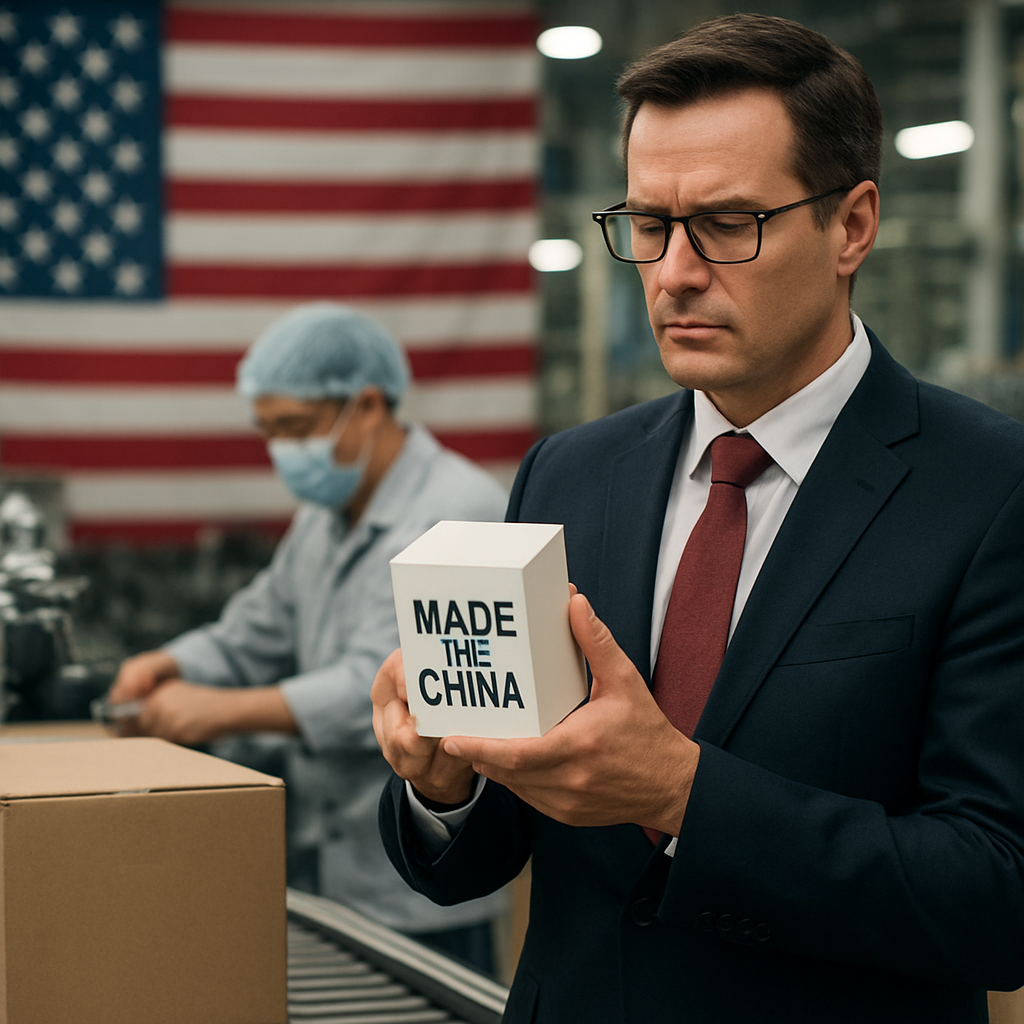
American companies make products in China mainly because it can be cheaper, faster to source, and easier to scale production there than in the United States. The usual drivers are lower labour costs, a large available workforce, industrial subsidies, fewer regulatory frictions, established supplier networks, and manufacturing infrastructure that has been built up over decades. For many firms, the decision is less about abandoning the U.S. market and more about producing goods in the location that gives the best mix of cost, capacity, and supply-chain reliability.
That said, manufacturing in China is not just about cheap labour. It is also about access to a mature ecosystem of component makers, toolmakers, logistics providers, and assembly plants. In other words, companies often choose China because an entire production system already exists there. According to an overview of why so many goods are made in China, the key advantages include lower labour costs, abundant workers, subsidies, fewer regulations, and long-term infrastructure investment. A separate trade analysis from the Congressional Research Service on globalised supply chains also shows how deeply embedded international production networks can shape where firms manufacture and how trade policies affect those decisions.
Why American Companies Manufacture in China
The direct answer is simple: many American companies manufacture in China because it lowers production costs and gives them access to a huge, established industrial base. That does not mean China is the only possible location, but for many products it remains one of the most efficient places to make goods at scale.
Several practical factors drive the decision:
- Lower labour costs: Wages in Chinese manufacturing are still typically below U.S. manufacturing wages, even though Chinese wages have risen over time.
- Large workforce: China has long offered a broad pool of industrial labour for assembly and component work.
- Industrial subsidies: Government support can lower operating costs for factories and suppliers.
- Fewer regulatory frictions: In some sectors, firms face fewer immediate cost burdens than they would in the U.S.
- Built-out infrastructure: Ports, industrial zones, transport links, and utilities have been developed to support large-scale production.
- Established supply chains: Suppliers of raw materials, parts, packaging, moulding, finishing, and shipping are already clustered together.
This matters because manufacturing is rarely just about the factory floor. A company is also paying for tooling, components, quality control, packaging, warehousing, and delivery. When those services are all available in the same region, the total landed cost can be lower than producing in a country where the entire ecosystem has to be rebuilt from scratch.
It is also important to separate final market from manufacturing location. A product can be made in China and sold only in the United States. That is a sourcing decision. It is different from selling into the Chinese market itself, which is a market-access decision.
Why supply-chain capacity matters as much as labour costs
For many American firms, the attraction of China is not only cheaper labour but also manufacturing depth. If a company needs custom parts, repeat production, and reliable replenishment, a mature supplier base can reduce delays and coordination problems. Once a business has qualified suppliers, tested moulds, agreed quality standards, and shipping routines in place, moving production becomes expensive and disruptive.
This is why the conversation should not be reduced to a simple “labour is cheaper” explanation. Cost matters, but so do capacity, supplier concentration, and the ability to produce many units consistently. In many categories, China offers a production environment that would take years and significant capital to replicate elsewhere.
Why Some American Companies Also Sell in China
Some American companies operate in China not because they want to manufacture there, but because China is itself a major commercial market. A firm may open offices, distribution channels, sales operations, joint ventures, or service arrangements in China in order to reach Chinese consumers and business customers.
This is an important distinction. An American company can have a presence in China for sales, sourcing, customer support, or partnerships without relying on China as its main production base. Likewise, a company can manufacture in China for the U.S. market without making a major sales push inside China.
Trade and market-access discussions often blend these two issues together, but they are not the same. A company may ask:
- Where should we make the product?
- Where should we sell the product?
- Where should we source components?
- Where should we place our regional operations?
Those answers can be different. China matters because it is both a production base and a consumer market, and many American firms try to take advantage of one or both of those realities.
Is $1000 USD a Lot in China?
If you are asking this as a shorthand for purchasing power, the safest answer is that $1000 USD generally has stronger buying power in China than in the United States in many contexts, but there is no single universal answer that applies everywhere in China. Costs vary widely by city, housing market, and lifestyle.
For this topic, the most reliable point supported by the supplied research is narrower: Chinese labour and production costs are materially lower than U.S. costs in manufacturing, which is one reason companies source there. That lower cost base is part of the business logic behind China-based production. A sourcing overview from Maple Sourcing’s discussion of U.S. imports from China notes that established supply chains, manufacturing efficiency, and competitive pricing help explain why Chinese factories remain central to the American market.
So while a thousand dollars may stretch further in many Chinese contexts than it would in the U.S., this article should not treat that as a precise cost-of-living conversion. The key takeaway for importers is simpler: lower operating and labour costs can improve the economics of manufacturing in China.
Will Manufacturing Come Back to America?
Some manufacturing can return to the United States, but the evidence does not support the idea that all manufacturing will come back. Reshoring is possible in certain industries, especially where automation, strategic security, or local demand justify the investment. But rebuilding broad manufacturing capacity is expensive, slow, and complex.
There are several reasons the return will likely be partial rather than complete:
- Factory capacity takes time to rebuild: New plants, equipment, utilities, logistics links, and trained labour do not appear overnight.
- Supply chains are already embedded: Many products depend on suppliers and sub-suppliers clustered in China or nearby regions.
- Moving production costs money: Tooling, qualification, and re-engineering can be expensive.
- Business models are already built around offshore sourcing: Some firms have organised procurement, inventory, and distribution around overseas production.
A useful way to think about this is that firms are de-risking, not necessarily fully reversing globalisation. Recent trade coverage from CNBC’s reporting on supply-chain volatility and tariff pressure indicates that companies are stockpiling key inputs, reassessing exposure to China, and looking at alternative sourcing. But that does not mean all production will return to the U.S. overnight. In practice, some capacity may shift to Southeast Asia or Mexico rather than moving back only to America.
That point matters because reshoring is often discussed as if there are only two options: China or the U.S. In reality, companies may spread production across multiple countries to reduce risk.
Can the United States Survive Without Imports from China?
The U.S. could adjust to severe reductions in imports from China, but not without disruption. The more realistic question is not whether the country could exist at all, but what would happen to prices, availability, and supply chains if imports were sharply reduced or cut off too quickly.
The most likely effects would include:
- Shortages of some goods: Many products and components would not be replaced immediately.
- Higher prices: Alternative sourcing is often more expensive, at least at first.
- Production delays: U.S. manufacturers that rely on Chinese inputs could face interruptions.
- Inventory stress: Companies would need to rely on stockpiles while new sourcing is arranged.
This is especially important because Chinese imports are not just finished consumer goods. They also include components that feed American assembly lines, such as circuit boards, display panels, and other industrial inputs. When those parts move through supply chains, the impact extends far beyond the final retail product.
That interdependence is one reason trade shocks can ripple so widely. The CRS report on globalised supply chains and U.S. policy explains that import barriers do not only affect foreign exporters; they can also raise costs for U.S. multinationals with manufacturing operations in China that ship goods back to the United States. In other words, supply-chain dependence is mutual and layered, not one-directional.
A severe break in imports would therefore be an adjustment problem, not a simple switch. The U.S. would not necessarily collapse, but consumers and businesses would feel the shock through higher costs and reduced availability before new supply networks had time to settle.
How Dependence on China Shapes Business Decisions
Once production is established in China, companies often become tied to the system around it. That can include suppliers, freight routes, customs processes, quality assurance routines, and payment terms. The longer a firm operates that way, the harder it becomes to move quickly.
This is why businesses think in terms of risk management, not just low unit cost. They consider:
- How concentrated their supply base is
- Whether they can source the same components elsewhere
- How much inventory they need as a buffer
- How tariffs or trade disputes might affect landed cost
- Whether product quality can be maintained during a move
If you want a practical example of how sourcing networks work, see our guide on finding a Chinese supplier. For buyers who source through online marketplaces, our article on supplier checks on Made-in-China.com also shows why verification matters when a business depends on overseas production.
What Trade Tensions and Tariffs Really Change
Trade tensions do not usually end China-based manufacturing overnight. What they do is change the economics and the risk profile. Tariffs, compliance delays, and geopolitical uncertainty can make some products less attractive to source from China, especially if margins are thin.
But a tariff is not the same as a ban, and higher trade barriers do not automatically create domestic replacement capacity. Instead, firms may respond by:
- raising prices
- reworking product design
- moving some sourcing to another country
- increasing inventory
- splitting production across multiple locations
That is why the effect of tariffs is often gradual and uneven. Some companies absorb the cost, some pass it on, and some reconfigure their supply chain. The result is usually diversification rather than a complete break.
IP, Quality, and Other Risks of Manufacturing Overseas
There are real trade-offs when manufacturing in China. Lower costs and scale can be attractive, but they come with risks that businesses need to manage carefully.
Common concerns include:
- Intellectual property exposure: Designs, moulds, and product concepts can be harder to protect across borders.
- Quality control: If oversight is weak, consistency can slip.
- Communication gaps: Specifications must be clear and documented.
- Dependency risk: If one supplier or region is disrupted, the company may have limited backup options.
When IP protection is part of the sourcing discussion, contracts and factory access controls matter. Our guide on how to protect your IP in China explains the role of NDAs and factory-tour agreements in reducing risk. That is especially useful for companies developing branded products, custom tooling, or proprietary designs.
So, Why Do American Companies Make Products in China?
Because for many products, China still offers the best overall mix of cost, scale, supplier depth, and manufacturing infrastructure. American companies are not choosing China simply because it is foreign or because labour is cheap in isolation. They are choosing a production system that has matured over decades and is deeply integrated into global trade.
The practical reality is this:
- China often lowers production costs.
- China offers a large and experienced manufacturing base.
- Many American firms already depend on Chinese suppliers and components.
- Some companies also operate in China because it is a large market in its own right.
- Reshoring may happen in selected industries, but a full return to the U.S. is unlikely to be quick or universal.
For importers, exporters, and brand owners, the key is not to treat China as either a miracle solution or a permanent problem. It is a supply-chain choice with clear advantages and clear trade-offs. Understanding both sides helps businesses make better sourcing decisions, protect themselves from disruption, and plan for the possibility that future production will be spread across several countries rather than concentrated in one.