
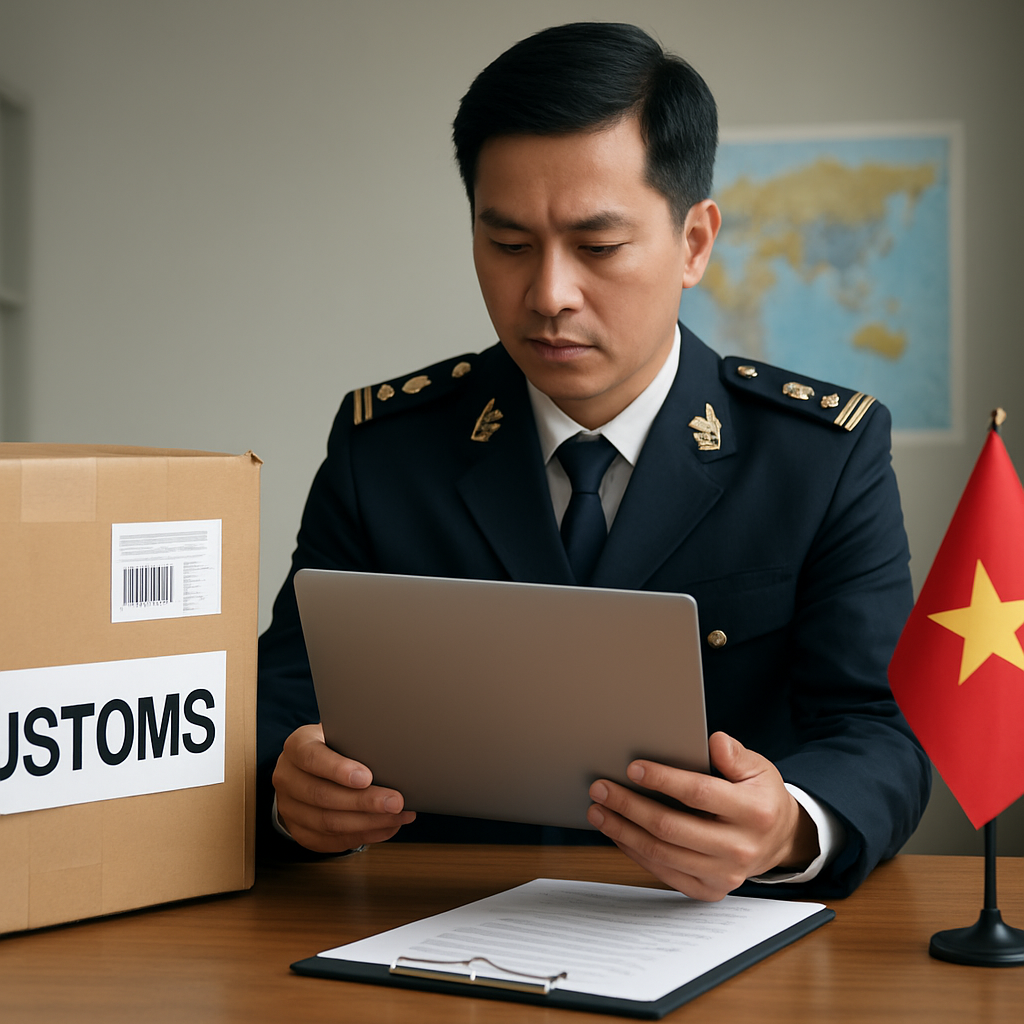
If you are bringing or shipping a laptop into Vietnam, the short answer is: one laptop for personal use is normally allowed, but customs may ask questions, inspect the item, or require a declaration if you are carrying multiple new devices, commercial quantities, or a shipment that looks like resale stock. The clearance outcome depends on how the laptop is described, its value, whether it is used or new, and whether the shipment is being treated as personal baggage or an import.
Laptop Customs Clearance in Vietnam: The Basic Rules
For most travellers, a single laptop is treated as personal-use electronic equipment and usually does not create a problem at the border. Vietnam customs guidance and practical traveller advice both point in the same direction: officers are mainly alert for commercial quantities, not ordinary personal electronics. One laptop that you carry openly and can explain if asked is usually much easier to clear than several brand-new laptops in sealed boxes.
The key practical distinction is this:
- One laptop for personal use is usually treated as normal baggage or personal equipment.
- Several laptops, especially new and unopened units, can look commercial and may attract questions, inspection, or a declaration requirement.
- Shipped laptops are more likely to be checked against invoices, packing lists, and valuation documents because customs is reviewing an import, not just a traveller’s carry-on item.
If you are entering Vietnam with a laptop, keep it accessible in case customs asks about it. If the device is expensive, keep the receipt with you as well. A clear explanation of ownership and use is often enough when the item is plainly personal. Vietnam’s customs framework also uses a risk-based approach, so not every traveller or shipment is checked the same way.
For the broader traveller side of the question, the same logic applies to Vietnam customs declaration rules: if something is within normal personal-use limits, you may pass through the green channel; if it needs declaration, you move into the red channel and complete the form before you are released.
How Much Are You Allowed to Bring to Vietnam?
The practical answer to this question is not a fixed “one-device rule” for every situation, but rather a customs judgement about whether the items look personal or commercial. A traveller with a single laptop, a phone, and other ordinary personal belongings is usually in a different position from someone carrying two or three brand-new laptops in retail packaging.
That means the question is less about a strict laptop allowance and more about how customs views the baggage as a whole:
- Normal personal baggage is usually fine.
- Multiple high-value electronics can trigger questions about ownership and purpose.
- Unopened or duplicate devices can look like stock for sale rather than personal equipment.
If you are unsure whether your bag might be treated as commercial-looking baggage, the safest approach is to keep the devices visible, document what they are, and be ready to explain why you are carrying them. The more the shipment resembles ordinary use, the easier the conversation at customs is likely to be.
What Documents and Declaration Steps May Be Required
When a laptop is imported as a shipment rather than carried as straightforward personal baggage, documentation matters. The supplied customs guidance shows that import clearances can require a customs declaration form and supporting documents such as a commercial invoice, contract or equivalent document, bill of lading, packing list, and any permit required for a controlled item.
Here is a practical checklist of what to keep ready:
| Document | Why it matters |
|---|---|
| Customs declaration form | Used when the goods must be declared to customs rather than passed through as ordinary personal baggage. |
| Receipt or invoice | Helps show the value of the laptop and supports the customs valuation. |
| Contract or equivalent supporting document | Useful for imported goods or commercial shipments where the transaction needs to be evidenced. |
| Bill of lading | Relevant for shipped goods moving by air or sea rather than hand-carried baggage. |
| Packing list | Shows what is in the shipment and helps customs verify quantity and contents. |
| Permit, if applicable | Only needed if the item is controlled or subject to a special requirement. |
Vietnam customs does not automatically inspect every shipment in the same way. The supporting evidence shows a risk-based system in which the authorities decide whether to inspect and to what extent based on information, records, and compliance history. In practice, that means a laptop shipment can move quickly if the paperwork is clean, or slow down if customs wants to check the declaration, value, or classification.
If you are shipping commercially, it is worth understanding the role of a third party in the process. Our guide to customs broker and importer of record explains who is responsible for the filing and who carries the legal liability when an import is cleared.
What happens if customs asks for more information?
If the laptop is flagged, customs may ask for the invoice, proof of ownership, or a clearer explanation of the purpose of the import. In a shipment context, the officer may review the declaration, compare the documents to the contents, and decide whether the goods should be released, held for review, or assessed for duty and tax payment first.
That is why a simple receipt can be useful even for a personal laptop. It does not guarantee automatic clearance, but it can help show that the item is yours and support the value you declared.
Do Laptops Pay Duty and VAT in Vietnam?
They can, depending on how the laptop is classified, declared, and valued. The important point is not to assume one universal laptop rate applies in every case. The evidence available for this article points to different figures depending on the source and scenario: one shipping guide says laptops above US$300 may face 10% duty plus 10% VAT, while another source on imported electronics suggests a combined tax burden that can be around 30% of declared value in some cases. Those figures are not a guarantee for every laptop, but they do show why the final landed cost can be higher than the purchase price alone.
What matters most is the customs valuation and the category the laptop falls into. If customs accepts a lower declared value and the product classification is straightforward, the tax impact may be lower. If customs revalues the shipment, questions the description, or treats the item as commercial stock, the payable amount can change.
A useful way to think about the cost is:
- Purchase price is only the starting point.
- Shipping cost adds to the landed cost for mailed or couriered laptops.
- Duty and VAT may apply depending on classification and value.
- Clearance fees or handling charges may also be added by the carrier or logistics provider.
If you want a deeper explanation of how customs sets the tax base, see our article on customs value vs declared value. That distinction is important because the value customs uses is the one that affects duty and VAT, not necessarily the figure you casually write on a label.
For readers comparing imported units with local retail prices, the question “How much does a laptop cost in Vietnam?” cannot be answered reliably with one universal number here. What can be said is that an apparently cheap laptop from Amazon, AliExpress, or another overseas seller may stop being cheap once you add shipping, tax, and clearance costs.
Why HS Code and Classification Matter for Laptop Clearance
HS code and product classification are central to laptop customs clearance in Vietnam. The supplied research repeatedly shows that classification affects the duty rate, the paperwork, and the likelihood of a smooth release. If the code or description is wrong, customs may hold the shipment, ask for more documents, or require correction before release.
The practical compliance logic is straightforward:
- Correct classification helps customs assess the laptop under the right rules.
- Wrong or missing classification can delay clearance and may create extra costs or penalties.
- Origin information can matter for tariff treatment, even when no special laptop-specific preference is assumed.
- Accurate product description reduces the chance of a mismatch between the paperwork and the goods.
This is also why the cheapest purchase price is not always the lowest total cost. A laptop bought “cheap” online can become expensive if the classification is unclear or if the paperwork is not ready when it reaches Vietnam customs.
For a broader explanation of why these details matter across trade compliance, see our guide to classification, origin, and valuation. Those three elements are exactly the ones that drive most customs decisions.
Can You Bring or Ship a Used Laptop to Vietnam?
Yes, a used laptop is generally not treated as automatically prohibited on the evidence available here. But “allowed” does not mean “ignored.” Customs rules still apply, and the shipment still needs to make sense from a value, ownership, and classification perspective.
Used laptops are often easier to explain than several brand-new devices in sealed packaging, because they look like personal equipment rather than inventory. That said, customs may still ask questions if the item is high value or if the overall baggage pattern looks unusual.
Here is the practical distinction:
- Used personal laptop: usually easier to justify as personal-use equipment.
- Two laptops or more: more likely to attract questions about ownership and purpose.
- New laptops in unopened boxes: more likely to look commercial, even if you say they are for personal use.
If you are carrying a used laptop, proof of prior ownership or a prior purchase receipt can help explain the item’s origin and value. That is not a guarantee of trouble-free clearance, but it can reduce friction if customs wants to verify whether the device is yours and what it is worth.
The same logic appeared in traveller discussions about bringing multiple laptops into Vietnam: customs can let one through as ordinary baggage, but two or more devices may prompt extra questions, especially if they are new and packaged like stock.
What Happens If Customs Flags Your Laptop?
If customs flags your laptop, the response is usually process-driven rather than dramatic. The shipment may be held while documents are reviewed, the declared value is checked, or the classification is confirmed. In some cases, duties and taxes must be settled before the goods are released. If customs is not satisfied with the paperwork, they can ask for more evidence or keep the shipment until the issue is resolved.
Vietnam’s customs process commonly works through green, yellow, and red channels or an equivalent risk-based system:
- Green channel: low-risk goods may pass with minimal intervention.
- Yellow channel: documents are reviewed.
- Red channel: the goods may be physically inspected.
This does not mean every laptop is destined for a physical inspection. It means customs chooses the level of scrutiny based on risk and the information in front of it.
If valuation is disputed, clearance can depend on whether you can support your declared amount with an invoice, receipt, or other evidence. If the shipment is commercial, the importer may need to satisfy more formal requirements before release. That is why it is sensible to keep all clearance documents together rather than scattered across emails, luggage, and carrier portals.
If you want to understand what happens when payment is due, our article on customs duty payment deadlines explains the timing side of release and what can happen if payment is delayed.
Shipping a Laptop with a Lithium Battery: What to Watch For
A laptop is not only a customs issue; it is also a transport issue. Laptops contain lithium batteries, so shipping acceptance can depend on battery-related transport compliance as well as customs paperwork. This is especially relevant if you are sending the device by courier rather than carrying it with you.
The practical point is simple: a laptop may be allowed into Vietnam, but the battery can still affect whether the carrier accepts the parcel, how it is packaged, and how it is handled in transit. That is why it is not enough to focus only on duty and VAT. You also need to make sure the shipment is acceptable from the carrier’s transport perspective.
Keep the focus on the basics:
- Check whether the shipment is being accepted by the carrier for lithium-battery transport.
- Make sure the laptop is packed in a way that protects it in transit.
- Do not assume customs clearance and carrier acceptance are the same thing.
Battery compliance is not the same as customs valuation, but both can affect whether the laptop reaches the recipient smoothly.
Is It Cheaper to Buy a Laptop in Vietnam or Import One?
That depends on the model, the warranty, and the total landed cost. The import route can look cheaper at first glance if the overseas seller lists a lower sticker price, but the final cost can change significantly once shipping, duty, VAT, and clearance charges are added.
In other words, a laptop bought from Amazon or another foreign marketplace may not be cheaper once it lands in Vietnam. The same is true for other low-cost online sources. A low purchase price does not eliminate the customs bill.
A sensible comparison should include:
- Retail price of the laptop
- Shipping or courier charges
- Import duty and VAT, where applicable
- Clearance or brokerage fees
- Warranty support and local after-sales service
This is why the answer to “What is the best online shopping website in Vietnam?” is not something this customs article can rank. There is no sound basis in the evidence here for naming a winner, and the better decision is usually to compare total landed cost, warranty terms, and clearance friction rather than shopping by headline price alone.
A Practical Checklist Before You Bring or Ship a Laptop
Before the laptop reaches Vietnam customs, make sure the basics are covered:
- Confirm whether the laptop is for personal use or commercial import.
- Keep the device accessible if you are travelling with it.
- Carry the invoice or receipt if the device is valuable.
- For shipped goods, prepare the declaration, invoice, bill of lading, packing list, and any other supporting documents.
- Check the product description and HS classification before shipment.
- Make sure battery-related transport rules are satisfied if the laptop is being couriered.
- Be ready to explain ownership, value, and purpose if customs asks questions.
If your laptop is part of a broader import workflow, it helps to review the roles and responsibilities of the parties involved, especially if you are using an agent, forwarder, or broker. The right paperwork at the start is usually what prevents problems at the border later.
The Bottom Line
Laptop customs clearance in Vietnam is usually straightforward when the device is clearly personal, the quantity is normal, and the documents are in order. Problems are more likely when the shipment looks commercial, the value is unclear, the classification is wrong, or the battery/transport requirements are ignored. One laptop is generally much easier to clear than several new units, and a cheap online purchase is not necessarily a cheap landed purchase once duty, VAT, and clearance costs are included.
If you are bringing a laptop into Vietnam, the safest approach is simple: keep it accessible, keep the receipt, declare it if needed, and make sure the paperwork matches the item. If you are shipping it, treat customs value, classification, and battery compliance as part of the cost of doing it properly.