
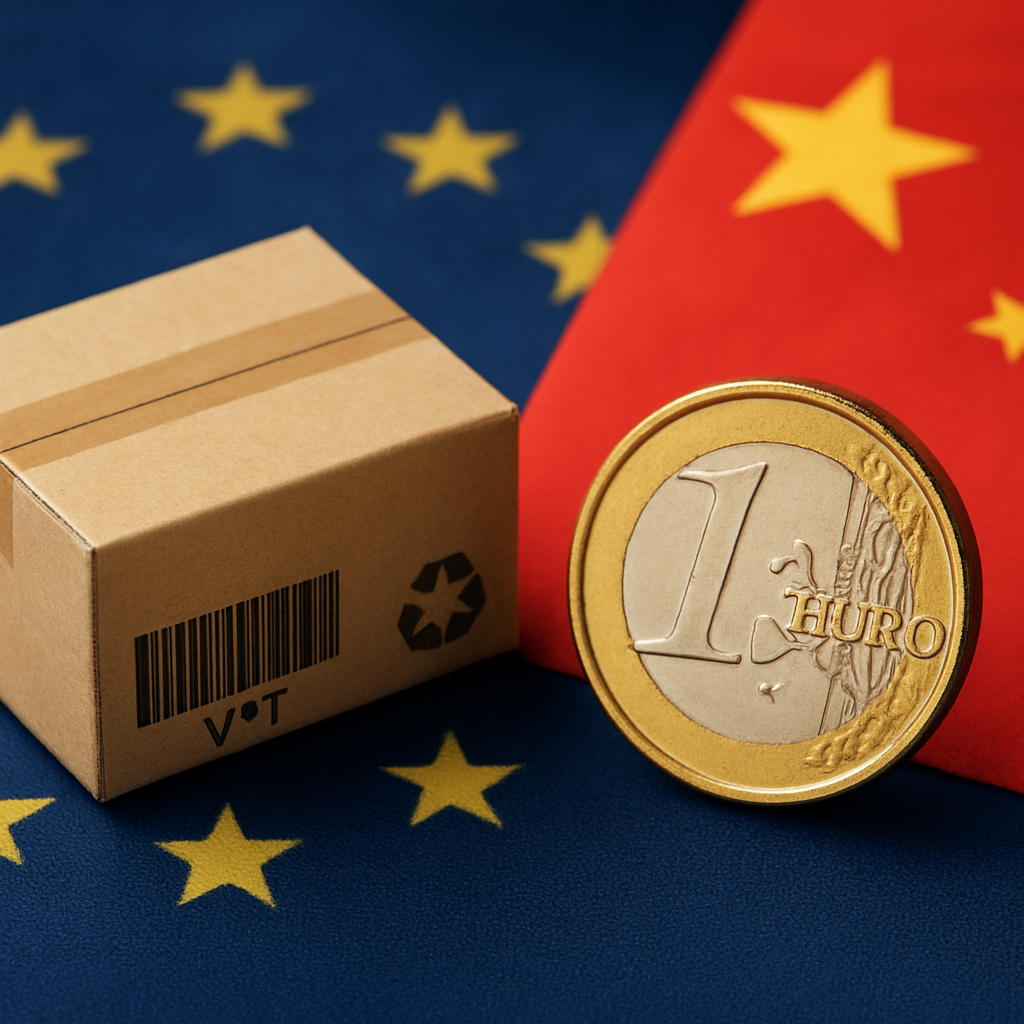
The EU does not charge one single flat tax on all Chinese goods. The amount you pay depends on what the product is, how it is classified under customs rules, its declared value, and where in the EU it is being imported. In practice, most imports from China can face customs duty, VAT, or both. Some low-value parcels also fall under special parcel rules, and certain products such as Chinese-made electric vehicles face additional duties.
What tax applies to goods imported from China into the EU?
The main rule is simple: goods entering the EU from China are treated as imports from a non-EU country, so the EU’s common customs rules apply. The EU’s guide for importing goods explains that VAT applies to imported goods and that tariff treatment depends on the product and market of destination. The EU also uses the Common Customs Tariff for goods imported from outside the bloc, as described in the EU’s customs tariff system and in the U.S. trade guidance on EU import tariffs.
That means there is no universal “China tax” for every product. Instead, you usually need to look at two separate charges:
- Customs duty or tariff: a product-specific import charge based on the customs classification of the item.
- VAT: the sales tax applied in the destination EU Member State, which is usually due on imported goods as well.
So if you are asking, “What is the EU tax on Chinese goods?”, the real answer is: it depends on the item, its HS/TARIC code, and the country where it enters the EU.
How EU customs duty is calculated on Chinese goods
Customs duty is not set by where the goods were made alone. It is usually determined by the product’s classification under the EU tariff schedule, which is why one Chinese product may face a low duty while another faces a much higher rate. The duty is linked to the customs value of the goods and the applicable tariff line, not a single blanket rate for all Chinese imports.
The EU customs framework uses the product code to determine the applicable duty and any additional trade measures. The most practical way to find the exact rate is to check the EU Integrated Tariff / TARIC for the specific product you are importing. A general tariff database such as the World Bank’s WITS tariff data for EU tariffs on China can show that tariff rates exist across many product lines, but it is not a replacement for the exact TARIC lookup for your item.
This is why a single percentage for “Chinese goods” would be misleading. The duty rate can change by product type, and additional measures may apply to particular sectors. If you are importing commercially, classify the product correctly before you calculate landed cost.
If you need a practical customs-clearance example, our guide on why DHL asks for customs information explains why carriers sometimes request extra details when a shipment is being cleared.
Is VAT payable on goods imported from China?
Yes. In general, VAT is payable on imported goods from China when they enter the EU. VAT is separate from customs duty, so even if a product has a low or zero duty rate, VAT may still apply.
VAT is usually charged in the destination Member State, so the rate depends on the country receiving the goods. It is generally calculated on the total import value, which may include the value of the goods, customs duty if applicable, and transport or insurance costs where relevant. The importer of record, or the party clearing the shipment, is typically responsible for paying it.
That is why importers often think in terms of “landed cost” rather than just the invoice price. A low-cost product from China may still become significantly more expensive once VAT and duty are added. For a related explanation of import VAT mechanics, see our article on how VAT works on imported goods.
If you are importing something practical rather than theoretical, our example of China-to-Europe customs and VAT treatment shows how these charges can affect a real shipment.
What happens to low-value parcels from China under EU rules?
Low-value parcels are one of the biggest reasons this topic gets searched. Many consumers ordering from Chinese e-commerce platforms want to know whether small orders face customs fees. The short answer is that the current framework has treated parcels below the EU’s de minimis threshold as duty-free, but the rules are changing.
Under the current system described in the supplied sources, parcels valued below the threshold have been able to enter without customs duty. However, the policy direction is to tighten that treatment. The supplied reporting points to a planned €3 per-item levy on cheap packages, with timing tied to next July/2026 in the sources provided. That change should be read carefully as an announced or upcoming policy shift, not as a universal duty that is already in force everywhere today.
The practical effect is straightforward: cheap parcels that once slipped in without duty may no longer stay “tax-free” in the same way. This matters especially for marketplace orders from platforms such as Temu, Shein and AliExpress, where many shipments are low value and individually small but numerous.
For shoppers, the key point is that “free shipping” does not mean “no import charges”. Even when the seller quotes a low item price, the parcel can still face VAT, handling charges, or future low-value parcel levies depending on the timing and the destination country’s procedures.
Does Temu charge customs fees for orders?
Temu itself is not the customs authority, but Temu orders can still be subject to EU import charges once they reach the destination country. That means a buyer may pay customs duty, VAT, or a new low-value parcel levy depending on the item and the rules in force when the parcel is imported.
So the practical answer is: do not assume a Temu order is customs-free just because it is cheap. If the order is below the de minimis threshold today, duty may have been exempt under the current rule set, but VAT can still matter and the announced parcel-fee changes may affect future shipments.
That is why buyers should check the estimated import charges before they order, especially if they are buying multiple low-value items in separate parcels.
Does Europe tariff Chinese cars and EVs?
Yes, Chinese-made electric vehicles are a special case. They are subject to additional EU duties on top of the EU’s standard 10% import duty for cars. These are not general duties on all Chinese goods. They are product-specific countervailing or anti-subsidy measures applied to Chinese EV imports.
According to the supplied live source on EU tariffs for China-made EVs, the EU imposed additional duties on imported EVs made in China, with examples including BYD at 17% and Tesla at 7.8% for Shanghai-produced vehicles. Other companies face different rates, including higher rates in some cases. The exact duty can depend on the manufacturer and, in some cases, the specific model or production arrangement.
In other words, if someone asks, “Does Europe tariff Chinese cars?”, the answer is yes for certain Chinese EV imports, but the rate is not a blanket tariff on every Chinese vehicle or every Chinese good. It is a sector-specific measure tied to the EU’s investigation into subsidies and competition in the EV market.
The live reporting also notes that carmakers can negotiate individual treatment or exemptions for certain models under EU rules. That is why the rate can vary, and why importers should not assume every Chinese car faces the same charge.
Why is the EU changing its rules on Chinese imports?
The policy shift is largely about fair competition and the volume of low-value shipments entering the EU. The supplied reporting on Temu and Shein explains that Brussels is responding to concerns about market distortion, product compliance, and the rapid growth of very cheap cross-border e-commerce shipments.
This is not the same thing as a broad EU-China free trade agreement that removes tariffs across the board. The evidence here points to customs tightening, low-value parcel reform, and product-specific trade defence measures rather than a completed, sweeping trade deal that changes all import taxes.
In practical terms, the EU is trying to do three things at once:
- protect its customs revenue and reduce duty-free leakage on low-value parcels;
- address compliance and safety concerns for mass-market e-commerce imports;
- apply sector-specific trade measures where it believes imports are being unfairly subsidised, such as in the EV market.
So when people ask about “China and the European Union” or “China and EU trade agreement”, the most accurate answer is that the current debate is about tariffs, customs policy and anti-subsidy measures, not a single all-encompassing trade deal.
How to estimate the real cost of importing from China to Europe
If you want to calculate the true cost of importing from China into the EU, start with these steps:
- Identify the product and its correct HS/TARIC classification.
- Check the product-specific customs duty rate for that code.
- Estimate VAT in the destination Member State.
- Add transport, insurance, and any handling or brokerage charges.
- Check whether the shipment falls under any low-value parcel rule or special measure.
This is the easiest way to avoid being surprised by the final landed cost. A product that looks inexpensive on paper may become much more expensive once duty, VAT, and clearance fees are added. For more context on shipping cost structure, see our guide on shipping and landed-cost basics.
Quick answer: what tax do you pay on Chinese goods in the EU?
Here is the shortest useful answer:
- Customs duty: usually product-specific, based on the tariff code.
- VAT: generally payable on imported goods, at the destination country’s rate.
- Low-value parcels: may have been duty-free under the current threshold rules, but the EU is moving towards a €3 per-item levy on cheap packages according to the supplied sources.
- Chinese EVs: can face additional sector-specific duties on top of the standard 10% car import duty.
So the answer to “What is the EU tax on Chinese goods?” is not one figure. It is a combination of product-specific customs duty, VAT, and, in some cases, special parcel or sector rules. If you know the item, the code, and the destination country, you can usually estimate the charge quite accurately.