
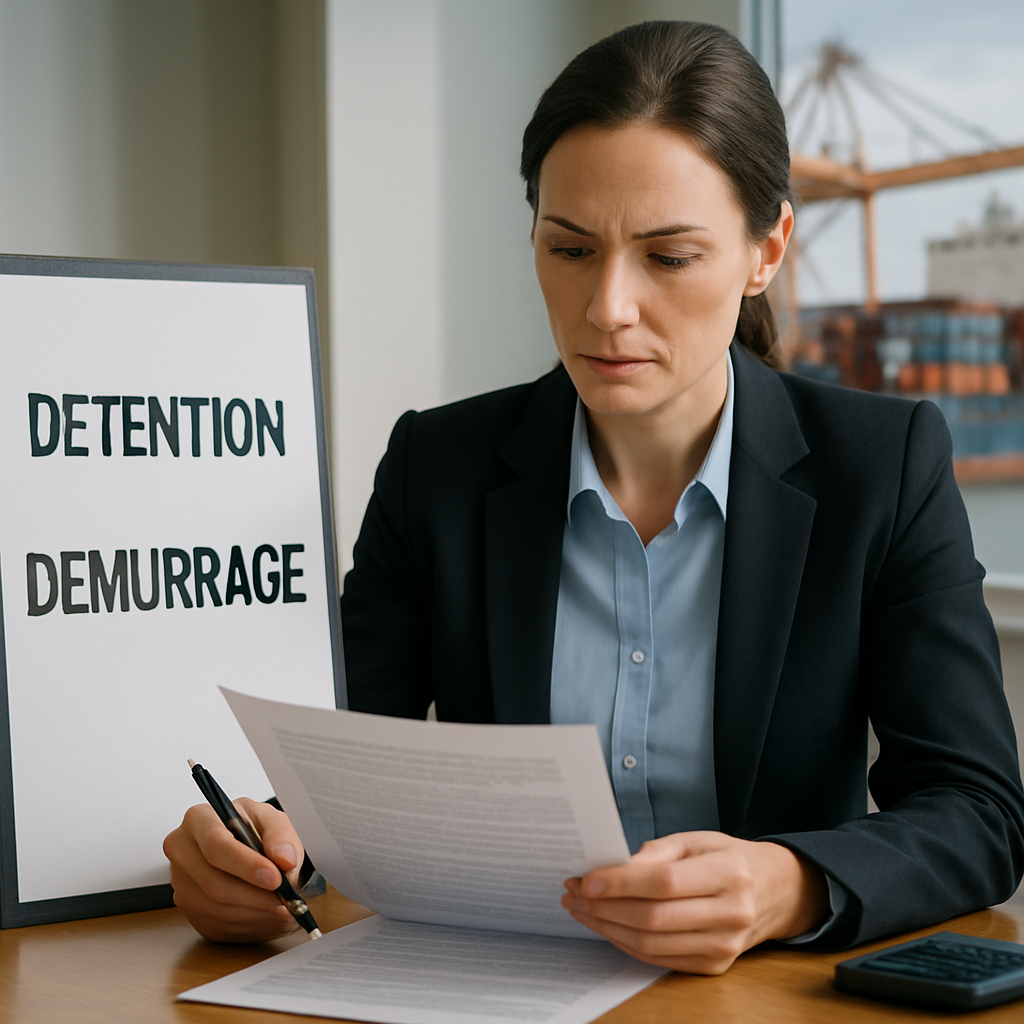
Detention and demurrage charges are fees you can be billed for when a container stays too long in the wrong place or is returned too late. In simple terms, demurrage is charged when a loaded container remains in the terminal or port beyond the allowed free time, while detention is charged when the container is kept outside the terminal too long before it is returned. The exact free days, rates, and waiver rules depend on the carrier, terminal, port, and shipping contract, so there is no single universal price.
What Are Detention and Demurrage Charges?
Although the two terms are related, they are not the same. The clearest way to think about them is location and stage of the shipment:
- Demurrage applies while the loaded container is still inside the port or terminal after free time has expired.
- Detention applies after the container has left the terminal and the clock keeps running until it is returned on time.
That distinction is widely used in shipping practice. For example, Clarksons explains demurrage as a charge for cargo remaining in port beyond the agreed free time, while the carrier view of the two charges is also set out clearly in Maersk’s explanation of demurrage and detention in shipping.
If you are asking what a freight detention charge is, it is simply the cost of keeping the shipping line’s container outside the terminal longer than allowed. In other words, the carrier expects the empty container to come back within the agreed window once you have unloaded the cargo.
Demurrage in simple terms
Demurrage is the charge for leaving a loaded container sitting in the terminal for too long. The container has arrived, but it has not been picked up and cleared within the free period.
Detention in simple terms
Detention is the charge for keeping the carrier’s container outside the terminal for too long after pickup. The container has been released to you, but it has not been returned on time.
Because the terms are sometimes used loosely, it is better to rely on the wording in the tariff, bill of lading, or service contract rather than assuming every shipment uses the same definition. Carrier terms can differ significantly.
How Free Time Works for Demurrage and Detention
Free time is the contractual window during which no demurrage or detention charge applies. It is the period you use to collect, unload, clear, and return the container according to the rules in your shipment contract.
The sequence usually works like this:
- The cargo is discharged from the vessel or arrives at the terminal.
- You receive a free time allowance to pick up the container and move it out.
- Demurrage begins if the container remains in the terminal after free time expires.
- Once the container is collected, detention clock time starts to matter outside the terminal.
- After unloading, the empty container must be returned within the allowed return period.
- If the return is late, detention charges begin.
This is why timing matters so much. A shipment can move smoothly through customs and still incur charges if the truck is delayed, the warehouse is not ready, or the empty container is not returned promptly.
Free days are not fixed across the industry. They vary by carrier, terminal, port, container type, and commercial arrangement. A shipping line may offer one set of days at one port and a different set elsewhere. That is why you should always check the specific tariff and booking terms for your own shipment.
Carrier guidance often reflects this variability. Maersk notes that free time determines how long a container may be used before fees apply, and Pangea’s overview of free time, demurrage and detention also explains that the allowance is tied to the contractual time window, not to a universal standard.
How Much Do Demurrage and Detention Cost per Day?
There is no single per-day cost for detention and demurrage charges. The amount can change based on the carrier, port, terminal, container size and type, and the tariff that applies to the move.
These charges are usually billed per container per day, and they often increase in tiers. That means the first few days after free time may cost less, then the rate rises if the container remains out of compliance for longer.
| Pricing factor | Why it matters |
|---|---|
| Carrier tariff | Each shipping line can set its own demurrage and detention structure. |
| Port or terminal | Different locations can have different free time and rate schedules. |
| Container type | Dry containers, reefers, and larger boxes may be charged differently. |
| Days over free time | The longer the delay, the more likely the rate will rise in tiers. |
Published examples show how quickly costs can escalate. In one current tariff example cited by GoComet’s demurrage and detention guide, Maersk’s U.S. import detention for a dry container is shown in tiers, with free days followed by higher daily charges, and demurrage can also start at several hundred dollars a day depending on the port. Weber Logistics likewise notes that detention charges are commonly daily fees and can fall in the approximate range of $125 to $175 per container per day in some published examples, while demurrage at some terminals can climb above $300 per day.
Those figures are examples, not universal norms. They are useful because they show the practical risk: once free time ends, the total bill can rise quickly, especially if the shipment is delayed for several days and the rate tiers step up.
That is why a small delay can become an expensive problem. Missing even one pickup window may not feel serious operationally, but the financial impact can compound rapidly if the container sits longer than planned.
When Each Charge Applies in the Shipping Process
The difference between detention and demurrage becomes much easier to understand if you follow the shipment stage by stage.
Demurrage happens inside the terminal
Demurrage is triggered when a loaded container stays in the port terminal after the free period has ended. Common reasons include customs clearance delays, port congestion, missed collection appointments, or a warehouse that is not ready to receive the cargo.
In practical terms, the container is still occupying terminal space, and the carrier or terminal charges for that extra time. This is one reason demurrage is often associated with customs delays, even though the charge itself is generally governed by carrier or terminal terms rather than by customs authorities. If you want a deeper view of how paperwork and clearance timing affect shipping costs, see customs clearance and logistics costs.
Detention happens outside the terminal
Detention starts after the container has been picked up and is outside the terminal. If you hold on to the carrier’s equipment too long while unloading, staging, or transporting the cargo, the clock continues to run until the empty container is returned.
This is why detention is often tied to operational bottlenecks such as slow unloading, warehouse delays, missed delivery appointments, or poor return planning. It is not a separate penalty for the cargo itself; it is a time-based charge for use of the carrier’s equipment beyond the agreed period.
A note on customs and airports
People sometimes search for demurrage charges in customs or even demurrage charges airport. In ocean shipping, customs holds are a common trigger for demurrage because they can stop the container from leaving the terminal on time. But the charge still follows the carrier or terminal tariff, not a universal customs rule.
As for airports, the term may appear in broader logistics contexts, but the evidence in this article is centred on ocean and container shipping. Airport-specific rules and pricing can differ, so it is best not to assume that air cargo follows the same process as marine container movements.
What Causes Detention and Demurrage Charges?
These charges are not random. They usually appear when the shipment runs past its free time because something in the process took longer than planned.
- Customs holds that delay release of the cargo
- Port congestion that slows gate-out or pickup
- Missed appointments for collection or delivery
- Warehouse bottlenecks that delay unloading
- Slow container return after unloading
- Documentation problems that stop clearance or handover
In many cases, the operational trigger is paperwork rather than physical congestion. Missing or incorrect documents can delay customs processing and make the shipment sit longer in the terminal than planned. If documentation issues are part of the problem, it can help to review documentation errors that delay shipments.
There is also a simple commercial reason these charges exist. Carriers and terminals use them to keep containers moving and to stop terminals from becoming storage yards. That is the logic behind demurrage and detention in most shipping contracts: encourage timely pickup, unloading, and return so equipment is available for the next shipment.
How to Avoid Demurrage and Detention Charges
The best way to reduce these fees is to manage the clock before it starts working against you. Prevention is mostly about process control, communication, and timing.
1. Check the tariff and free time before the container arrives
Do not wait until the cargo lands. Review the carrier tariff, the bill of lading, and any service contract terms early so you know how many free days apply, when they start, and what the charge tiers are.
2. Prepare customs and paperwork in advance
Pre-arrival planning gives you more chance of clearing the shipment inside free time. That includes making sure documents are complete, duties and taxes are ready to be paid, and any approvals or inspections are handled without delay. Where import compliance is a repeated challenge, import compliance automation can help reduce manual delays and improve visibility.
3. Align trucking, warehouse space, and labour with the free-time window
If the truck is not booked, the warehouse is full, or unloading staff are unavailable, the container may overrun its free time even if customs is already complete. Make sure the next step in the chain is ready before the container is released.
4. Track the container in real time
Real-time visibility helps you act before free days expire. If you know where the container is, whether it is gated out, and whether the empty box has been returned, you are much less likely to let time slip away unnoticed. In more advanced supply chains, visibility tools and tracking systems can make a real difference.
5. Return the empty container on time
Detention is often missed because teams focus only on pickup and forget the return deadline. The container must be sent back within the allowed period, and that return should be scheduled before the deadline becomes tight.
6. Escalate quickly if a hold or official delay appears
If a shipment is held by customs or another authority, act immediately. When the delay is official, the deadlines can still matter, and the paperwork trail becomes crucial. In more serious cases involving official action, it may help to understand the next steps after a customs hold or seizure letter, including the deadlines involved.
Can Demurrage and Detention Charges Be Disputed?
Yes, they can sometimes be challenged, but the first step is to check the facts carefully. If the bill appears incorrect, unreasonable, or inconsistent with the tariff or contract, review the shipment record before accepting the charge as final.
What to review first:
- The date and time the free period started and ended
- The actual gate-out and return times
- The tariff or service contract that applies
- Any hold notices, terminal closures, or access problems
- The invoice detail and supporting shipment records
Detailed invoices matter because they show exactly how the fee was calculated. Without them, it is difficult to tell whether a charge is correct, excessive, or based on the wrong timing.
Some carrier practices also allow suspension of charges where interchange is blocked by circumstances beyond the merchant’s reasonable control, but that depends on the applicable rules. ZIM’s U.S. demurrage and detention practices, for example, state that such charges may be suspended in certain circumstances, and the same page points users to tariff pages and a calculator for estimate purposes. The key point is that exceptions are not automatic; they depend on the shipment terms and the carrier’s practice.
Disputes therefore tend to be strongest when you can prove a mismatch between the invoice and the actual shipment timeline, or where the carrier’s own rules provide an exception that should have applied.
How Storage Charges Differ From Demurrage and Detention
Storage charges are related, but they are not the same as detention or demurrage. Storage usually refers to fees for holding cargo or equipment in a warehouse, yard, or terminal beyond a permitted period. Demurrage and detention are specifically tied to the time-based use of the container in relation to the terminal and the return window.
It is common to see storage charges discussed alongside demurrage and detention because all three can raise total logistics costs. But they are distinct fees, and they should be checked separately on the invoice. If you are comparing shipping cost categories, do not assume that a storage fee is simply another name for demurrage or detention.
What to Remember Before Your Next Shipment
Detention and demurrage charges are timing charges. Demurrage is about time inside the terminal; detention is about time outside the terminal before the empty container goes back. Free time is the key factor that decides when the clock starts. Once that time expires, the cost can rise fast, often in daily tiers.
If you want to reduce the risk, focus on the practical basics: confirm your free days early, clear documents before arrival, keep trucking and warehouse plans aligned, monitor the container closely, and return the equipment on time. If a charge appears, compare the invoice with the tariff and the shipment timeline before deciding whether to pay or dispute it.