Edwin M. Knowles China Company: History, Marks, Plates, and Value
 Import Export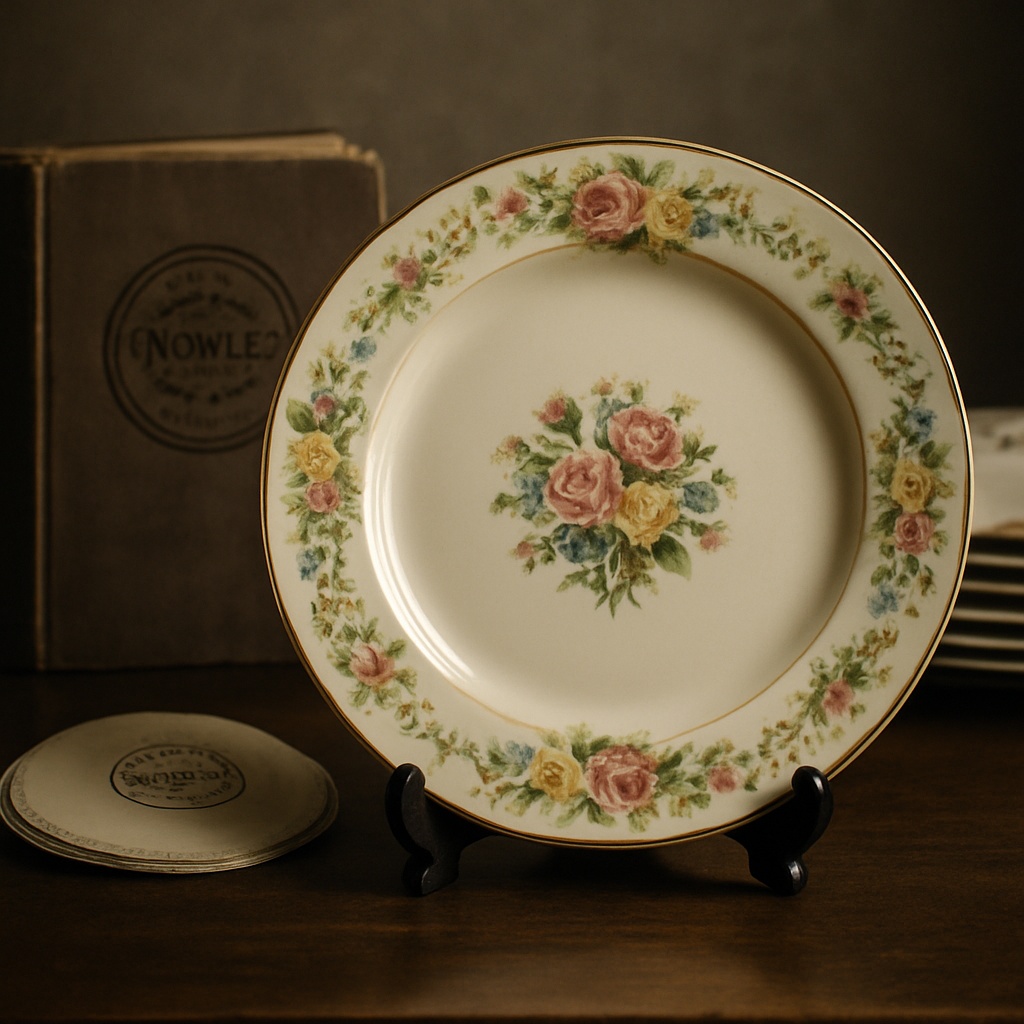
The Edwin M. Knowles China Company was a historical American maker associated with semi-vitreous china ware, with offices in East Liverpool, Ohio, and documented plants in West Virginia. For collectors, the most useful starting point is not an assumed date or price; it is the complete mark on the underside. That record can help distinguish Edwin M. Knowles China Company ware from other pottery bearing the Knowles name while avoiding unsupported conclusions about pattern history, rarity, or value.
This guide separates what the available historical and import-record evidence establishes from what it does not. It is intended for readers who have found a vintage plate, bowl, platter, or serving piece and want a sound basis for identification and further research.
History of the Edwin M. Knowles China Company
The available historical overview places Edwin Knowles within an established pottery family context. According to WorthPoint’s Edwin Knowles China reference, Edwin Knowles was the son of Isaac Watt Knowles, described as a founder and partner in Knowles, Taylor, and Knowles Company. This connection matters because similar family and company names can make marks easy to misattribute.
In 1890, Edwin Knowles assumed management of the Potters Supply Company in East Liverpool, Ohio. The same historical source describes the later company’s offices as being in East Liverpool, with a plant in Chester, West Virginia. Its stated objective was to manufacture high-quality semi-vitreous china ware.
A further documented milestone came in 1913, when a new plant opened in Newell, West Virginia. Production was subsequently consolidated at the Newell facility, and the Chester plant was sold to Harker Pottery.
Those facts provide a useful, bounded outline of the company’s geography and manufacturing direction:
| Documented point | What the available source says | Why it matters to collectors |
|---|---|---|
| Family background | Edwin Knowles was the son of Isaac Watt Knowles of Knowles, Taylor, and Knowles Company. | A shared surname does not automatically identify the same manufacturer. |
| 1890 context | Edwin Knowles assumed management of Potters Supply Company in East Liverpool, Ohio. | This is documented background, not proof of the production date of a particular object. |
| Office and first noted plant locations | Offices were in East Liverpool, Ohio; a plant was in Chester, West Virginia. | Place names may assist research, but the backstamp remains the primary item-level evidence. |
| 1913 change | A new Newell, West Virginia, plant opened; production was later consolidated there. | It establishes a company-level production development, not a date for every pattern or mark. |
| Ware description | The company aimed to make high-quality semi-vitreous china ware. | “Semi-vitreous” is the historical manufacturing description used by the source. |
The available material does not establish a complete corporate timeline. In particular, it should not be used to assert a founding year, closure date, ownership succession, full range of production dates, or output quantities. Likewise, today’s listings on resale and marketplace sites show that collectors encounter Knowles bowls, plates, platters, and serving pieces, but those listings are not evidence for company-history facts.
How to Identify Knowles China—and What Can Be Said About Value
Is Knowles china worth anything? It can have collector interest: Edwin Knowles pieces appear in a collector price-guide context and in current resale listings. However, the evidence available here does not support a reliable dollar or pound valuation, a general price range, a rarity ranking, or an appraisal conclusion for any particular item.
Value is not established by the word “Knowles” alone. A credible valuation would normally need to compare the exact maker, pattern, form, size, completeness, condition, decoration, and recent verified completed sales. A dinner plate, an oval platter, and a serving bowl are different forms; even two apparently identical plates may differ materially if one has chips, glaze wear, crazing, restoration, staining, or an incomplete backstamp.
Read the complete backstamp before attributing a piece
Start by photographing the entire underside in clear, even light. Then transcribe every visible element rather than relying on a partial recollection of the mark. Record:
- all words exactly as printed, including punctuation and abbreviated wording;
- every symbol, device, border, or emblem;
- country-of-origin wording, such as “Made in U.S.A.” where present;
- the pattern name, series name, or shape designation, if stated;
- numbers, letters, mould codes, decorator marks, or impressed marks; and
- the item type and measurements, for example, plate diameter or platter length.
This process is particularly important because the WorthPoint reference on Edwin Knowles marks makes a specific distinction. It describes a mark with “KNOWLES CHINA CO.” arranged around it and “UNION MADE IN U.S.A.” beneath. Separately, it says that an urn-style mark with “VITREOUS” in the centre and “EDWIN M. & K” in it relates to Knowles, Taylor, Knowles, rather than to the Edwin M. Knowles China Company.
In practical terms, do not assign a piece to Edwin M. Knowles China Company simply because it includes:
- the name “Knowles”;
- the word “vitreous”; or
- an urn device.
Each feature must be read in the context of the entire mark. This is also why “semi-vitreous” should be treated carefully. It is the manufacturing description used in the historical source; it should not be automatically equated with fine bone china, porcelain, or any particular quality grade without further documentation.
A practical, responsible route to a valuation
If you are considering a sale, insurance, or a purchase, build an object record before comparing it with any listing:
- Identify the maker mark. Preserve full images and a word-for-word transcription.
- Identify the object accurately. Note whether it is a dinner plate, bread-and-butter plate, bowl, platter, serving dish, cup, saucer, or another form.
- Measure it. Record diameter, length, width, and height as appropriate.
- Describe condition candidly. Photograph chips, hairlines, cracks, crazing, rubbing, discolouration, repairs, and missing elements.
- Separate maker from pattern. A company name does not necessarily identify the pattern, and a pattern name does not necessarily establish the maker.
- Seek like-for-like evidence. Use documented, completed sales of the same pattern and form where available, rather than asking prices for vaguely similar china.
- Use a qualified appraiser when the result matters. This is especially prudent for estates, insurance, disputed attribution, or unusually complete services.
Marketplace results remain useful as recognition terms: searchers may see vintage bowls, “Made in USA” platters, plates, or semi-vitreous serving pieces. They should not be treated as proof of authenticity, original date, provenance, rarity, or sale value. An asking price is not the same as a verified transaction price.
What Is Known About Edwin M. Knowles Plates
Plates are a distinct collecting question because they may be dinnerware, decorative display ware, commemorative issues, or parts of a broader service. The supplied record supports only a limited conclusion: decorative bird plates appear among examples in WorthPoint’s Edwin Knowles price-guide material, and plates are a recurring type of item in the collector marketplace alongside bowls, platters, and serving pieces.
That does not establish a complete history of Knowles plates. The available sources do not document launch dates for individual plate patterns or series, artists, edition sizes, original retail programmes, whether a particular plate was commemorative rather than functional dinnerware, or a chronology for specific designs. Seller descriptions may include pattern names and dates, but those claims need independent documentary support before being repeated as history.
How to research a particular plate
For a plate you own or are considering buying, use a pattern-specific workflow rather than assuming that company history answers every object-level question:
- Capture the full backstamp, including any impressed wording that may be difficult to see in a photograph.
- Write down the exact pattern or series wording, if any, separately from the maker mark.
- Measure the plate’s diameter and note rim style, decoration, and whether it has hanger hardware or evidence of display use.
- Document condition from front and back. A small rim chip, crack, or restoration can materially affect later comparison.
- Look for pattern-specific evidence in a dated manufacturer catalogue, museum collection, archive, historical society record, or specialist reference.
- Only after identifying the exact pattern and form should you compare documented sales or request an appraisal.
This approach avoids a common error: treating a name on the back as a full date, edition, or provenance record. The mark may identify a maker or related pottery concern, while the pattern, form, and original distribution history require separate evidence.
Do Not Confuse Historic Knowles China with Unverified Modern Import Claims
The word “china” creates an understandable ambiguity. In a collector context, it means ceramic tableware. In shipping and import databases, “China” may mean the country of origin or port of loading. The two uses are not evidence of a connection.
Import-record pages also require careful reading. ImportInfo’s page for an entity named The Edwin M Knowles China Company reports 1,367 bills of lading between 31 October 2012 and 15 June 2021, and its displayed recent-period counts show no records. ImportGenius’s importer page displays examples of 2020 shipments for goods including clocks, glass decoration, and decorative resin articles, with entries from multiple origins.
Those database observations are narrow. By themselves, they do not establish that the named importer was the same legal entity as the historical tableware manufacturer; that it made the imported products; that it remains active; that it held any licence to use a historic name; or that original Edwin M. Knowles dinnerware was manufactured in China.
For the same reason, claims about licensed reproductions, compatible replacement pieces, factory locations, Chinese manufacturing clusters, specific heritage patterns, lead times, or modern production continuity should not be accepted without corroborating corporate, trademark, licensing, manufacturer, or catalogue documentation. A similarly named importer, a shipping record, and a historic pottery mark are different kinds of evidence and should not be collapsed into one conclusion.
Bottom Line for Collectors
The documented history identifies Edwin M. Knowles China Company as a maker associated with high-quality semi-vitreous ware, East Liverpool offices, West Virginia plants, a Newell plant opening in 1913, and later production consolidation at Newell. It also gives a useful warning about confusing its marks with those of Knowles, Taylor, Knowles.
For an individual vintage item, begin with the full backstamp, exact form, measurements, and condition. That evidence is more useful than a broad label such as “Knowles china,” and it is the necessary foundation for pattern research or a defensible value assessment. The available record supports collector interest, but not blanket claims about dates, rarity, authenticity, or monetary value.