Initiated Customs Clearance at Destination Country: Meaning, Timeline, and Delays
 Import Export
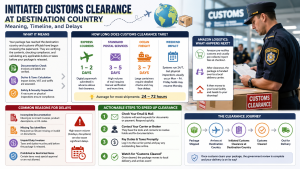
Seeing the tracking status "initiated customs clearance at destination country" simply means your package has physically reached the border of the receiving nation, and local government officials have begun reviewing its paperwork. In most standard scenarios, this legal review takes anywhere from 24 to 72 hours, though express couriers can often finalize the documentation in under a day. Officers are actively verifying the contents, checking safety compliance, and calculating any applicable import duties or taxes before granting final entry. For the majority of international deliveries, this is a routine administrative hurdle requiring absolute patience rather than immediate action from the buyer.
Initiated Customs Clearance at Destination Country: Meaning, Timeline, and Delays.
Decoding What "Initiated Customs Clearance at Destination Country" Means
To truly comprehend what customs mean in shipping, one must recognize that international borders operate as tightly regulated gateways. When a tracking update indicates that a customs agent received the shipment, it signifies the official transition of authority from the global freight carrier directly to the local governmental enforcement body. Officials are deeply scrutinizing the attached commercial invoices and shipping labels to confirm exactly what is inside the box and verify its declared financial value. This initial phase is entirely about data validation, ensuring the physical items perfectly match the digital declarations submitted during the initial export phase.
During this mandatory administrative hold, the receiving country calculates potential financial liabilities on incoming goods. Many consumers anxiously wonder who pays processing fees or import duties when purchasing items from overseas retailers. Depending entirely on the shipping terms agreed upon at checkout, either the sender has prepaid these taxes, or the receiver will be billed prior to final release. Officials perform intricate tax math to assess local sales tax, value-added tax, or specific tariffs based on the Harmonized System codes applied to the cargo. This thorough mathematical assessment guarantees the destination nation collects its legally mandated revenue before the goods enter domestic circulation.
Beyond baseline financial calculations, national safety and internal security represent paramount concerns for these border agencies. People often ask why going through this rigid inspection is necessary for everyday consumer purchases like clothing or basic electronics. Government bodies must actively prevent prohibited agricultural products, counterfeit electronics, and illegal contraband from entering their domestic markets. The package might undergo non-invasive X-ray scanning or, in rarer cases, a physical open-box examination to verify total compliance with strict national safety standards. Only after passing these rigorous safety scans does the package finally move forward toward the domestic delivery carrier.
The Complete Timeline: How Long Does Customs Clearance Take?
Global shipping networks operate on highly variable schedules, leading many anxious buyers to ask: once customs clearance at the destination country, how long does it take? On average, standard air cargo and routine consumer parcels navigate this bureaucratic maze within 24 to 72 hours. However, premium express couriers utilize advanced electronic pre-clearance systems that can frequently push a shipment through government checkpoints in under 12 hours. Conversely, heavy ocean freight or massive consolidated shipping containers might require three to seven business days just to receive initial processing attention from overwhelmed port authorities.
Understanding the specific transit methods heavily influences your realistic delivery expectations. Let's look at how initiation timelines vary across different international transportation networks. Relying on an authoritative guide on how long customs clearance takes helps clarify these transit expectations.
- Express Couriers: Massive logistics firms often clear international borders in one to two days by submitting digital paperwork while the cargo plane is still in the air. This proactive data transmission allows government agents to pre-calculate duties and green-light the cargo the moment the wheels physically touch the tarmac.
- Standard Postal Services: Packages routed through standard international mail networks usually take significantly longer, often requiring three to five days for border processing. These vast facilities handle staggering volumes of mixed-origin mail, meaning your delivery sits in a physical queue awaiting manual verification by busy inspectors.
- Ocean Freight: Heavy sea cargo moves at a noticeably slower pace, generally demanding up to seven business days for standard clearance protocols. Because a single flagged item inside a massive consolidated container can halt the entire unit, these complex maritime shipments require meticulous documentation to avoid cascading operational delays.
Weekend processing rules represent another major point of confusion for global shoppers awaiting their deliveries. Shoppers tracking a Friday arrival frequently wonder does work weekends packages? While automated digital systems process electronic data around the clock, physical inspections and administrative interventions generally adhere to standard Monday-through-Friday government operating hours. Therefore, a parcel flagged for manual review on a late Friday afternoon will likely remain completely stationary until port officials resume their shifts on Monday morning, extending the overall delivery window.
Amazon Logistics: What Happens After Import Starts?
E-commerce giants manage cross-border shipping significantly differently than independent regional freight forwarders. Users frequently ask: What does initiated customs clearance at destination country mean on Amazon? When this exact status populates your Amazon order history, it confirms the retail platform has electronically pre-notified the receiving country's border patrol that your specific purchase is actively arriving. Because Amazon strictly enforces regulatory compliance at the point of sale, they typically pre-calculate and collects estimated import deposits directly during checkout. This seamless backend integration significantly accelerates the border transition, allowing the package to effortlessly bypass standard payment holds.
Tracking the exact sequence of events provides absolute clarity on when the purchased item will finally reach your doorstep. You might notice earlier statuses like started export started, which simply indicated the physical item was leaving its original country of origin. Once the destination border agents take over, you are waiting for the customs clearance, which translates to a formal governmental release of the imported goods. To understand exactly what happens after import processing clears, you simply watch for the hand-off. After delivering this final approval, the international logistics provider seamlessly surrenders the parcel to a localized domestic courier, such as the local postal service or a regional delivery fleet.
Knowing exactly where to find the most accurate updates is vital for anxious buyers tracking international goods. For an Amazon order, do I check the status directly through the retailer's dedicated interface, or should I rely on the underlying independent carrier? Amazon's internal interface provides highly synthesized, user-friendly updates specifically tailored to the consumer experience. However, plugging the primary tracking number directly into the specific carrier's website often yields far more granular, real-time geographic data. This carrier-level tracking will accurately reflect exactly when the next step is finished, confirming the package is actively en route to your local neighborhood distribution center. For a deeper understanding of platform specifics, you can review Amazon's international shipping policies.
Common Reasons a Package Gets Stuck in Customs
Even the most technologically sophisticated global supply chains occasionally encounter severe bureaucratic friction at the border. Answering the question of whether a package stay clearance indefinitely requires intimately understanding the rigid nature of import law. When a shipment sits idle for days without a tracking update, the primary culprit is almost always incomplete or entirely missing commercial documentation. If an official commercial invoice lacks a precise product description, omits the manufacturer's address, or utilizes an incorrect Harmonized System code, the entire governmental review process halts immediately until the data is corrected.
In certain operational scenarios, an extended delay is simply the unfortunate result of standard statistical sampling rather than a specific paperwork failure by the sender. Is it normal to be 4 days? Yes, it is entirely normal if your parcel was randomly selected by algorithms for an intensive physical examination. For more insights into these commercial delays, Amazon sellers frequently reference the Seller Central guide on international fulfillment.
- Missing Tax Identifiers: Border agencies strictly require precise tax identification numbers for commercial imports to ensure total corporate accountability. If a sender carelessly fails to include these mandatory credentials on the commercial invoice, officials will physically quarantine the cargo until the receiver manually supplies the missing regulatory data.
- Unpaid Duty Invoices: Government revenue bodies will never release taxable merchandise until all financial obligations are fully settled. If a shipment arrives with outstanding tariff fees, the package will languish in a holding facility until the importer of record submits a verified payment to the respective national treasury department.
- Prohibited Merchandise Flags: Certain agricultural products, specific cosmetic ingredients, or unregulated electronic devices trigger automatic regulatory holds at the border. Inspectors will meticulously verify these restricted items against national safety standards, a highly specialized review that easily adds weeks to the standard international delivery timeframe.
Seasonal volume surges radically distort typical processing timelines, leaving buyers profoundly frustrated and confused regarding their shipments. If you find yourself angrily asking US taking right now so long, you must actively consider the broader global calendar. During major holiday rushes or significant global supply chain disruptions, port facilities massively overflow with imported commercial merchandise. This massive backlog stretches out wait times dramatically, turning a standard 24-hour administrative turnaround into a multi-week waiting game as understaffed agencies struggle to clear the immense backlog of incoming freight.
Actionable Steps to Speed Up the Clearance Process
When tracking updates abruptly stall, passive waiting is not always the best strategy for an importer. If you are staring at a static screen thinking about my clearance. Should do? Your very first step is to aggressively monitor your email inbox and physical mailbox. Border agencies will rarely initiate a phone call; instead, they send formal digital notices or physical letters requesting missing commercial invoices or proof of payment. Ignoring these official government communications practically guarantees your package will remain locked inside a warehouse or eventually be forcefully returned to the original sender.
Reaching out for professional assistance requires directing your urgent inquiries to the correct entity. Can I contact about the package directly at the border facility? Generally, no; everyday consumers cannot directly call a busy port inspector to demand an update on their shoes. Instead, you must immediately contact your specific shipping carrier or hired customs broker. These logistics professionals possess dedicated government liaisons and internal tracking systems that can rapidly pinpoint exactly where packages go when held up. They act as your authorized legal representative, capable of submitting corrected paperwork or identifying precisely how many times clear customs procedures have failed on your specific delivery route.
Proactive financial preparation effectively eliminates the most common bottleneck in international retail trade. Will notified doesn't charge me much? Yes, if duties are low or non-existent, the package passes through silently; however, if taxes apply, the carrier will alert you to the exact amount charged, paying get look like a secure online invoice. To actively speed up USA hold if stuck for 2 weeks, promptly log into the carrier's proprietary system, locate the outstanding tax invoice, and process the payment digitally. You can often learn more about these requirements through the DHL customs clearance FAQ. Once the financial block is officially lifted, the status will dynamically shift, and how will you come to know has cleared? The tracking will update to "Customs Cleared." Once clearing will my arrive? Shortly after. When asking this, when is it completed? You must understand it finalizes the bureaucratic journey. You can rest assured that the government review is finally complete, ensuring the goods are formally released and rapidly dispatched to your front door for final delivery.