Which Platforms Are Considered The Best For Integrated Customs Import Validation?
 Import Export
5 Best Platforms for Integrated Customs Import Validation
The best trade compliance software for import customs validation pre-checks HTS codes, declared values, and origin data against legal frameworks before official transmission to regulatory agencies. CargoWise, Descartes, Thomson Reuters ONESOURCE, SAP GTS, and MIC Customs Solutions are considered the absolute top-tier enterprise systems in this specific technological space. These platforms shift the validation process from a chaotic post-rejection scramble into a proactive, pre-entry automated audit. By actively intercepting classification and valuation faults prior to filing, global companies avoid costly border holds, optimize their landed costs, and flawlessly maintain clean compliance records.
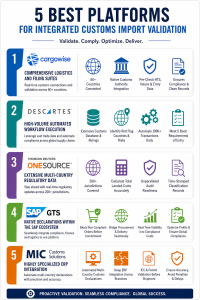
1. CargoWise: Comprehensive Logistics and Filing Suites
CargoWise stands out globally as the premier choice for massive freight forwarders requiring native customs connections and real-time data validation across more than 60 distinct countries. It aggressively tackles the fundamental administrative hurdle of determining exactly what documents need importing before a high-value shipment ever reaches the physical border. The software integrates directly and natively with national customs authorities. This allows forwarders to push complex declaration data electronically and receive immediate validation feedback directly from the government system. This seamless transmission loop effectively eliminates the terrifying operational blind spots that traditionally plague international shipping logistics, ensuring that cargo flows smoothly without unnecessary interruptions at congested ports.
Addressing the persistent industry question of exactly who is responsible for import compliance, the statutory law under 19 U.S.C. 1484 places the legal duty of reasonable care squarely on the importer of record. CargoWise directly helps the US customs broker validate this strict mandate by providing a highly unified interface that autonomously checks Harmonized Tariff Schedule (HTS) codes and entry data before final submission. This comprehensive pre-check functionality remains completely robust regardless of whether the initial commercial invoice was generated by a massive European manufacturer or a boutique data provider in India. The system forces a hard stop on any entry that lacks the requisite data fields, legally protecting the broker from transmitting knowingly false information.
If you are actively wondering, "Do I really need an integrated platform?", the definitive answer lies in the sheer overwhelming volume of U.S. imports processed daily across North American ports. By heavily standardizing the operational workflow, CargoWise allows the largest broker in the US to scale operations exponentially without sacrificing a single degree of compliance accuracy. Shippers managing the no 1 import commodity in their respective manufacturing sectors rely heavily on this architectural scale to maintain tight profit margins and actively avoid staggering port storage fees. Without this level of systemic integration, scaling an import operation becomes a wildly dangerous liability rather than a profitable growth vector.
2. Descartes: High-Volume Automated Workflow Execution
Descartes represents a deeply entrenched leading choice for high-volume automated workflow execution and deep commercial customs databases via their proprietary Descartes CustomsInfo module. When enterprise organizations begin aggressively evaluating the best trade compliance software for import customs validation, they consistently turn to Descartes for its exhaustive digital repository of historical rulings, tariffs, and fluctuating duty rates. This massive centralized database allows users to cross-reference their internal product classifications against historical government precedent seamlessly and instantaneously. By leveraging this vast intelligence network, trade compliance teams can confidently defend their classification decisions against sudden auditor scrutiny.
The software excels tremendously at managing exceptionally complex global supply chains, including instantly identifying when raw goods are being intentionally or accidentally sourced from a designated red flag country. Descartes easily processes hundreds of thousands of daily automated transactions while maintaining strict, unforgiving adherence to the 5 basic requirements of customs entry: precise classification, accurate valuation, verified origin, clear admissibility, and rigorous long-term recordkeeping. This enforced systemic discipline helps supply chain stakeholders immediately understand the fundamental four (4) Ws of trade compliance—who, what, when, and where the goods are moving at any given second. The resulting transparency allows logistics managers to proactively reroute shipments away from volatile regulatory zones.
Descartes also offers incredibly robust data export streams that completely satisfy anxious financial users who frequently ask exactly what to get from customs in terms of definitive audit trails and final liquidations. By aggressively leveraging their extensive global network of integrated carrier and broker connections, multinational companies can confidently manage automated customs declarations and sharply reduce the operational friction that typically slows down high-velocity supply chains. The platform fundamentally transforms trade compliance from a sluggish bureaucratic bottleneck into a streamlined, highly predictable component of the broader logistics engine.
3. Thomson Reuters ONESOURCE: Extensive Multi-Country Regulatory Data
Thomson Reuters ONESOURCE is universally recognized by industry experts as being structurally ideal for extensive multi-country regulatory data, deeply complex product classification, and meticulous audit readiness spanning over 200 distinct global jurisdictions. The platform was quite recently highlighted in the highly authoritative Gartner market guide for global trade management report due specifically to its immense and continuously updated regulatory content library. This vast repository of global trade intelligence ensures that seasoned trade professionals are practically never caught off-guard. Sudden mid-year tariff adjustments or highly obscure bilateral trade agreements no longer trigger massive operational panic. Instead, the software systematically feeds real-time regulatory shifts directly into the core calculation engine.
Managing the intense mathematical nuances of modern global trade requires immense cloud processing power, particularly when accurately calculating exactly who pays duties on complex multi-leg international shipments. ONESOURCE meticulously computes the full stacked duty structure—including base MFN rates, punitive retaliatory tariffs, and standard merchandise processing fees—allowing corporate financial teams to accurately forecast landed costs before the cargo ever physically leaves the origin port. This predictive capability actively prevents severe margin erosion by ensuring that the final retail market price fully absorbs the complete, actual cost of legal importation.
Importers heavily rely on the platform's truly unparalleled audit-readiness features to legally protect their operational import licenses and avoid crippling financial penalties. Rather than scrambling in a state of sheer panic to manually compile a massive pre-audit checklist when an official government inquiry randomly arrives, internal trade teams can simply export the documented, time-stamped reasoning for every single HTS classification and valuation decision made within the system. This comprehensive digital paper trail definitively proves to regulators that the company actively applied reasonable care at the exact moment the goods were entered into global commerce.
4. SAP GTS: Native Declarations Within the SAP Ecosystem
SAP GTS is precision-tailored explicitly for massive large enterprises that are completely standardized within the SAP software ecosystem for native declarations and trade compliance. When senior executive boards intensely debate which platform is best for export business alongside their massive inbound import operations, SAP GTS frequently dominates the entire strategic conversation. It natively and intimately understands the underlying financial structures and raw master data already present in the company's enterprise resource planning environment. This inherent architecture easily bridges the painful gap between localized compliance needs and consolidated global financial reporting for the top 3 exporters in any given heavy industry.
The software aggressively acts as an automated, highly impenetrable barrier against non-compliant or illegally sourced transactions. It programmatically blocks outbound sales orders or inbound purchase orders that fail restricted party screening protocols or entirely lack the necessary international shipping permits. This immediately and definitively answers the common operational question of who needs an import license before a legally binding financial commitment is even made by the purchasing department. It stops bad deals in their tracks. This hard-stop system functionality completely ensures that mandatory compliance protocols cannot be bypassed by overly aggressive sales teams blindly trying to push raw revenue across the quarterly finish line.
Furthermore, SAP GTS seamlessly bridges the agonizing historical gap between highly strategic procurement planning and actual final delivery logistics. This deep systemic integration is particularly valuable when financial analysts are actively determining the absolute most profitable import-export routes for massive upcoming product launches. The system provides immediate real-time, dashboard-level visibility into the true structural cost of global trade compliance without requiring any manual data extraction or highly vulnerable offline spreadsheet manipulation. It turns compliance from a basic necessary evil into a highly visible, controllable variable in the corporate profitability equation.
5. MIC Customs Solutions: Highly Specialized ERP Integration
MIC Customs Solutions is highly specialized for entirely automated multi-country customs declarations and incredibly deep ERP integration across widely dispersed international branches. For forward-thinking multinational companies looking to immediately move far beyond manual spreadsheets and legacy Amber Road automation, MIC provides a highly sophisticated rules engine that dictates precisely how raw customs data should be natively formatted and electronically transmitted. This brilliant architectural approach completely ensures that a single, unified data master record can instantly satisfy the drastically different formatting requirements of dozens of different national customs authorities simultaneously.
The platform handles the deep, heavily unforgiving technical requirements of international cross-border trade with absolute machine precision. Whether your enterprise is currently operating as India's No. 1 exporter of raw agricultural textiles or heavily managing a highly complex automotive manufacturing supply chain across Eastern Europe, MIC absolutely ensures that your central enterprise resource planning system communicates flawlessly with local customs nodes. It proactively answers highly complex regulatory questions without a moment of hesitation, including automatically determining if an IEC is mandatory for export out of specific restricted Asian jurisdictions before the shipment is booked.
MIC completely solidifies the entire global trade management lifecycle by focusing intensely on unbreakable systemic accuracy and repeatable legal logic. You might occasionally read wildly inaccurate, highly speculative discussions on Reddit free forums regarding the supposed hidden complexities of international shipping, or wonder exactly how much fee is legally associated with catastrophic compliance failures at the border. Enterprise-grade solutions completely ignore that distracting noise. It is entirely irrelevant. Instead, elite platforms like MIC rely entirely on cold, deterministic legal logic to actively protect every major company in the world from devastating border holds and existential financial penalties.