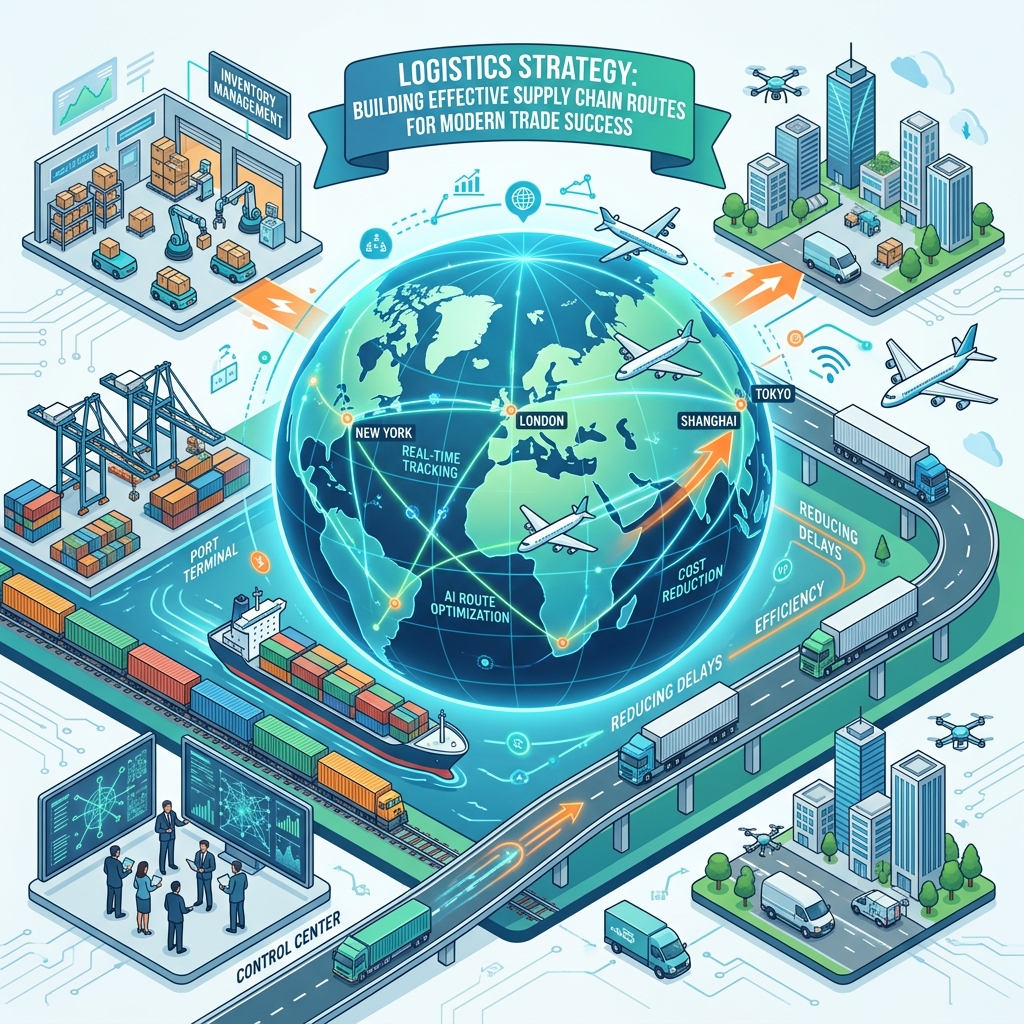
Logistics Strategy: Building Effective Supply Chain Routes for Modern Trade Success
Modern logistics strategy is the backbone of successful global business, with effective supply chain route planning enabling companies to deliver goods reliably, reduce costs, and respond nimbly to market demands. Rather than just being about moving items from one place to another, logistics routes reflect deep strategic thinking—balancing efficiency, risk, cost, and flexibility. In today’s complex environment, where logistics managers face new challenges and opportunities daily, a robust approach to developing multiple shipping routes unlocks both immediate and long-term competitive advantages for companies around the world.
Logistics Strategy Fundamentals: Route Planning and Supply Chain Types
Effective logistics strategy begins with a detailed understanding of supply chain types, from upstream suppliers to downstream distribution channels. Shipping managers must assess the most efficient logistics methods—be it road, cargo ship, air freight, or multimodal options. For example, shipping routes for perishable goods require different logistical tactics compared to manufacturing inputs or consumer electronics, with each type demanding a tailored solution that accounts for transit times, temperature control, and customs inspection requirements.
Planners use advanced tools and freight world data, such as live route maps and platforms like Google Maps or specialized road mapper/planner apps, to visualize and optimize routes in real time. These tools allow companies to run multiple stops, analyze real-world conditions (such as traffic on routes from Chennai to Kerala or Mumbai to Coimbatore), and factor in contingencies like port strikes or road closures. A dynamic logistics strategy adapts these plans daily, taking into account fluctuations in demand, fuel costs, and carrier capacity constraints, which directly impact both cost-effectiveness and reliability.
Across industries, providers implement a broad list of logistics methods, including drop-shipping, cross-docking, direct-to-store, and multi-echelon supply chains. Managers must weigh the benefits and risks of each, ensuring tactics are fit for specific product requirements and markets—whether shipping from Australia to the UK, or servicing remote areas near Kochi, Durban, and Grand Rapids, MI.
Key Positions and Skills in Logistics Management
Managing an effective logistics business requires more than just good route planning; it depends on skilled professionals occupying clearly defined supply chain positions. The primary roles include logistics managers, supply chain analysts, freight coordinators, shipping planners, and warehouse supervisors. Each position brings specialized knowledge and skills, from negotiations with providers to masterful use of tracking systems and logistics apps.
To excel in logistics strategy, professionals often pursue accredited logistics courses and certifications—available online in markets like India, Sri Lanka, South Africa, and via universities such as UNISA. These courses teach best practices in inventory management, regulatory compliance, and the application of logistics automation technologies. Requirements to enter the field vary globally, but entry-level jobs for freshers often start after 12th grade, offering rapid advancement for those who master tools, analytics, and freight arbitrage tactics.
The global diversity of logistics roles means skills must adapt to local and international contexts. In the Middle East, for example, logistics managers in Dubai or Saudi Arabia command significant responsibility for import/export operations, coordinating with companies like Lufthansa, Etihad, and Cathay for air cargo, or regional road freight providers such as TVS, SV Navata, and TCI in India. According to the World Bank’s Logistics Performance Index, companies that invest in skills development and specialized positions outperform competitors in both speed and reliability.
Tactics and Methods for Running Multiple Supply Chain Routes
Today’s businesses regularly face scenarios where a single logistics route is neither sufficient nor resilient. Running multiple stops or parallel routes is essential—especially in sensitive or high-demand sectors like retail, pharmaceuticals, and electronics. This approach minimizes disruption risk, optimizes delivery accuracy, and directly impacts customer satisfaction rates.
Modern route planner platforms use real-time freight world data and APIs to facilitate these multi-route operations. Companies look to logistics providers in key hubs—Mumbai, Pune, Memphis, or Melbourne, for example—to supply up-to-the-minute mapping and tracking. The use of marine vessel scanners and air cargo tracking systems further enhances visibility, enabling stakeholders to react instantly to delays or bottlenecks.
- Integrating instant tracking systems: These platforms offer granular view of shipments at each checkpoint, empowering managers to reroute deliveries in response to live conditions. For example, if a shipment en route to Durban faces unexpected port holdups, real-time data allows the logistics manager to divert through alternative ports or expedite land-based transit, minimizing impact on customer delivery timelines.
- Leveraging provider networks: Top shipping companies maintain extensive global relationships—enabling businesses to switch carriers or shipping modes quickly. This is particularly valuable for time-sensitive or regulated cargo, such as pharmaceuticals sent from Singapore to Germany, where routing flexibility can make a difference between success and costly spoilage or delays.
This multi-route mindset is reflected in the world’s most resilient logistics businesses, whose managers constantly analyze new mapping data, update route maps, and collaborate with local freight agents, from Kerala to Boston, to ensure continuous operation—even during crises.
Regional Logistics Trends and Job Outlook
Globalization has spawned an explosion in regional logistics trends—each with unique methods, technologies, and workforce requirements. In Asia, for instance, India and Sri Lanka have witnessed a surge of remote logistics jobs as e-commerce expands, with strong demand for both entry-level and experienced logistics coordinators. South Africa and Australia see growing needs for marine shipping and route planning professionals, with companies in coastal hubs like Kochi, Durban, and Melbourne requiring specialized knowledge of marine vessel routing and international customs regulations.
Logistics service providers now compete on both cost and technology. In the US, companies in Grand Rapids, Michigan, and Pleasant Grove, Utah, are investing heavily in logistics automation, route optimization apps, and instant revenue tracking systems, as highlighted in this WTO report on digital trade and logistics innovation. In the Middle East, logistics managers in Dubai and UAE oversee massive cargo flows between Asia, Europe, and Africa—requiring up-to-date knowledge, regulatory savvy, and strong provider networks to compete effectively.
The surge in logistics demand also creates attractive salary prospects and job security for skilled logisticians, with compensation varying by market—from entry-level provider positions in Pune and Hyderbad, to high-responsibility roles leading multi-stop route planning in Europe, the US, and Southeast Asia.
Effective Tips and Trends for Building a Logistics Career
Succeeding in the logistics field requires a blend of soft and hard skills. Communication, critical thinking, and real-time problem-solving are as important as technical knowledge of freight, tracking systems, and regulations. Many aspiring logistics managers begin with foundational roles at regional companies, then pursue formal training through online courses or on-the-job apprenticeships, particularly in supply chain hubs such as Mumbai, Chennai, or Singapore.
Staying current is critical. Professionals should monitor new logistics trends, from the rise of electric vehicle (EV) delivery fleets and EV route mapping (e.g., for Tesla distribution) to the proliferation of APIs connecting cargo platforms, ship tracking, and map-based trip planners. Many companies in India, the UK, and the US offer free online logistics resources—ranging from regulatory updates to best-practice guides for running multiple supply chain routes—allowing managers and freshers alike to upskill quickly.
Networking is another core tactic. By connecting with providers through regional conferences, industry events, and digital trade organizations, logistics professionals keep their knowledge fresh, learn about new route mapping technologies, and forge relationships that can smooth both upstream and downstream supply chain operations for years to come.
In today’s business environment, mastering logistics strategy and tactical route planning isn’t just an operational necessity—it’s your passport to thriving in the global economy.